

THE EPIC OF 1940 AND WHY THE ITALIANS WERE DEFEATED
THE EPIC OF 1940 AND WHY THE ITALIANS WERE DEFEATED

Of IOannis Ath. Baltzoi*
On October 28, 40, with a solemn ultimatum, delivered by the Italian ambassador at 03:00 to the governor of Greece, Ioannis Metaxas, Mussolini requested a passport for his own immortality, he requested the surrender of eternal Greece, without conditions, he requested that its glorious past be erased, ignoring its history.
Italian Ambassador Emmanuelle Grazi wrote in his book “The Beginning of the End – the Operation Against Greece”: “As soon as we sat down, and since it was a few minutes after three, I immediately told him that my Government had assigned me to personally deliver to him a text, which was nothing more than Italy's ultimatum to Greece, with which the Italian Government demanded the free passage of its troops through Greek territory, from 6 a.m. on 28/10/1940. Metaxas began to read it. Through his glasses, I could see his eyes watering. When he finished reading, he looked me in the face, and in a sad but firm voice he said to me: "Alors, c'est la guerre" (So, we have war)). "
-Graci: "Pas nécessaire, mon excellence" (not necessary, your excellency) - Metaxas: "Non, c'est nécessaire" (no, it is necessary). This NO of the Prime Minister became a Flag, a symbol, a cry in the mouths of ALL Greeks and was transformed into the slogan AIR during the counterattacks of the Greek army on the Epirus front, on the path to a magnificent victory, with catalytic developments of unparalleled importance for the Allied forces and the final outcome of the war, which we will discuss below.
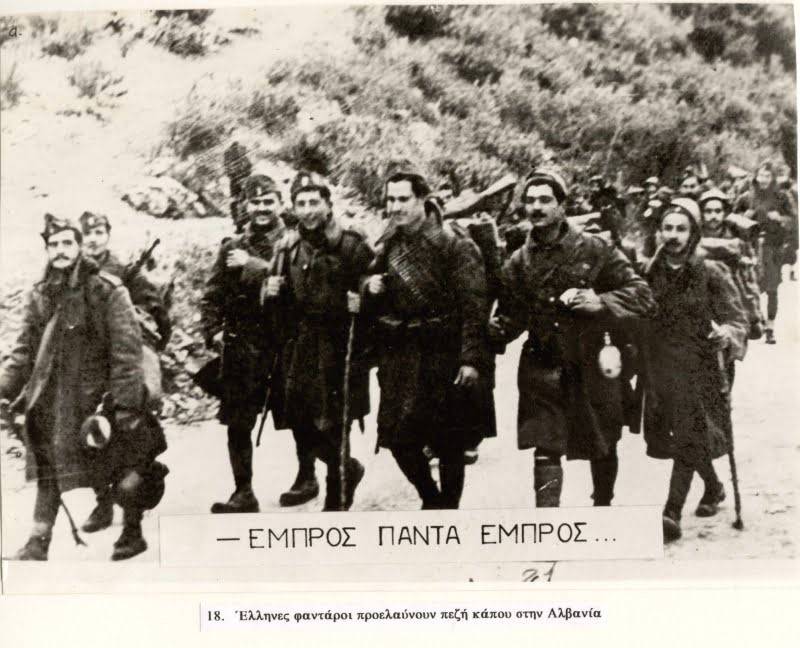
On October 28, 1940, fascism, which is synonymous with obscurantism and oppression, knocked on the door of Greece. It demanded “land and water.” It sought to subjugate the proud Greek soul, to tear apart the eternal virtue of the Greek. Then, as always, there was no dilemma. When the fascist attack came, the Greek people, united and united, poured into the streets with strength, passion, and enthusiasm. The Greek patriots presented their breasts to foreign fascism and raised their NO, dynamic and victorious, writing the glorious epic of Albania. The Greek people, defying then numerical analogies and realistic calculations, as some still invoke today for Turkey, celebrated the glorious past and the greatness of the race. It confirmed once again that greatness in peoples is measured by the fighting spirit, the decision to sacrifice and "the burning of the heart".
The cry “AIR” scattered, like autumn leaves, 5 of the 9 Italian well-equipped Divisions, of the two Army Corps, the XXV SS Tsamouria and the XXVI SS Korytsa. Of these, approximately 14.000 fell dead in the frozen mountains, 18.000 were wounded and useless from frostbite and 13.000 were captured. They were the first victories of the free world. The beginning of the crushing of fascism. On the Greek side, the heroic Epirus VIII Infantry Division reinforced with various Units and Groups, which had in its sector the entire Epirus front, with Major General Charalambos Katsimitros as Commander. The Greek losses were 7.989 dead.
It should be noted that Greece regularly deployed defense along its entire border from Epirus to Macedonia and Thrace, with 5 Army Corps, of 2 to 3 Infantry Divisions, with a total force after mobilization of approximately 300.000 men. On the Epirus and Thessaly front was the XNUMXst Army with the XNUMXndα-IIIη and VIIIη Division, which faced 5 Divisions out of the 10 Italian Divisions.
FINDINGS – CONCLUSIONS.
Analyzing the military operations and their results, the following can be found:
A. The General Staff's choice of the "Elaia - Kalama" defense location was successful.
B. The Italian plan of operations against Greece, as a strategic concept, was masterful. However, in its implementation it failed, due to errors and omissions of its leadership.
C. The main error of the Italian Command was its over-optimism and at the same time its underestimation of the opponent, as well as the capabilities of the Greek Army. Thus, it committed the following disastrous mistakes:
- They staged the attack on the eve of the winter season, resulting in a reduced performance of both air force and tanks.
- He did not provide the main effort in Epirus with comparable forces, having only five of the ten Divisions available.
- The Italian forces reinforced at the start of the operations had 10 Infantry Divisions, 1 Armored Division, 1 Cavalry Division, 4 Versailles Regiments and 8 Albanian Battalions. The Greek First Army Corps 3 Infantry Divisions.
- The Italian leadership and its troops were taken by surprise by the amazing resistance of the Greek forces, as the belief and climate of optimism that possessed everyone was that this was a healthy march and they would be in Athens in 2-3 weeks.
D. A fatal mistake for the Italian command was the rigidity of the plan of operations, in contrast to the Greek plans, which were flexible, adaptable to the demands of the struggle and were implemented with great success. The Italian command insisted on the main direction, on the central Kalpaki-Ioannina axis and did not exploit the success of secondary directions, resulting in continuous attrition and ultimately defeat. The Southern coastal axis was successful and advanced, while the Northern axis was split with the Julia Division in the Metsovo area, resulting in the Cavalry Division intervening decisively and after fierce battles finally intercepting it, advancing and scoring in early November the first victory against the axis in Europe, and this was Greek.
E. The attacking Italian forces attempted to break up the Kalpaki location into formations more of a parade than an attack, thus making it an excellent target for the exceptional Greek artillery, with its astonishing accuracy and effective fire.
F. It is clearly demonstrated that material power alone is not enough to defeat a Nation that rises up together and decides voluntarily to secure its freedom.
G. Finally, the myth that the Italians did not fight bravely and that is why the Greek army won should be dispelled. On the contrary, both the Italians and the Greeks fought bravely, fought very hard battles, and the battle on hill 731 was the modern Thermopylae of Hellenism, and this is proven by the large number of dead and wounded on both sides.
EPILOGUE
On the occasion of the anniversary of the NO and the epic of 1940, let us look to the future with optimism. With optimism and love for the homeland, uncertainties become opportunities. Let us be responsible successors of our heroic ancestors. The invisible shadows of our heroes accompany us, the total of 13.936 dead and 41.217 wounded and missing. And it is imperative that we find all 7.989 of our dead who fell in Northern Epirus and very few are today buried in only two organized Greek Military Cemeteries that exist in Vouliarates and Kleissoura and honor them as the morality of every people, as well as the Greek tradition, dictates. 80 years and still thousands of heroes are buried in mass graves, in many places in Northern Epirus. As an Epirusian and as a Greek, I cannot accept the excuse that Albania did not allow us for so many years.
*Ioannis Ath. Baltzoi is an Associate Professor with a Master's degree (M.Sc.) in Geopolitics of the National University of Athens and president of the Hellenic Institute for Strategic Studies (ELISME).
Sources: With information and data from the archives of the Directorate of Army History of the GES.