

The Acheson plan for Kastellorizo
Everyday
The Acheson plan for Kastellorizo
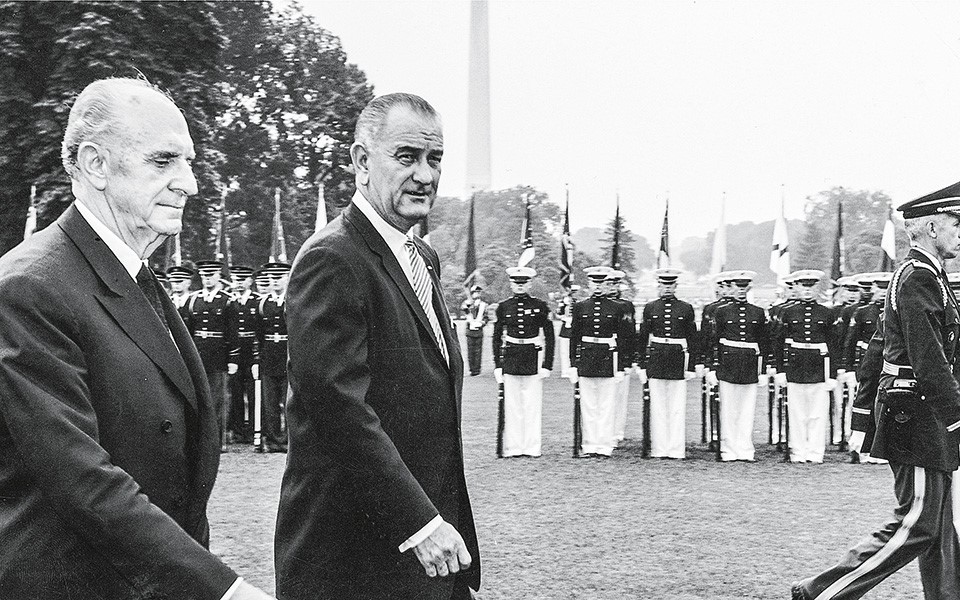
George Papandreou and US President Lyndon Johnson during the Greek Prime Minister's visit to Washington, 23-27 June 1964.
September 28, 2020 28.09.2020 • 18:13
“The [Greek] offer of Kastellorizo to Turkey cannot be considered very generous. The island is generally barren, has no significant agricultural or artisanal sector and supports a declining population. It has a small sheltered harbour but is not equipped with ship repair, storage or refuelling facilities. [Also] Kastellorizo is not suitable for aviation facilities.”
The above paragraph is part of the CIA’s secret report on Kastellorizo, written in August 1964, at the height of the negotiations on the Cyprus problem, and concerned the Greek proposal to give Kastellorizo to the Turks in exchange for a solution that would lead to the Union of Cyprus with Greece. The Americans went many steps further and, as declassified CIA and White House documents confirm, they were considering the possibility of a population exchange between the Dodecanese and Cyprus. According to this plan, which was not put on the table, the Dodecanese would pass to Turkey, the Turkish Cypriots would move there and the Greek Dodecanese would move to Cyprus…
Meeting in Kastri
Regarding the negotiations that were underway, the confidential conversation between Greek Prime Minister George Papandreou and Henry Lambois that took place on July 19, 1964 is revealing. Henry Lambois was the American ambassador in Athens from March 1962 to May 1965. A lawyer with a broad education, he had married Eva Curie, daughter of Marie and Pierre Curie, in a second marriage. Lambois had developed humanitarian action in Palestine before coming to Greece. In 1965, he took over the reins of UNICEF and immediately received the Nobel Peace Prize on behalf of the organization. On the evening of Sunday, July 19, 1964, at exactly 11.00:XNUMX, he sent a telegram to Washington concerning the meeting that had taken place that afternoon with George Papandreou in Kastri. In this telegram he states that Papandreou told him that he could agree to Greece giving Kastellorizo to Turkey as a base in exchange for a good solution for Greece in Cyprus. Specifically, Lambuis states in his telegram:
"In one-hour talks with the Prime Minister on Sunday afternoon, he insisted that it is urgent to find a solution to the Cyprus problem. He stressed that he wanted to facilitate [US Secretary of State] Acheson's work as much as possible and stressed that for this purpose last night during his radio address he emphasized for the first time that the security of the Turkish state and the protection of the Turkish minority are the issues of discussion."
“Papandreou proudly showed a new photograph of President Johnson that he had in his library and said that he felt bad that he had given the impression of intransigence [during his trip] to Washington [June 23-27, 1964] as opposed to the proposed process of dealing with the Cyprus problem. He said that he sincerely believed then, as he does now, that if the necessary preparations have not been made, direct talks could lead to a deadlock and the possibility of a conflict. He cited the Turkish riots in Constantinople in 1955 as an example of what the Turks do when talks do not lead where they want. He also said that he wanted to avoid war at all costs (he quoted the phrase “war is 100 times more serious for Greece than it is for the US”) and expressed disappointment that there was no discussion of a solution in Washington, but only pressure to start talks with the Turks immediately. With the constant Turkish threats, this would not be possible. However, [he added that] the talks, which are now underway in Geneva, are the right approach to finding a solution and the Greek government wants to facilitate these talks as a matter of immediate priority. [Papandreou added that] the urgency of the matter is due to the fact that Makarios is closer to the Soviets and to [Egyptian leader] Nasser and is making moves without consulting the Greek government. He hinted that if too much time passes, a fully free Cyprus, under strong eastern influence, might stop seeking Union."
The status of the bases
“As for the solution, he reiterated that the Turkish minority should be offered all the necessary guarantees, including UN supervision (he specifically said “whatever you want”). For Turkey’s security and to cover the Turkish “national prestige” side of the problem, he said that Greece would agree to the conversion of the British bases into NATO bases with Turkish troops and a commander. He had heard from [Foreign Minister and later President of Cyprus, Spyros] Kyprianou that British Prime Minister Wilson and others in the British government were ready to evaluate this proposal. He said that Britain could retain or relinquish its sovereignty over the bases – in either case, appropriate action could be taken to bring [the bases] under NATO jurisdiction with a Turkish commander.”
“This last point, in Papandreou’s view, would cover every Turkish demand both in terms of security and prestige. Papandreou sees no possibility of [creating] an area of Turkish sovereignty on the island. [According to Papandreou] The London-Zurich agreements only allowed the presence of a Turkish army on the island. To now give Turkey a sovereign presence, after 100 years in which it had no claim to sovereignty, would be an unacceptable step for any Greek government, but also for the Cypriots. However, the Greek government would be ready to give Kastellorizo as a base [Lambois’s exact phrase is: to turn over Kastellorizo as a base]. There was a suspicion that some other concessions might be possible, but these were not formulated.”
Towards the end of the telegram, Papandreou says meaningfully, always according to the American ambassador: "Greeks and Americans should always speak as relatives because Makarios, the USSR and Egypt are now speaking as relatives."
Dodecanese - Turkish Cypriot population exchange
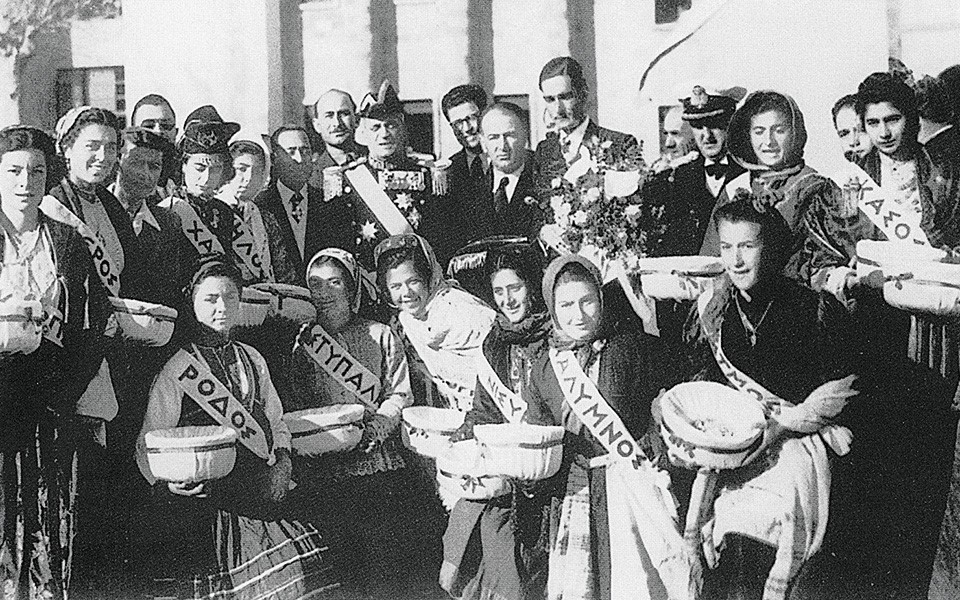
Rhodes, 31.3.1947. Vice Admiral Pericles Ioannides has just taken over the command of the Dodecanese from the British military commander, Brigadier General Parker. Sixteen years later, they are "involved" in the effort to resolve the Cyprus problem. (Photo: MICHALIS N. KATSIGERAS "GREECE 20th CENTURY, THE PHOTOGRAPHS")
A document from the Library of US President Lyndon Johnson dated August 24, 1964 states, among other things: “During talks with ministers in London, Papandreou (ed.: on July 20, 1964) confirmed that he could offer a base at Kastellorizo in exchange for an agreement in Cyprus” (which would be concessionary on the part of Turkey) – (ed.: Papandreou seems to have sought a solution that would lead to the union of Cyprus with Greece). Elsewhere in the lengthy report, the American idea of a population exchange between Cyprus (Turkish Cypriots) and the Dodecanese is mentioned, which apparently, according to the Americans, would be the necessary “exchange” for Turkey to accept the union of Greece and Cyprus: “From a “practical” point of view, a population exchange between Cyprus and the Dodecanese would be possible and feasible. The total number of Turks in Cyprus is approximately 114.000-120.000 and is almost the same as the number of Greeks living in the Dodecanese, which is 90.000-100.000. Furthermore, the different aspects of the natural environment (climate, geography, hydrography, etc.) are comparable, if not identical.”
The reason Washington was considering the possibility of a population exchange and the concession of the Dodecanese to Turkey was the fact that in those weeks of the summer of 1964, the conditions for a Greek-Turkish conflict centered on Cyprus were taking shape. The CIA report of the same period is characteristic. The following are extensive excerpts: “Since early June 1964, when a Turkish invasion was averted at the last minute, conditions have changed. The Greeks, who were apparently taken by surprise in June, have been moving men and weapons to Cyprus for the past six weeks. They are disembarking at night and under conditions of maximum security in the port of Limassol.”
"There may be 7.000-8.000 Greek soldiers on the island, many of them Greek Cypriots. There are three infantry regiments, in addition to artillery units and special forces hidden in the Troodos Mountains in central Cyprus."
“The Greek government has admitted that only about 100 officers have ‘volunteered’ to follow General Grivas. UN officials agree that Greek forces have arrived on the island, but they believe that they are no more than 1.200-1.500 men… The Greek Cypriot forces, scattered throughout the island, number about 30.000-35.000. The corresponding Turkish Cypriot forces do not exceed 13.000 and lack equipment and transport. The Turks also smuggle men and equipment to the island, but the numbers are insignificant compared to those of the Greek Cypriots. There may be no more than 1.000 Turks in addition to the 650 allowed by the agreement (ed.: Zurich – London). "This shows that a Turkish intervention may be much more difficult than it was in June."
“The great reinforcement of the Greek and Greek Cypriot forces has increased the self-confidence of the Makarios regime. Makarios has made statements that there can be no compromise or concession since Cyprus is now an “impregnable fortress”. The Greek government in Athens, knowing that any forced action by Makarios and the irregulars could provoke a military conflict between Greece and Turkey, is trying to ensure that all forces under Greek influence take orders from Grivas and not from Makarios, calculating that the former hero of the guerrilla is a prudent factor.”
"At the same time, Dean Acheson is holding consultations in Geneva with representatives of the governments of Greece and Turkey. These talks are a continuation of the talks that President Johnson had with Turkish Prime Minister Inonu and then with Greek Prime Minister Papandreou in Washington in June. The Greek Cypriot government has no delegation in Geneva and Makarios has publicly disapproved of the talks. However, the talks are continuing with the logic that Greece will be able to convince the Greek Cypriots to accept an agreed solution, with or without Makarios' acceptance. Recent reports from the American ambassador in Nicosia and Athens leave doubts that the Greek government can control Makarios to such an extent. Makarios, against the wishes of Athens, ordered four torpedo boats from the Soviets."
“Mr. Acheson is not offering an ‘American Plan’ in Geneva, but rather a series of exploratory proposals. His proposals include the creation of a Turkish base in Cyprus, a large degree of local self-government for the Turkish minority, and an international presence on the island to guarantee that the rights of the minority are respected. The Turks, while insisting on something resembling full partition, have shown flexibility on the border. They initially showed interest in the Greek offer of Kastellorizo, but only as part of a broader formula. The Turkish military representative, in talks reflecting the positions of the Turkish general staff, insists that Turkey must have at least one port on the island – preferably Kyrenia – plus co-administration of Famagusta.”