

Turkey-Israel, ten years after the Mavi Marmara
Turkey-Israel, ten years after the Mavi Marmara
“Truths, lies and misconceptions”
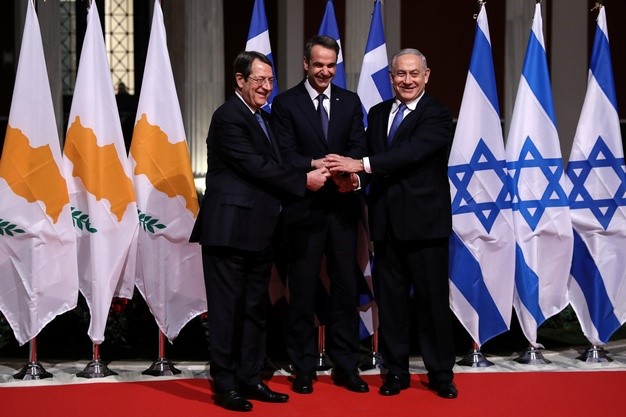
In recent weeks, there have been estimates in Greece that the once-famed Israel-Turkey axis is about to be revitalized. However, evaluating recent developments, a tendency towards a hasty assessment of important aspects of Israeli-Turkish relations is evident. In view of the upcoming visits to Israel by Greek Prime Minister Kyriakos Mitsotakis and Cypriot President Nicos Anastasiades, a pragmatic assessment of Turkey-Israel relations is useful, also on the occasion of the recent completion of a decade since the Mavi Marmara incident.
On May 31, 2020, it was exactly ten years since the bloody Mavi Marmara incident, an event that marked Israeli-Turkish diplomatic relations on the one hand, and on the other, was an occasion for Israel, Greece and Cyprus to develop closer relations. Since then, the degree of mutual understanding between Athens, Nicosia and Jerusalem is now evident, as they have deepened their ties in the fields of energy and military cooperation, noting significant similarities in the way they assess the existing regional balances. However, since 2010 and onwards, looking back at Greek and Cypriot news, the question is often raised whether Greek-Israeli cooperation has an expiration date, with the main argument being that Israel does not forget its ties with Turkish regional policy. Recently, such assessments have been increasing in the media in Greece and Cyprus. Let's examine them more closely.
For those wondering whether Israeli-Turkish relations at the political level have entered a normalization trajectory, the answer is that this has already happened since 2016 and at the instigation of the US. At that time, Israel apologized for the Mavi Marmara incident and paid financial compensation to the families of the victims. Nevertheless, bilateral diplomatic relations were not restored. After a brief period of recovery of the Ambassadors in Ankara and Tel Aviv (December 2016-May 2018), the mutual diplomatic representation was downgraded again to the level of chargé d'affaires, when Turkey protested President Trump's recognition of Jerusalem as the capital of Israel. Thus, for two years now, at the diplomatic level, Israeli-Turkish relations have been reminiscent of the climate of the day after the Mavi Marmara incident, and harsh Turkish criticisms of a religious and political nature – sometimes on the occasion of the Palestinian conflict and sometimes for the Cyprus EEZ – are a common phenomenon.
On the other hand, bilateral trade relations were not only not affected, but were even strengthened. Characteristic is the recent statement by the president of the Turkish-Israeli Chamber of Commerce, İbrahim Sınan Ak, to the Anadolu Agency on 29/5, according to which, during the last quarter of the coronavirus crisis, and given the US recommendation to Israel to reduce its trade with China, Turkish exports of raw materials and electrical household appliances to the Israeli market increased sharply. Essentially, this statement does not add anything new to what is already known in Athens and Nicosia over the last ten years. In any case, Greek and Cypriot entrepreneurship is not in a position to compete with Turkish exports.
Recently, a map was reproduced in Greece and Cyprus that allegedly proved behind-the-scenes Turkish-Israeli negotiations for the conclusion of an agreement to define the EEZ boundaries, in the image and likeness of the Turkey-Libya agreement. Just as in the Turkey-Libya agreement the existence of Crete was disputed, in the alleged Turkey-Israel agreement, Cyprus was allegedly absent from the map. Although the news was officially denied by Israel, the media in Greece and Cyprus perceived it as more or less already in force. But they did not ask themselves the following simple questions: Why did Israel not recognize the "TRNC" in the 80s and 90s, when a regional alliance in the full sense of the word was actually maintained between them, while Athens and Nicosia were implementing a purely pro-Arab policy? Would a bilateral EEZ agreement ever be signed with Cyprus erased from the map, at a time when the Israeli army is conducting joint exercises with the National Guard in Troodos? What is the point of Israeli travel advisories that prevent any passage to the northern part of Cyprus?
The landing of an [Israeli airline] El-Al aircraft in Istanbul after ten years, amid the coronavirus, for the transit of hospital supplies, was considered a sign of rapprochement. It is forgotten, however, that El-Al has been operating flights to and from Greece since the early 50s, even though the Greek parliament never ratified the (first intergovernmental Greek-Israeli) air connection agreement of 1952. From then until March 2010, it was applied as a matter of custom (!), and throughout the decades that Greece and Israel maintained degraded diplomatic relations. It was not until April 2010 that an air connection agreement was signed, which was ratified by the Parliament.
Israel’s absence from the five-party energy meeting on 11/5, attended by Greece, Cyprus, Egypt, France – and for the first time, the United Arab Emirates – was seen as a sign of rapprochement. In Greece and Cyprus, Turkish media outlets reported that “this Israeli absence means a lot.” However, these estimates overlooked the following: On 11/5, Israel had not yet formed a government. Furthermore, the official visit of US Secretary of State Mike Pompeo, which had only been announced on 7/5, was expected, with the main objective of preventing the possibility of a unilateral annexation of West Bank territories by Israel.
- GABRIEL CHARITOS is a lawyer, PhD in international relations, researcher at the Ben-Gurion Institute (Azrieli Center for Israel Studies) of Ben-Gurion University in Israel, and Senior Fellow at the Cyprus Center for European and International Affairs of the University of Nicosia.
- https://www.foreignaffairs.gr