

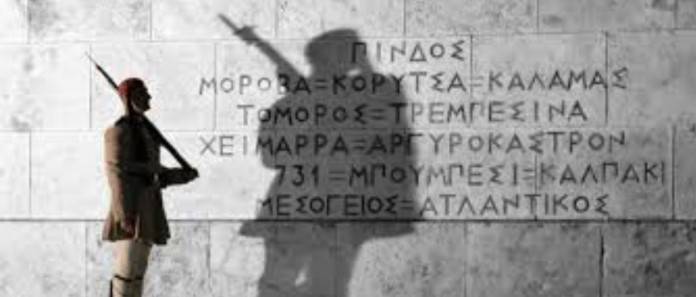
Europe before the war and Greece in 1940
Europe before the war and Greece in 1940 –
From Military News
By Ioannis Ath. Baltzoi*
The purpose of national anniversaries is to immerse ourselves in their names, with a disposition for reflection and contemplation, so that we can draw on their message, experience their historical lesson and responsibly determine our own debt, our own obligations. Because only with historical memory and the correct evaluation of historical experience, can we create the conditions for our national survival. Thus, in order to understand the events, it is necessary to briefly refer to the geopolitical situation of Europe before the war, in order to understand the subsequent developments.
EUROPE BEFORE THE WAR
The victors of World War I believed that they had consolidated peace and a balance of power with the peace treaties and the establishment of the League of Nations. Many agreements were made during the interwar period by many states, which ultimately did not help to avoid war. Greece concluded a Treaty of Friendship with Italy in 1928, a bilateral agreement in 1930 and 1933 with Turkey, for mutual border guarantees, and in 1934 the Balkan Pact was signed. However, the geostrategic aspirations of the Great Powers had a conquering orientation. Italy wanted the dominance of the Mediterranean, Germany for the hegemony of Europe, Russia for world hegemony, through world revolution, and Japan for the dominance of the Pacific. France, Britain and the US followed a policy of defensive isolation, which essentially neutralized their contractual obligations of collective security and annihilated the League of Nations. I would say that we have a similar case with the aggressive and uncontrolled Turkey and the passive attitude and behavior of today's Great Powers and especially the US and the EU. Let me mention a few examples.
In France, the spirit of passive defense prevailed, 12 months of service was enough and strong armed forces were not needed. And among the people, the famous slogan "porquois = why" prevailed. In England, they discussed whether compulsory service should be established and they reduced defense spending. And in the USA, with the mistaken perception of isolationism, they had surrendered to the bliss of neutrality and the security of the Pacific and Atlantic Oceans. And yet, when the serpent's egg was broken and the Nazi monster appeared in its hideous guise, both Daladier's France and Chamberlain's England tried with the mistaken policy of appeasement to appease the beast, caressing it, in the direction of the fur, or signing ephemeral agreements, refusing to realize that this policy leads directly to the opposite result, namely total war.
This passive strategy towards the Western powers ultimately provoked World War II, because it solidified Hitler's belief that he could conquer central and eastern Europe without the reaction of the Western powers. The initial seizure of the Sudetenland and the conquest of all of Czechoslovakia in 1938 strengthened his belief that he was free to proceed with his plans of conquest. The current revisionist and aggressive stance of Turkey, a pirate country, which has today invaded or uses military force in many states (Iraq, Syria, Cyprus, Greece, Libya, Nagorno-Karabakh and internally with the Kurds), as even Turkish analysts rightly point out, is strongly reminiscent of this period of the end of the interwar period, which prevailed in Europe at the time.
GREECE IN 1940
And as far as Greece was concerned, the country's defense problem was obvious and significant. After the Asia Minor catastrophe, the internal situation had almost descended into anarchy, and coups followed one another. Fortunately, during this abnormal period, serious orders were made for war material, such as firearms and automatic weapons, etc. But the most important thing was that after the 1935 movement, Ioannis Metaxas took over the government of Greece, who gave a strong impetus to the country's war preparations by supplying necessary materials and by fortifying the borders with Bulgaria, foreseeing the developments to come. War preparation so systematic and exceptional, that we could say that Greece and the Greek Army were ready and waiting for the enemy to reap the laurels of an unprecedented and, according to the Europeans, unexpected victory, who had not understood what the Greek soul is, when it fights for altars and hearths and obviously had not studied Greek history well. Much was written by foreigners about the Greek holocaust in the Pindus mountains and the heroic resistance of Greece. The greats of the era, Churchill, Eisenhower as well as the Moscow radio station, with their words and comments praised the greatness of the Greek soul and virtue, the courage and bravery, but also the great importance of the Greek resistance for the final outcome of the war. And the words of General Yannis Makrygiannis, from the revolution of 1821, come to mind: "Luck has always had us Greeks in the minority. Beginning and end, from ancient times to the present, all the beasts fight to eat us and cannot. They eat from us and there is only yeast left. And the few decide to die. And when they make this decision, they rarely lose and many win..» In the cruel and relentless battle of Pindus, the few defeated the many, the old weapons prevailed over the modern ones, the Greek soul, fighting for altars and hearths, achieved a historic victory against invading would-be conquerors.
THE EPIC
The Greek epic of 1940-41, which began with the terrible battles in Epirus, continued with the unequal defensive struggle at the Metaxa Forts and ended with the heroic resistance on the island of Crete, lasted a total of 216 days, changed the course of war events against the Axis! To understand its significance, it is enough to remember that, by the summer of 1940, Austria, Czechoslovakia, Poland, Norway, Denmark, Belgium, the Netherlands, France - that is, most of Europe - had been subjected to the iron violence of Nazi Germany. France was occupied in 45 days, Belgium in 18, the Netherlands in 5, while Denmark succumbed in 12 hours. Austria, Bulgaria, Hungary, Romania and Albania surrendered without a fight. In these circumstances, the victorious struggle of the Greek people stood up, with a wonderful unanimity, defended the borders of their country, expelled the invaders and liberated Northern Epirus for the third time. A dark spot in the epic, when General Tsolakoglou, "unauthorized and in an open field", as the Military Court ruled after the war that sentenced him to death, signed the surrender of the homeland in April 1941.
The heroic resistance of Greece was the first to shatter the myth of the Axis' invincibility. It dealt a fatal blow to a partner. It disabled him. Fascist Italy never recovered from its defeat. The consequences were catastrophic. They delayed the Battle of Crete, the planned Operation Barbarossa, resulting in Nazi Germany being defeated on the Eastern Front, culminating in the Battle of Stalingrad, which became the beginning of the end of the Nazi defeat and the end of the war.
*Ioannis Ath. Baltzoi is a member of the Greek Academy of Sciences with a Master's degree (M.Sc.) in Geopolitics and president of ELISME.
Sources: With information and data from the archives of the Directorate of Army History of the GES.