

Giali 'Olga- Source* SUMMARY OF ESPERIDAS ELISME'S PRESENTATIONS: "AFTER THE PRESPES AGREEMENT"
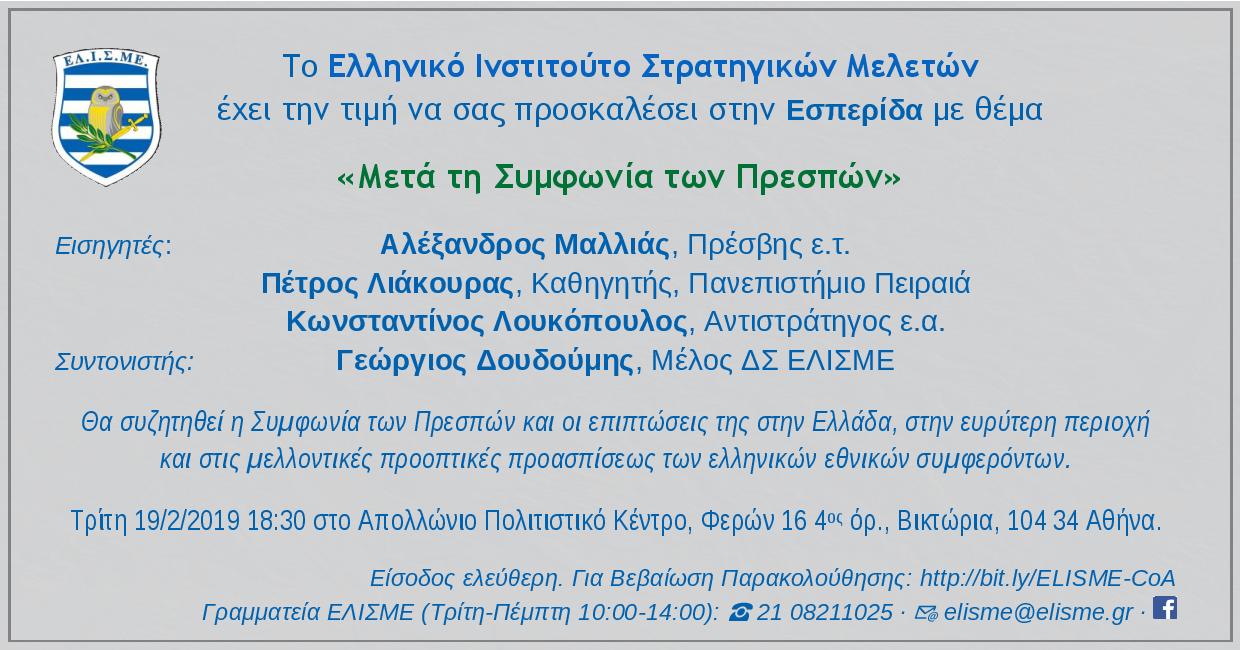
On February 19, 2019, the Hellenic Institute for Strategic Studies (ELISME) held a symposium on the topic “After the Prespa Agreement” at the Apollonius Cultural Center. Speakers included Ambassador emeritus Alexandros Mallias, Professor of the University of Piraeus Petros Liakouras, and Lieutenant General (retd) Konstantinos Loukopoulos, while the moderator was Georgios Doudoumis, Member of the Board of Directors of ELISME.
"Ambassador Alexandros Mallias"
The first speaker was Ambassador Alexandros Mallias, a veteran diplomat with many years of service involvement in the Greece-FYROM conflict. The Ambassador began his speech by making a comment regarding Greece's foreign policy. As he emphasized, our country has always been based on a sense of moderation ("every measure is excellent"), which is unfortunately absent in our time and this is being erased accordingly in our foreign policy.
Referring to the events of the last decades in the Balkans, he expressed the conclusion that Europe and especially the Balkan states have now entered a new phase of revisionism, where nothing can be taken for granted. He specifically spoke of the “Charter of Paris for a New Europe” in 1990, which, as he noted due to other priorities that had been set at the time (e.g. the liberation of Kuwait) emphasized a new beginning characterized by peace, freedom and harmonious coexistence. However, this was followed by the dissolution of Yugoslavia in 1991 through genocides and wars and later in 2008 by the declaration of independence of Kosovo from Serbia. Giving this example, Mr. Mallias pointed out that the major issue in the Balkan region today is not the Prespa Agreement but an Agreement between the "Republic of Kosovo" and Serbia for the exchange of territories and the redrawing of borders. Therefore, we are going through a period in which it is impossible to make long-term predictions since what we agree on is not long-lasting.
He assessed that the Prespa Agreement meets the conditions that the Greek side had set publicly under the mandate of the United Nations for the settlement of the name issue. On the other hand, however, it adds two important commitments that the Greek side had no reason to proceed with, such as the issue of the Macedonian language and Macedonian citizenship.
The Ambassador closed his speech by concluding that it must be taken into account that quite often, agreements, even UN Security Council resolutions, do not last for more than a few years.
"Professor Petros Liakouras"
This was followed by the speech of the senior professor of the University of Piraeus, Petros Liakouras. The professor began by briefly reviewing Greece's stance in recent years towards FYROM. He referred to the Interim Agreement between Greece and FYROM in 1995, which, as was emphasized, was never ratified and in which Article 11 obliged Greece not to oppose a request for FYROM's admission to International Organizations. The change in Greek strategy in 2008 in Bucharest with the pending threat of a veto on its part, if the name issue was not resolved, was considered a violation of Article 11, resulting in the conviction of Greece by the Hague Court after the neighboring country appealed. Nevertheless, this decision did not favor the state of Skopje. The change in Greek strategy, however, set a new basis on the line of settlement of the issue by accepting a composite name with a geographical designation.
Mr. Liakouras assessed that the present Agreement was made under favorable conditions by two governments that had good will to settle the issue and clearly at a time when the international political scene was favorable towards such a direction. He also emphasized that the Agreement does not imply a concession or assignment of Greece's sovereign rights.
One issue that the professor raised is the confusion between the terms ethnicity and citizenship. Regarding the English term, nationality, and whether it will be used by the other side with the term ethnicity and not citizenship, he pointed out that Skopje made a verbal statement that confirms the translation of the term in the text, as citizenship. As he stated, ethnicity is a matter of self-determination and is not defined by the state. Furthermore, he separated the concept of self-determination from minority rights, trying to dispel justified concerns. Regarding the ratification process of the Agreement, he notes as an excess the fact that the constitutional changes should have been put into force by the other side before the ratification of the Convention and not afterwards.
He argued that the Agreement must be respected (pacta sunt servanda), demonstrating good faith on both sides, while any kind of undermining or demonization of it should be avoided. The Greek government should monitor the safeguarding and observance of the agreements, especially those provisions under which the state of North Macedonia waives any minority rights and is obliged to take the necessary measures to ensure that there are no irredentist intentions.
Regarding the views on the cancellation of the Agreement, he concluded that the Agreement cannot be cancelled or terminated and cannot be amended with regard to Articles 1 and 2. In closing, he said that we cannot yet predict whether the Agreement will be viable or not, but it must definitely be respected, otherwise the state itself will be held responsible.
"Lieutenant General (retd.) Konstantinos Loukopoulos"
The last speaker, Lieutenant General (retd.) Konstantinos Loukopoulos, began his presentation by expressing the view that nothing could have been done substantially differently regarding the name settlement. However, he considers the Agreement detrimental to our country, as it is a package agreement including issues of nationality and language beyond a simple name settlement. He argued that the weak erga omnes, as well as the long adjustment process, will make its implementation difficult. He believes, of course, that the Agreement is impossible to annul.
He then expressed his concerns about the name of the Greek Macedonians, who will now have to add the designation "Greeks" before Macedonians. "Will the ability of the Greek Macedonians to call themselves Macedonians disappear in the future, resulting in the denial of Macedonianness, which also implies the denial of Greekness," he worries, noting that in the text Macedonia is simply referred to as the Northern Region of the First Part, that is, of Greece. General Loukopoulos stated that the name of the ethnicity is something that our neighbors will take full advantage of, citing as an example the interview that Prime Minister Zoran Zaev recently gave to the German channel Deutsche Welle, stating, among other things, in the "Macedonian language" "I am Macedonian." He also spoke about the German Foreign Minister's warning about the consequences of a Greek withdrawal due to the non-general acceptance of the Agreement by the Greek people.
Regarding the possibility of a threat from the state of North Macedonia, he believes that a government of the neighboring state, perhaps manipulated by another clearly stronger force, could potentially pose a threat to Greece in the future.
Finally, he concluded his speech by agreeing with the Ambassador's proposal for the establishment by the Ministry of Foreign Affairs of a group responsible for monitoring and controlling compliance with the Prespa Agreement.
Questions followed, with the majority of the audience expressing their concerns and doubts about the sustainability of the Agreement and, above all, about serving our national interests.
*ELISME Research Trainee
Undergraduate Student of the Department of International Studies,
European and Regional Studies at Panteion