

How to reverse the Turkish casus belli
How to reverse the Turkish casus belli

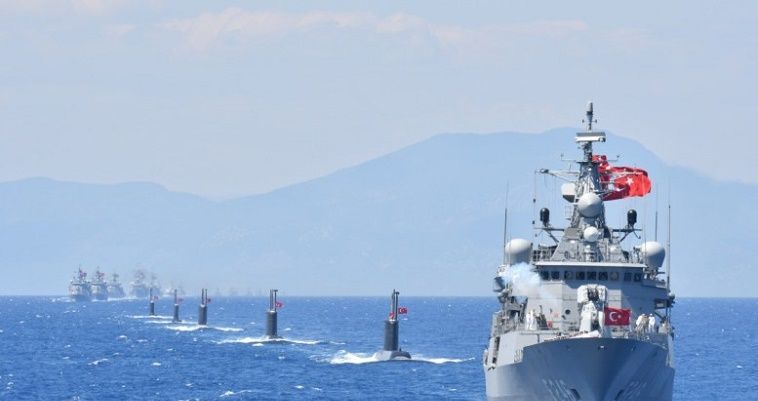
Without any sense of fearmongering, we must acknowledge that there have been increasing indications and analysts’ corresponding assessments recently that Turkey is seeking a military conflict with Greece. This Turkish planning stems from the Turks’ assessment that the threat of military escalation will force Athens – sooner or later – to accept the start of bilateral negotiations in accordance with their desires.
Within the framework of this policy of coercion, the risk of a smaller or larger escalation that will take the form of a heated episode is acceptable (and even desirable, perhaps) by Ankara, while at the same time seeking to make our country appear as the main culprit for the conflict.
Athens is trying to counter this Turkish strategy, walking a tightrope between deterrence, demonstrating moderation, and cautious moves at the diplomatic and military levels that inevitably raise doubts not only about their effectiveness but also the looming (long-term) choice of a dangerous policy of appeasement.
We do not demonize the policy of appeasement as a temporary option aimed at multiplying the power factors and/or waiting for better conditions to be created. Unfortunately, however, we see significant delays in taking the necessary actions to improve – in our favor – the balance of military power, and a lack of courage and even chronic inconsistency in defending our positions and sovereign rights.
The importance of 12 nautical miles in the Aegean
Of course, time will show the correctness of the above observation, which is not the main topic of this analysis. The aim of the text is to highlight the need for a more methodical and bold promotion of the increase in the width of Greek territorial waters to 12 nautical miles. A similar move would render most of the Turkish claims in the Aegean Sea meaningless.
The area of the continental shelf to be settled will be drastically reduced while the different air-sea space width will be resolved automatically. Even the Turkish claims for the limits of the search and rescue zone and the Athens FIR will be weakened, as the Aegean will now include areas of Greek sovereignty at almost 72% (compared to 43% today). All this will be achieved by the simple exercise of a conventional and customary rule of international law and the painless adoption of certain foreseen measures that will ensure freedom of navigation (determination of international navigation straits).
Turkey, realizing the unfavorable situation that a corresponding Greek move would create, has deployed (successfully to date) the threat of war (casus belli) in the event of any expansion of the scope of Greek territorial waters in the Aegean. It is estimated that Ankara will implement, to a lesser or greater extent, its threat, possibly not by resorting to a “declaration of war” but by daily and intensely challenging the maritime zones of the increased Greek territorial waters (and not only).
Certainly the scene of conflict will be daily, without ruling out a “war of attrition” as Israel and Egypt experienced in the period 1967-1970. Under this threat, the self-restraint of all Greek governments and the constant announcement of the future exercise of the right is completely understandable. Certainly even the projection of this intention (future) is a measure of Greek pressure on Ankara.
This Greek intention may have had results in Turkish restraint in the past, but the recent, boundless escalation of Turkish claims demonstrates that it has become ineffective. Living under the daily threat of a military conflict, Greece must resort to more dynamic measures, of course assuming the corresponding risk.
The need for preparation
Turkey and the entire international community must realize (and be appropriately warned) that any military conflict, regardless of scale, will result in the automated and irreversible increase in the breadth of territorial waters to 12 nautical miles. As “the wet one is not afraid of the rain,” the Turkish threat of casus belli will no longer matter, since hostilities will have begun.
And in the final analysis, regardless of the results of the conflict, it is better to enter the dangerous (but also inevitable) path of negotiations with a width of 12 instead of the current 6 nautical miles. However, a similar Greek warning, in order to be credible, should be accompanied by similar preparations, military, diplomatic, political and procedural. Notifications of foreign states, provision for compliance with international treaties (determination of narrow international navigation routes), appropriate selection of base lines, closure of bays, readiness to immediately issue and deposit relevant documents and maps, etc.
To increase the credibility of the Greek threat, the Greek parliament could, from today, authorize the (any) Greek government to proceed with the immediate increase in the width of Greek territorial waters in the event of a Turkish offensive action (i.e. an “anti-casus belli” declaration) without, of course, renouncing the autonomous choice of the time to exercise this right.
Certainly, the above proposals involve serious risks of escalation, but now Turkish declarations and actions demonstrate the impossibility of achieving any peaceful settlement and consequently all Greek preparation must focus, not on the welcome avoidance of conflict, but on our multi-level dominance, in the undesirable but quite possible nightmare scenario.