

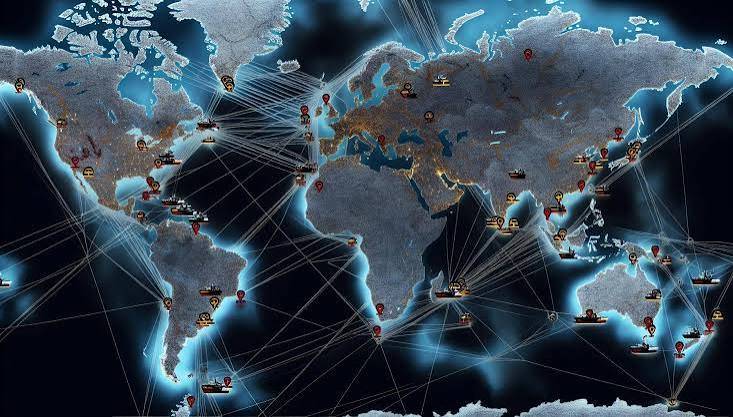
CESMAR Daily Global Maritime Geopolitical Forecast – July 24 2026 –
CESMAR Daily Global Maritime Geopolitical Forecast
– July 24 2026 –
Summary prepared by the Centre for Geopolitics and Maritime Strategy Studies, compiled on the basis of analyses from third-party sources. While the content does not reflect the Centre’s own positions but is instead drawn from the work of other authors and publications, as indicated in the references, the structuring and interpretation of the data are the result of the Centre’s own synthesis process, aimed at creating a coherent and organic analytical framework. The summary therefore represents a structured reorganisation of the collected and selected information, based on the expertise of our scholars, who have subsequently extrapolated its implications in the geopolitical, strategic, technological, and maritime fields, as well as those related to Mediterranean countries. Reproduction, in whole or in part, is authorised provided that the source is acknowledged.
Geopolitical Scenarios of July 24, 2026
Daily Summary of Global Maritime Geopolitics
Introduction
The developments of 23 July 2026 confirm the convergence of the Middle Eastern, Ukrainian, and Arctic theatres into a unified system of interconnected crises. The escalation of Houthi actions against Saudi Arabia, the consolidation of drone warfare in Ukraine, and the civil nuclear negotiations between the United States and Saudi Arabia are reshaping power hierarchies and maritime vulnerabilities on a global scale.
Key Events
Negotiations between Washington and Riyadh regarding civil nuclear cooperation continue, navigating ambitious goals and structural obstacles (ispionline.it; CSIS; nationalinterest.org). The Trump administration intends to condition the accord on Saudi normalisation with Israel, whereas Riyadh asserts its sovereign right to enrich uranium on domestic soil. Analysts highlight the risk of triggering a regional proliferation race that could undermine the non-proliferation regime, set against a backdrop where Washington seeks to curb Chinese and Russian influence in the Saudi energy sector.
On the Ukrainian front, warfare has consolidated around the so-called “kill zone”—the belt of territory along the line of contact where the pervasive employment of uncrewed aerial systems has virtually eliminated conventional infantry combat. This shift bestows tactical advantage upon the side possessing autonomous systems, electronic warfare capabilities, and intelligent sensor networks (ilsussidiario.net). In parallel, President Zelenskyy has rejected any prospective negotiated settlement, whilst military leadership figures assume an increasing number of roles within the Kyiv government—a signal of wartime centralisation that further constrains diplomatic options in the immediate future of the conflict.
On 23 July, Houthi forces struck the Saudi oil tankers Encelia and Layla in the Red Sea using missiles and drones, enforcing the naval blockade announced against Riyadh three days prior (ohimag.com; gcaptain.com; The National; Reuters). The attack drove Brent crude beyond one hundred dollars per barrel. Concurrent pressure on both the Strait of Hormuz and the Bab al-Mandeb strait deprives Saudi Arabia of alternative export routes, validating the efficacy of sea denial even for non-state actors reliant solely on low-cost missile capabilities.
Geopolitical Agorà
The strategic-academic debate on 23 July centred upon two primary axes: polar governance and hybrid maritime warfare. Writing for CIMSEC, Jake Brantley advocates establishing an Arctic Joint Interagency Task Force, modelled on the Caribbean JIATF-South, to overcome the “tyranny of distance” and remedy the deficiency in maritime domain awareness in the High North. He underscores Russia’s icebreaker dominance alongside China’s ambition to position itself as a “near-Arctic state”. CESMAR, in its daily Bussola, counters this thesis by asserting that militarising the polar framework may prove counterproductive. It advocates the Antarctic Treaty model as a paradigm for shared scientific diplomacy and cautions against excluding Russian sovereign prerogatives from future negotiation frameworks.
Regarding the Black Sea theatre, the Center for Maritime Strategy tempers the emphasis placed on autonomous systems, noting that whilst uncrewed surface vessels have inflicted substantial losses on the Russian Fleet, maritime drones remain merely one component within a multi-domain operational construct, rather than a standalone panacea. ELISME, operating from its Hellenic observatory, outlines a picture of heightened tension in the Eastern Mediterranean: it prepares public opinion for an impending Israeli ground offensive, highlights restored strategic alignment between Washington and Netanyahu, notes deteriorating security conditions in the Persian Gulf, and urges Athens to bolster its deterrence within the “new NATO”.
Finally, OHI Magazine offers an insightful reading of the Houthi strike on Saudi tankers, framing it as the catalyst for a dual-chokepoint energy crisis in an accessible format tailored for early-morning non-specialist readers. A comparative analysis of these contributions reveals a landscape in which Euro-Atlantic and Mediterranean strategic agendas, despite stemming from differing doctrinal premises, converge on a singular question: how to reconcile deterrence and cooperation in theatres where Great Power competition threatens to overlap with human and environmental security imperatives.
Consequences of the Events
Geopolitical Consequences
The convergence of the issues observed on 23 July is redrawing global alliances and power hierarchies. Should the US–Saudi nuclear agreement be finalised, it would solidify Washington’s role as the primary security guarantor in the Gulf, albeit at the potential cost of regional proliferation emulation. Meanwhile, the FBI Director’s visit to Moscow signals that covert channels between the two powers persist despite overt geopolitical competition (notiziegeopolitiche.net).
The inconclusive outcome of the Lavrov–Rubio summit in Manila confirms the absence of diplomatic leeway regarding Ukraine, further entrenching the Western–Russian diplomatic divide. Concurrently, the deepening Turkey–Pakistan axis and Belarusian military reinforcement along the Ukrainian border expand the footprint of regional polarisation, whilst Islamabad leverages its mediating posture by requesting ten billion dollars in assistance from Washington. In Latin America, Palantir’s expansion into Patagonia alongside the continental migration crisis reflects a geoeconomic realignment fusing data security with social instability.
Growing domestic dissatisfaction within India towards the Modi administration and structural fragilities in China—as examined by Foreign Affairs—indicate that Great Power competition is increasingly determined by internal resilience rather than external power projection alone. Within this context, smaller states remain exposed, according to Foreign Affairs, to alignment pressures that constrain their decision-making autonomy. Meanwhile, Saudi Arabia—historically maintaining a balanced posture in its rivalry with Iran—has itself become a direct target, an unprecedented development that could accelerate its rapprochement with the US-led maritime coalition.
The aggregate of these factors suggests that the international system is settling into an asymmetric multipolarity, wherein Washington retains its function as the ultimate security guarantor but must effectively share this responsibility with increasingly assertive regional actors and powers such as China and Russia, which stand ready to offer alternatives unencumbered by political conditionality or stringent oversight.
Strategic Consequences
On the military level, recent events confirm the central role of uncrewed warfare across multiple theatres. In Ukraine, the “kill zone” is redefining infantry doctrine, rendering superiority in automated reconnaissance systems and electronic warfare the decisive factor in battle. Concurrently, long-range Ukrainian strikes against Russian fuel depots and refineries, while destabilising enemy logistics, heighten the risk of direct conflict expansion (Responsible Statecraft). In the Black Sea, the Center for Maritime Strategy cautions against overemphasising the isolated effectiveness of uncrewed surface vessels, recalling the imperative for a balanced, multi-domain approach.
In the United States, a Government Accountability Office report criticises the absence of a unified hypersonic strategy across the Navy and Army, warning of industrial duplication. Meanwhile, nationalinterest.org cautions that concentrating hypersonic missiles on a limited number of high-value platforms leaves force structures vulnerable. In the Middle East, breakingdefense.com rejects assertions of US naval failure at Hormuz, highlighting both the efficacy of the blockade against Iranian units and autonomous mine-countermeasure capabilities. Concurrently, elisme.gr prepares the public for a high-intensity Israeli ground offensive involving severe risks in urban combat.
Finally, France’s reinforcement of Kyiv’s air defences via Mirage and Rafale fighters alongside anti-drone systems, coupled with the unresolved Turkish F-35 file, confirms that Allied interoperability remains a structural bottleneck for rapid response capabilities across simultaneous theatres. Consequently, Western planners must undertake a doctrinal reassessment that fully integrates autonomous systems, electronic warfare, and crewed platforms into genuinely joint command architectures, moving beyond the mere aggregation of domain-specific capabilities that characterises many current programmes.
Economic, Technological, Financial, and Energy Consequences
The Houthi attack on Saudi oil tankers triggered immediate market volatility: Brent crude surpassed one hundred dollars per barrel, continuing a monthly surge exceeding thirty per cent. Shipping lines are rerouting vessels toward the Suez Canal or circumnavigating Africa via the Cape of Good Hope, entailing increased transit times, fuel consumption, and insurance premiums (The National; CNBC; gcaptain.com). The suspension of port calls at Ukrainian Black Sea terminals due to the risk of Russian strikes further complicates Kyiv’s agricultural exports, bearing direct implications for global food security.
Regarding structural energy policy, RUSI proposes capturing North African gas flaring in Algeria and Libya as a diversification opportunity for European reserves, whereas Germany remains divided over the role of nuclear energy within its national energy mix. Japan is investing in seabed rare-earth mining to mitigate reliance on foreign suppliers, while Argentine Patagonia is establishing itself as a hub for data centres and artificial intelligence infrastructure linked to Palantir.
On the military-technological front, the CSIS highlights the vulnerability of US critical infrastructure to AI-driven cyber-attacks, prompting Congress to work towards establishing a national regulatory authority for AI. The convergence of a Middle Eastern dual energy chokepoint and fragilities in Ukrainian and North African supply chains points to widespread inflationary pressure, directly impacting transport costs and procurement strategies for importing economies, led by China and India. The simultaneous manifestation of energy tensions, cyber vulnerabilities, and global technology value-chain realignments confirms that economic security and maritime security are now inextricably linked within the decision-making agendas of major global actors.
Maritime Consequences
The developments of 23 July mark an unprecedented convergence between two critical energy chokepoints in the Arabian quadrant: Hormuz, already under strain from the US–Iran standoff, and Bab al-Mandeb, currently targeted by the Houthi blockade against Saudi Arabia (Source: ohimag.com; nationalinterest.org). The low-cost sea-denial doctrine executed by a non-state actor utilising ballistic missiles, cruise missiles, and uncrewed aerial vehicles demonstrates how a narrow maritime strait can be denied without requiring permanent naval presence.
Nationalinterest.org broadens this perspective to other vital maritime arterial passages—Malacca, Suez, and the Taiwan Strait—urging Western naval powers not to concentrate force posture in a single theatre. In the Black Sea, shipowners withdrawing from Ukrainian ports and the selective efficacy of uncrewed surface vessels against the Russian Fleet, as detailed by the Center for Maritime Strategy, underscore the persistent vulnerability of maritime lines of communication outside the Middle Eastern quadrant.
Concurrently, EMSA is deploying Airbus Flexrotor VTOL drones for Baltic Sea surveillance, enhancing European monitoring against illicit traffic and marine pollution. Industrially, Fincantieri is progressing with the U212 NFS and FREMM EVO programmes, while exercise RIMPAC 2026 demonstrated robust multinational interoperability in the Pacific through SINKEX operations that saw the live-fire sinking of two decommissioned US vessels. Finally, the transit of two Chinese supertankers towards Bab al-Mandeb amid the active crisis underscores Beijing’s imperative to maintain Saudi crude flows, raising questions regarding the selectivity of Houthi targeting towards Chinese-flagged or -linked carriers.
The CIMSEC Italia bulletin (23 July 2026) highlights an extreme risk level for global maritime security. In the Persian Gulf, Kuwaiti oil terminals have commenced partial operational recovery following UAV strikes. At Hormuz, the IRGC continues to enforce restrictions and harassment, complemented by electronic warfare operations (GPS spoofing) and dark AIS fleet operations. In the Red Sea, international coalitions and the Italian frigate ITS Fasan are actively intercepting Houthi drones to protect commercial shipping. In the Mediterranean, the Italian Navy maintains surveillance over critical undersea infrastructure, whereas the Gulf of Guinea remains stable. CIMSEC Italia recommends suspending non-essential transits in the Upper Gulf and Hormuz, adopting maximum self-protection protocols and maintaining 24/7 communications.
Consequences for the Southern European Mediterranean countries
For Italy, the scenario of 23 July reinforces the strategic centrality of shipbuilding and Arctic surveillance as instruments of power projection. Fincantieri is consolidating the U212 NFS submarine programme incorporating next-generation lithium battery systems, while laying down the second FREMM EVO frigate at Riva Trigoso. Concurrently, trilateral GCAP cooperation between Italy, the United Kingdom, and Japan is advancing via Sovereign Effects Partners to secure technological sovereignty in sixth-generation air combat systems (analisidifesa.it). Task Force X Arctic reflects the evolution of Italy’s High North presence from scientific research towards the digital surveillance of submarine cables and critical infrastructure networks—a shift on which CESMAR has voiced critique regarding models that overlook scientific and environmental considerations.
For Greece, elisme.gr emphasizes the imperative for enhanced deterrence within the “new NATO”, advocating capital investment in force modernisation and Allied interoperability to secure the Alliance’s south-eastern flank, exposed simultaneously to Persian Gulf volatility and a potential Israeli offensive.
The dual chokepoint crisis across Hormuz and Bab al-Mandeb directly impacts freight rates and transit times into the Mediterranean, affecting Spain and Italy as key logistics terminals for routes diverted around the Cape of Good Hope or through Suez. Finally, Russia’s remilitarisation of the Arctic alongside China’s expansion as a “near-Arctic state” obliges Rome and its Mediterranean allies to balance the policing of Middle Eastern maritime chokepoints against vigilance in the polar theatre, avoiding the dispersion of finite naval resources across an excessive number of operational theatres.
Conclusions
The overarching situation on 23 July 2026 demonstrates an era of multiple, interconnected crises in which the maritime domain remains the primary vector for transmitting geopolitical shocks into the global economy. Indicators most susceptible to rapid escalation include the Middle Eastern dual energy blockade—with potential for further military escalation between the United States, Iran, and Houthi forces in the coming hours—and the Saudi nuclear negotiations, the outcome of which will determine regional non-proliferation dynamics.
The debate surrounding Arctic governance, opened by the dialogue between CIMSEC and CESMAR, is poised to intensify as the Northern Sea Route navigation season approaches. Priority monitoring should be directed towards maritime insurance rate movements in the Red Sea and Chinese operational maneuvers to secure its energy supply, serving as leading indicators for the potential expansion or containment of the crisis over the coming days.
Equal vigilance must be maintained regarding the Ukrainian front, where the military centralisation of the Kyiv government may manifest in new offensive options, as well as the internal political dynamics of India and China, whose domestic stability will dictate their ability to sustain coherent power projection over the medium term.
References
This summary has been prepared based on articles from various geopolitical and strategic analysis sources, including: Elisme, Center for Maritime Strategy, CIMSEC, Reuters, ShipMag, Navy Lookout, National Interest, Seapower Magazine, CSIS, RUSI, War on the Rocks, IISS, Responsible Statecraft, Foreign Affairs, Formiche.net, Il Sussidiario, Start Magazine, InsideOver, Notizie Geopolitiche, IARI, Dissipatio, Analisi Difesa, Jamestown Foundation, Atlantic Council, RAND Corporation.