

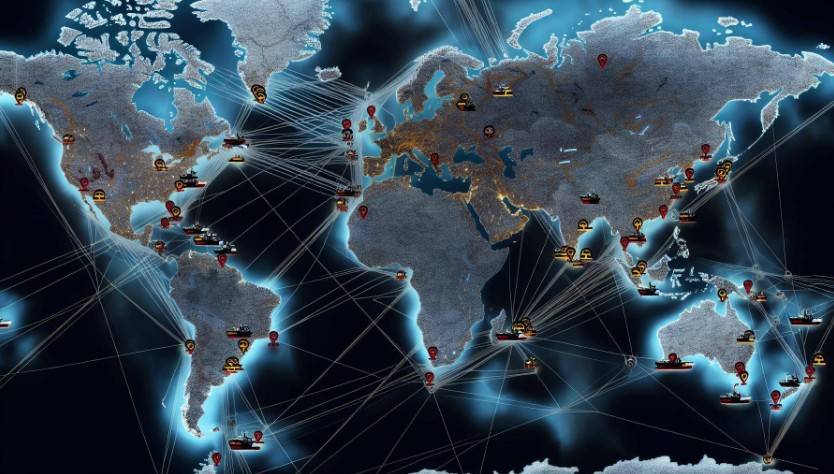
CESMAR Daily Global Maritime Geopolitical Forecast – August 17 2026 –
CESMAR Daily Global Maritime Geopolitical Forecast
– August 17 2026 –
Summary prepared by the Centre for Geopolitics and Maritime Strategy Studies, compiled on the basis of analyses from third-party sources. While the content does not reflect the Centre’s own positions but is instead drawn from the work of other authors and publications, as indicated in the references, the structuring and interpretation of the data are the result of the Centre’s own synthesis process, aimed at creating a coherent and organic analytical framework. The summary therefore represents a structured reorganisation of the collected and selected information, based on the expertise of our scholars, who have subsequently extrapolated its implications in the geopolitical, strategic, technological, and maritime fields, as well as those related to Mediterranean countries. Reproduction, in whole or in part, is authorised provided that the source is acknowledged.
Geopolitical Scenarios of August 17, 2026
Daily Summary of Global Maritime Geopolitics
Introduction
The week of 14–17 August 2026 was defined by the simultaneous escalation of three interconnected structural crises: the asymmetric warfare around the Strait of Hormuz, the intensifying pre-negotiation phase of the Russo-Ukrainian War, and the progressive crumbling of the multilateral security architecture. The common denominator remains the strategic competition for control over critical maritime chokepoints and the recalibration of the balance of power within an increasingly multipolar international system.
Key Events
Geopolitics / International Relations — The EU prepares its most stringent sanctions package against Moscow. As reported by Reuters (17 August 2026), the European Union is finalising its most impactful package of sanctions against Russia since the outbreak of the conflict, with formal approval expected in the autumn. The measures will target strategic sectors not yet fully covered by previous restrictions—trade, technology, and state financing—focusing heavily on cracking down on active circumvention mechanisms, including third-party actors providing indirect support to Moscow’s war effort. The initiative signals European resolve to maintain and tighten economic pressure at a moment when negotiation prospects between Russia and Ukraine become paradoxically more violent precisely because they are drawing closer.
Strategy / Warfare — Pre-negotiation dynamics fuel escalation on the Ukrainian front. InsideOver (16 August 2026) documents how the approach of hypothetical negotiation phases between Russia and Ukraine is driving a dramatic intensification of combat. Both belligerents are seeking to maximize territorial gains before coming to the table, stepping up missile strikes, drone attacks, and pressure along the entire frontline. A Russian attack on Kyiv caused fires and injured one person (Reuters, 16 August), whilst Ukraine claimed a successful strike against a Russian missile centre linked to the Rassvet satellite network. This paradoxical logic—peace intensifying war—compounds civilian suffering and risks undermining the very diplomatic foundations required for a durable ceasefire.
Maritime Affairs — The Strait of Hormuz: transit slowdowns and Iranian sea denial. Reuters (16 August 2026) and gCaptain record a marked deceleration in maritime traffic through Hormuz following a series of Iranian attacks on oil tankers, including a vessel belonging to the Emirati ADNOC (Abu Dhabi National Oil Company). Shipping lines are effectively forced to divert along routes that bring their hulls closer to lanes under Teheran’s direct control, enabling Iranian forces to monitor and inspect merchant traffic without resorting to a formal naval blockade. War risk insurance premiums for transiting vessels have surged, while Iran conditions any future diplomatic opening on the complete removal of sanctions.
Geopolitical Agorà
Current geopolitical analysis highlights the strategic failure and profound contradictions of Western leadership across three interconnected fronts: security, diplomacy, and geoeconomics.
On the internal security front, military support for Ukraine is generating a dangerous boomerang effect. As reported by Analisi Difesa and notiziegeopolitiche.net, approximately 800,000 donated weapons are now outside institutional control, feeding organized crime black markets and paramilitary groups. This phenomenon poses a severe threat to European stability for decades to come. Concurrently, InsideOver‘s analysis of the Sevastopol operation—resulting in the elimination of the former commander of the submarine Zaporizhzhia—demonstrates a ruthless and operationally mature Kyiv intelligence capability, adept at deep-strike actions in Crimea. The West thus finds itself funding an actor unshackled from its own control and potentially destabilising.
At the diplomatic and cultural levels, a year after the Anchorage summit, hopes for a shared security architecture have entirely vanished. As highlighted by The National Interest, Western diplomacy appears devoid of long-term vision and incapable of constraining revisionist powers. As Marco Tarchi (InsideOver) emphasizes, this political void reflects a deeper civilisational crisis: a loss of identity and social fragmentation that renders the West wholly ill-equipped to compete within the emerging multipolar system.
Finally, on the geoeconomic front, the Western approach appears anachronistic and short-sighted. Whilst the Eurozone and the broader West fracture over domestic budgets, individual arms deliveries, and technical details, the Sino-Russian axis is establishing alternative trade corridors such as the Polar Silk Road (InsideOver). This strategy bypasses traditional geopolitical chokepoints, including the Strait of Hormuz—the scene of Iranian provocations and power projection that highlight Western energy vulnerability. The West remains trapped in predictable theatres of confrontation, while its adversaries redraw the sea lines of communication (SLOCs) of global trade.
Consequences of the Events
Geopolitical Consequences
The simultaneity of ongoing crises is reshaping the vectors of force within the international system. The US attempt to exert maximum pressure on Iran—through sanctions on crude exports, naval operations in the Strait, and diplomatic pressure on Asian buyers (Reuters, 16 August)—clashes with Teheran’s capacity to leverage its geographic position to manipulate global supply chains without triggering open conventional war. Concurrently, Trump’s move to scale back joint military exercises with South Korea (Reuters, 16 August) signals a reassessment of the American forward presence in the Indo-Pacific. This weakens regional deterrence and encourages Asian partners toward greater strategic autonomy—with all the associated implications for the proliferation of sovereign military capabilities.
On the European continent, the hardening of the EU’s sanctions posture against Russia coexists with Macron’s proposals regarding European nuclear deterrence, which nevertheless retains exclusive command authority in Paris—arousing German skepticism. The 800,000 weapons dispersed across Ukraine portend an internal security issue for the EU that will extend far beyond the termination of hostilities. The Sino-Moroccan axis (InsideOver) marks the advance of the Belt and Road Initiative into the Mediterranean Basin, with Beijing building a logistical-industrial hub on Europe’s doorstep. Meanwhile, the pro-Israel lobby in Washington (notiziegeopolitiche.net) pushes toward a curtailment of UN-centered multilateralism (international legality, formal equality, collective security, and preventive diplomacy), accelerating the transition toward an international order based on exclusive strategic blocs and bilateral alliances.
Strategic Consequences
On the military level, the week highlights three significant doctrinal trends. First: asymmetric attrition warfare continues to prove more effective than conventional technological superiority. Iran downed one in four Reaper drones deployed in the region (InsideOver), rapidly depleting US precision-guided munition stockpiles and compelling Washington to revise its operational tactics. The same logic applies to Houthi strikes against Red Sea sea lines of communication: low-cost attacks inflict disproportionate damage on global supply chains.
Second trend: the acceleration toward technological autonomy in outer space. Moscow is expediting the deployment of its Rassvet satellite constellation (Analisi Difesa), while Kyiv claims the destruction of a key node within the same network. Control over space-based communications is becoming a primary military objective, carrying profound implications for the command-and-control (C2) doctrines of all actors involved.
Third trend: the recalibration of naval weapons systems. The return to steam catapults on American aircraft carriers ordered by Trump (navylookout.com; The National Interest) threatens to hinder the integration of light uncrewed aerial systems (UAS) and compound delivery delays for the Gerald R. Ford class. Conversely, Washington’s willingness to leverage allied shipyards—reflected in the rising stock values of Hanwha and Fincantieri (gCaptain)—signals a pragmatic restructuring of NATO’s defense industrial base. Furthermore, the record-breaking transit of the Orca XLUUV across the Pacific (navalnews.com) demonstrates the operational maturation of autonomous undersea vehicles as a future pillar of submarine deterrence.
Economic, Technological, Financial, and Energy Consequences
The Strait of Hormuz stands as the principal driver of energy and economic friction this week. Transit slowdowns (Reuters) and soaring war risk insurance premiums for Gulf shipping are already passing inflationary pressures downstream onto crude distribution networks. Trump’s appeal for Americans to accept higher petrol prices (Reuters, 14 August) signals that economic pressure on Teheran will impose significant domestic costs long before achieving strategic efficacy. Meanwhile, crude flows moving via the dark fleet (gCaptain) act as a de facto stabilizer for global markets, offsetting official supply cuts with unsanctioned oil.
Technologically, the US defense industrial base’s reliance on China for microchips, rare earth elements, and naval-grade steel (The National Interest) constitutes a structural vulnerability that cannot be swiftly remedied by reshoring schedules. Japan has responded by initiating deep-sea mining for rare earths at depths of 6,000 metres in the Pacific abyssal plain (notiziegeopolitiche.net), foreshadowing a intense geoeconomic scramble for critical materials that will reconfigure global supply chains in the coming years. The intersection between cryptocurrencies and statecraft (iari.site) introduces further complexity to the tracking of financial flows supporting non-state actors and disinformation campaigns, while the convergence of nuclear micro-reactors and AI data centres (The National Interest) opens a new front in energy-technology competition.
Maritime Consequences
The week confirms Hormuz as the most critical maritime chokepoint in the global system. Iranian attacks on oil tankers—including an Emirati vessel (gCaptain)—aim not merely to strike Gulf interests, but to structurally redirect commercial traffic into lanes Teheran can monitor and influence, thereby maximizing its strategic leverage without incurring the costs of a formal naval blockade. The closure of the Yemeni port of Mocha following Houthi attacks (Reuters, 15 August) and the suspension of commercial operations compound the strain on the Red Sea, delineating an arc of instability stretching from the Bab el-Mandeb Strait to Hormuz.
The power failure aboard USS Benfold in the South China Sea—leaving the vessel without propulsion for four days (USNI News)—illustrates the operational vulnerabilities of high-end naval surface combatants in the Indo-Pacific theatre, where rescue timelines are extended and reliance on primary infrastructure is absolute. Conversely, the transit of the Orca XLUUV (an Extra Large Unmanned Undersea Vehicle—a revolutionary, fully autonomous, long-range robotic submarine developed by Boeing and Huntington Ingalls Industries for the US Navy) over more than 1,000 nautical miles in the Pacific (navalnews.com) showcases the future of undersea power projection: uncrewed systems capable of sustained operations in contested environments.
On the European scene, the interception and destruction of a drone in Latvian airspace by an Italian NATO Eurofighter (notiziegeopolitiche.net) and a similar action by Romania (Reuters, 16 August) indicate that the Alliance’s maritime and aerial borders have effectively become active contact lines with the ongoing Russo-Ukrainian conflict.
Consequences for the Southern European Mediterranean countries
For Italy, Greece, and Spain, the week presents a heightened risk profile across multiple dimensions. Across the broader Mediterranean, three converging warning signals emerged. In the Baltic-Eastern sector, repeated drone incursions into Romanian and Latvian waters and airspace—both neutralized by NATO assets—demonstrate the spillover of hybrid warfare beyond the Ukrainian frontline. In the southern sector, the consolidation of the Sino-Moroccan axis and Beijing’s expanding investments in North African ports are altering the logistical geography of the Western Mediterranean. On the eastern flank, the Hormuz crisis is constricting energy flows bound for Europe via the Suez Canal route, while the closure of Mocha further reduces alternative options.
Italy finds itself in a moment of heightened strategic visibility: an Italian Air Force Eurofighter intercepted a drone over Latvian airspace (notiziegeopolitiche.net), Fincantieri saw its market valuation rise due to US Navy interest in allied shipyards (gCaptain), and the nation sits in a prominent position within the European defense debate. However, the Hormuz crisis bears down directly on the national energy bill: Italy imports substantial volumes of crude via Suez, and any further transit deceleration translates into immediate inflationary pressure.
Greece faces a structural domestic crisis: the friction between the green transition, summer wildfires, fragile power grids, and rural depopulation (notiziegeopolitiche.net) is eroding its infrastructural resilience, leaving it increasingly exposed to external shocks. This energy dependence is inextricably linked to the maritime security of Eastern Mediterranean sea lanes, where Turkish pressure remains a persistent background factor in regional dynamics.
Spain, given its strategic position controlling access to the Strait of Gibraltar, is directly affected by the progress of the Sino-Moroccan partnership: the port of Tanger-Med, already a prime logistical hub, could solidify as a Chinese bridgehead on Southern Europe’s doorstep, shifting the commercial and security balance of the area.
Conclusions
The week underscores that maritime chokepoints—Hormuz, Bab el-Mandeb, the Baltic seas—have become the primary battlegrounds of global geopolitical confrontation. The most critical indicators of imminent development concern three core dossiers: the Russo-Ukrainian pre-negotiation dynamics, which may drive further offensive escalation on both sides in the coming days prior to any diplomatic opening; the US response to Iranian actions in the Strait, where Washington must translate “maximum pressure” rhetoric into concrete measures without sparking open conflict; and the progress of the European sanctions package against Russia, whose final scope will test Western cohesion. Close monitoring of Persian Gulf rerouting patterns and maritime war risk insurance rates is strongly advised as early indicators of further deterioration in European energy security.
References
This summary has been prepared based on articles from various geopolitical and strategic analysis sources, including: Elisme, Center for Maritime Strategy, CIMSEC, Reuters, ShipMag, Navy Lookout, National Interest, Seapower Magazine, CSIS, RUSI, War on the Rocks, IISS, Responsible Statecraft, Foreign Affairs, Formiche.net, Il Sussidiario, Start Magazine, InsideOver, Notizie Geopolitiche, IARI, Dissipatio, Analisi Difesa, Jamestown Foundation, Atlantic Council, RAND Corporation.
For further insights, please visit the CESMAR websites or social media channels: