

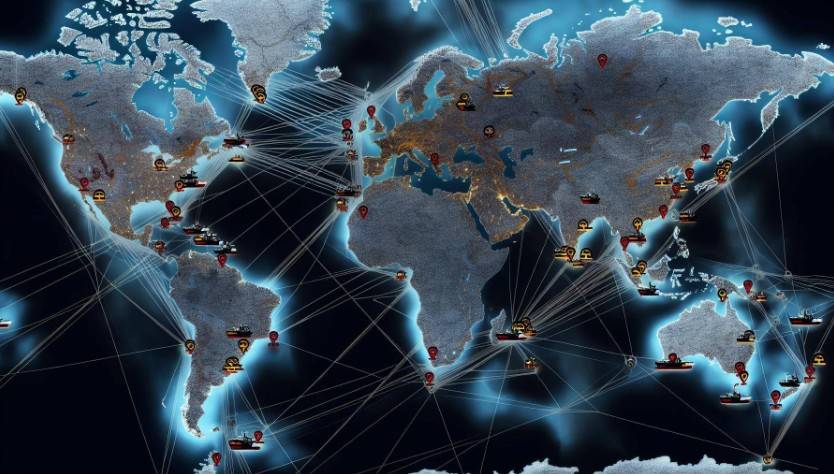
CESMAR Daily Global Maritime Geopolitical Forecast – August 28 2026 –
CESMAR Daily Global Maritime Geopolitical Forecast
– August 28 2026 –
Summary prepared by the Centre for Geopolitics and Maritime Strategy Studies, compiled on the basis of analyses from third-party sources. While the content does not reflect the Centre’s own positions but is instead drawn from the work of other authors and publications, as indicated in the references, the structuring and interpretation of the data are the result of the Centre’s own synthesis process, aimed at creating a coherent and organic analytical framework. The summary therefore represents a structured reorganisation of the collected and selected information, based on the expertise of our scholars, who have subsequently extrapolated its implications in the geopolitical, strategic, technological, and maritime fields, as well as those related to Mediterranean countries. Reproduction, in whole or in part, is authorised provided that the source is acknowledged.
Geopolitical Scenarios of August 28, 2026
Daily Summary of Global Maritime Geopolitics
Introduction
The day of 27 August 2026 stands out as a multi-domain strategic watershed: the Strait of Hormuz remains the primary global focal point of tension, intelligence diplomacy between Washington and Moscow is openly manifested, and the European and Atlantic security architectures exhibit increasingly sharp fault lines under the combined pressure of the Ukrainian conflict and the American review of its NATO force posture.
Key Events
The first event of paramount significance in the domain of geopolitics and international relations is the confirmation, by the head of Russian foreign intelligence, of talks held in Moscow with the Director of the US Central Intelligence Agency. As reported by Reuters and the National Interest, the meeting—occurring amidst maximum tension and in parallel with the Ukrainian conflict—represents one of the rare instances of direct, high-level security contact between the two superpowers. Washington intended to convey explicit warnings regarding the risk of escalation and the potential employment of non-conventional weapons, whilst Moscow confirmed its willingness to maintain an open intelligence channel to prevent miscalculations. This episode demonstrates that, beneath the rhetoric of frontal confrontation, a structured back-channel diplomacy exists to manage the margins of both nuclear and conventional friction.
The second crucial event pertains to strategy and warfare: Ukraine has consolidated its asymmetric naval warfare capabilities through the Magura MV11 system, a naval drone “mothership” presented by Formiche.net as an operational breakthrough in the Black Sea. The platform enables the coordination and deployment of long-range uncrewed maritime drones, enhancing tactical flexibility and the capacity to strike adversary naval units without exposing personnel. In parallel, Reuters reported explosions in Kyiv, signaling that the Russian missile campaign continues unabated. On the same day, Kyiv confirmed the comprehensive transfer of operational drone data to the United Kingdom, consolidating a military-technological alliance with long-term doctrinal implications for NATO as a whole.
The third event of primary relevance concerns the maritime domain: Iran and Oman, as reported by Shipmag and gcaptain, have agreed upon a temporary maritime corridor within the Strait of Hormuz to guarantee the transit of commercial oil tankers during a period of acute military tension in the Gulf region. AIS data recorded a slight increase in vessel transits, despite an oil tanker being struck by an attack of uncertain origin—an event that directly contradicted Trump’s triumphalist statements regarding the successful conclusion of the American mission against Iran. Qatari diplomacy was attempting to mend a channel with Tehran, whilst the US-led G20 finance meeting discussed the coordination of international sanctions.
Geopolitical Agorà
The completion of the first phase of barracks refurbishment by the US Navy, reported by USNI News, is not a merely administrative affair: it serves as a profound indicator of the institutional maturity of an armed force. A modern navy is not simply the sum of its naval platforms, missile systems, or operational doctrines. It is, above all, defined by the quality of the women and men who constitute its human fabric. When the leadership of the US Navy chooses to invest in the renovation of living quarters—upgrading air conditioning units, sanitary facilities, security systems, as well as recreational and study spaces—it performs an act that touches the very core of cohesion and operational readiness.
The dignity of living conditions is not a luxury: it is a prerequisite for morale, for trust in command, and for the psychological resilience of personnel on extended deployments. A navy that neglects these aspects strikes at the foundational needs of its sailors, silently undermining operational effectiveness as well as recruitment and retention rates. This reality is far from abstract: a fleet suffering from recruitment shortfalls is a fleet plagued by gaps in watchkeeping schedules, maintenance routines, and engine rooms. The message emerging from the American initiative is clear: personnel care cannot be detached from combat capability. It demands institutional maturity, a tradition of service, hierarchical integrity, and, above all, the seriousness of an organisation that places human capital at the centre of its organizational doctrine. This is a principle that any navy aspiring to greatness should internalise as an indispensable foundation.
Consequences of the Events
Geopolitical Consequences
The geopolitical landscape emerging from 27 August 2026 points to a phase of intense redefinition of power balances across multiple simultaneous theatres. The CIA-SVR talks in Moscow, confirmed by both sides, highlight that the United States and Russia retain a baseline level of strategic dialogue despite the absence of formal diplomatic progress on the Ukrainian conflict. This channel serves to prevent unintended escalation, though it does not replace a structured peace diplomacy. Meanwhile, Trump downplayed the political significance of Ratcliffe’s visit, ruling out aggressive Russian intentions toward NATO territory—a posture that creates apprehension among the more exposed Eastern European allies (particularly the Baltic states).
On the Atlantic Alliance front, the ongoing Pentagon review of the US troop footprint in Europe—with options to be presented to Hegseth by November, according to Reuters and the Military Times—has generated widespread anxiety among European partners. Concurrently, four EU member states called for the reopening of the debate on frozen Russian assets to fund Kyiv, reflecting financial creativity that encounters formidable legal and political resistance. Armenia witnessed the arrest of former President Kocharyan, consolidating Yerevan’s strategic decoupling from the Russian orbit. In Latin America, the US-Venezuela oilfields agreement, reported by Il Sole 24 Ore, outlines an energy repositioning trajectory that could alter regional dynamics and diminish American reliance on unstable Middle Eastern suppliers.
Strategic Consequences
From a military and doctrinal perspective, 27 August 2026 consolidates several long-term trends. The comprehensive sharing of operational drone data from Ukraine to the United Kingdom, documented by the National Interest, represents a qualitative leap in military-technological cooperation: it involves not merely the transfer of hardware, but operational intelligence gathered directly from the battlefield, including electronic signatures, vulnerabilities to jamming systems, and tactical employment methods. This dataset transforms the Ukrainian conflict into a doctrinal laboratory for NATO in its entirety.
The Magura MV11, analysed by Formiche.net, reinforces the shift toward asymmetric naval warfare as a force multiplier for actors possessing conventionally inferior navies. The implications for Western naval doctrine are substantial: the mothership concept facilitates long-range power projection with minimal risk to human life. In parallel, defenseopinion.com revisited the premise that recent military escalations in the Persian Gulf and the Middle East have reaffirmed the fundamental and irreplaceable role of aircraft carriers in US Navy operations. Indeed, aircraft carriers enable the execution of strike sorties, maritime patrols, and the protection of international sea lanes without subjecting operations to the political and diplomatic constraints imposed by host nations regarding land-based facilities. For the US, maintaining a sufficient number of carrier strike groups remains essential to preserving global maritime supremacy and responding effectively to high-intensity warfare scenarios within the contemporary international landscape. Elsewhere within the US military apparatus, the GAO reported 15,000 operational days lost across US submarines due to maintenance delays—a structural vulnerability that contrasts sharply with strategic ambitions in the Indo-Pacific. Russia threatened strikes against British military targets in response to the employment of UK-supplied weapons on its territory, elevating the risk of the conflict expanding beyond Ukrainian borders. Finally, the laser system deployed against Mexican cartel drones along the US southern border offered further evidence of the increasing militarisation of American domestic security.
Economic, Technological, Financial, and Energy Consequences
The economic profile of the day was dominated by two main vectors: the administration of sanctions against Iran and the reopening of the Venezuelan energy market. On the former front, Trump reiterated the absence of dialogue with Tehran and the centrality of economic warfare as the primary coercive tool, whilst the G20 finance meeting sought to coordinate restrictions on Iranian energy exports. The temporary maritime corridor agreed between Iran and Oman partially contained the impact on oil markets, with AIS data showing a modest uptick in traffic through the Strait of Hormuz. Crude oil flows from the Gulf majors were rising, offsetting part of the deficit induced by regional instability.
In the technological sphere, Meta’s $1.7 billion legal settlement, reported by Reuters and Notizie Geopolitiche, opens a new chapter in global digital platform regulation, establishing precedents that will weigh heavily on European and Asian Big Tech. US national debt approaching $40 trillion, analysed by InsideOver, alongside commercial friction with Canada—punctuated by Trump signing an executive order to rename Lake Ontario “Lake America”—delineated a macroeconomic environment marked by profound uncertainty. Von der Leyen reaffirmed the Draghi plan for European productivity, whilst Eni consolidated its position in Egypt as a Mediterranean energy hub, strengthening supply diversification toward Europe and reinforcing the strategic Italian-Egyptian axis.
Maritime Consequences
The maritime dimension of 27 August 2026 directed acute attention to the Strait of Hormuz, a global maritime choke point through which approximately one-fifth of global hydrocarbon production transits. The agreement between Iran and Oman for a temporary protected navigation corridor reflects a pragmatic diplomatic effort by littoral states which, although failing to resolve the structural drivers of tension, facilitates a partial resumption of commercial traffic. However, the targeting of an oil tanker under unconfirmed circumstances demonstrates that the asymmetric threat persists irrespective of political declarations.
In the Black Sea, persistent tensions are prompting grain importers across Africa and the Middle East to reroute contracts toward Baltic ports, triggering a reconfiguration of grain trade routes that elevates freight costs while securing supply continuity. Bulgaria took delivery of seven minehunter vessels from Belgium and the Netherlands to enhance the security of Black Sea waters—a tangible manifestation of Allied investment in this theatre. On the Atlantic flank, the Royal Navy was tasked with safeguarding Irish airspace during an EU summit, an episode that reignited debate surrounding Dublin’s military neutrality. The delivery of the final ESB unit to the US Navy completed the expeditionary sea base platform program, while Navantia unveiled the F-110 Flight II frigate configured for integrated anti-missile defence, confirming the vital role of escort vessels in protecting Sea Lines of Communication (SLOCs) in high-intensity operational theatres.
Consequences for the Southern European Mediterranean countries
The implications for Italy, Greece, and Spain emerged forcefully from the day’s developments. For Italy, the consolidation of Eni’s operations in Egypt reinforced the nation’s strategic role as a privileged energy interlocutor in the Southern Mediterranean, contributing to the diversification of European supplies and reducing reliance on Russian gas. The Russian military footprint at Tartus and Hmeimim maintained high pressure in the Eastern Mediterranean, a theatre where the Italian Navy (Marina Militare) exercises a prominent role within NATO and EU frameworks. Regarding defence policy, the American NATO review and the potential drawdown of US forces in Europe present Rome with the necessity of evaluating increased capital investments in its sovereign military capabilities.
For Greece, the operational deployment of Hellenic air defence batteries in Saudi Arabia confirmed Athens’ posture as an exporter of security capacity into the Gulf, diversifying its strategic partnerships beyond the traditional NATO-EU perimeter. Instability in the Aegean Sea and the migration crisis off the coast of Tunisia directly impacted Greek national interests regarding the management of southern maritime borders.
For Spain, the unveiling of the F-110 Flight II frigate by Navantia represented a milestone of industrial and strategic significance: the capacity to deliver an advanced naval platform tailored for integrated anti-missile defence to the international market positions the Iberian shipbuilding industry at the forefront of the European sector, with positive spillovers for the modernisation programmes of allied Mediterranean navies and export prospects to the Gulf and Indo-Pacific regions.
Conclusions
The events of 27 August 2026 yield a strategic landscape evolving at an accelerated pace across three primary axes. The first is the Strait of Hormuz: the temporary Iranian-Omani corridor remains fragile and reversible; the coming weeks will reveal whether Qatari mediation with Tehran yields tangible openings or if renewed escalation will once again sever maritime routes. The second axis is the American NATO posture review: the force structure options presented by the Pentagon to Hegseth by November will dictate the architecture of European deterrence for the next decade. The third axis is the Russian-Ukrainian diplomatic window: Kyiv’s openness to potential talks in September stands as the most significant diplomatic development and demands close monitoring. Close attention should likewise be maintained on the evolution of the US-Venezuela energy agreement and its broader impact on Atlantic energy sea lines of communication.
References
This summary has been prepared based on articles from various geopolitical and strategic analysis sources, including: Elisme, Center for Maritime Strategy, CIMSEC, Reuters, ShipMag, Navy Lookout, National Interest, Seapower Magazine, CSIS, RUSI, War on the Rocks, IISS, Responsible Statecraft, Foreign Affairs, Formiche.net, Il Sussidiario, Start Magazine, InsideOver, Notizie Geopolitiche, IARI, Dissipatio, Analisi Difesa, Jamestown Foundation, Atlantic Council, RAND Corporation.
For further insights, please visit the CESMAR websites or social media channels: