

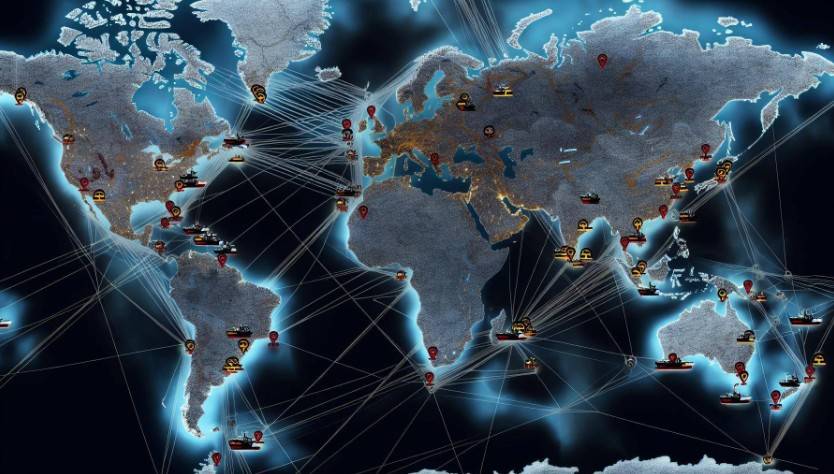
CESMAR Daily Global Maritime Geopolitical Forecast – October 30 2026 –
CESMAR Daily Global Maritime Geopolitical Forecast
– October 30 2026 –
Summary prepared by the Centre for Geopolitics and Maritime Strategy Studies, compiled on the basis of analyses from third-party sources. While the content does not reflect the Centre’s own positions but is instead drawn from the work of other authors and publications, as indicated in the references, the structuring and interpretation of the data are the result of the Centre’s own synthesis process, aimed at creating a coherent and organic analytical framework. The summary therefore represents a structured reorganisation of the collected and selected information, based on the expertise of our scholars, who have subsequently extrapolated its implications in the geopolitical, strategic, technological, and maritime fields, as well as those related to Mediterranean countries. Reproduction, in whole or in part, is authorised provided that the source is acknowledged.
Geopolitical Scenarios of October 30, 2026
Daily Summary of Global Maritime Geopolitics
Reading time: 10 minutes
For any further insights (syntheses and article texts), please visit cesmar.it – daily world news
Introduction
The current global geopolitical scenario on 30 October 2026 reflects a phase of profound transition and structural turbulence, in which friction between powers, the destabilisation of global maritime trade routes, and the realignment of strategic alliances severely test the resilience of international security, demanding a decisive doctrinal and operational shift from Italy and the European Union.
Key Events
On the geopolitical and international relations front, a primary event of significance is the UN General Assembly vote regarding the embargo against Cuba, where a notable decline was recorded in the number of countries prepared to reject Washington’s stance, highlighting shifts in diplomatic weight and global consensus dynamics, as analysed by InsideOver.
Regarding the dimension of strategy and warfare, a dramatic escalation in the Black Sea saw the sinking of a Greek-flagged container ship off the coast of Bulgaria by three uncrewed surface vessels—an episode highlighted by Notizie Geopolitiche and GCaptain that testifies to the perilous evolution of asymmetric maritime warfare and the expanding risks to merchant shipping.
Finally, regarding maritime affairs and the security of sea lines of communication, a highly critical crisis unfolded in the Strait of Hormuz, as reported by Notizie Geopolitiche, where three oil tankers suffered explosions, likely caused by naval mines laid along a route previously declared clear by United States forces. This demonstrates the persistent vulnerability of global energy chokepoints and the partial ineffectiveness of preventive security measures deployed in the Middle Eastern region.
Geopolitical Agorà
Today’s strategic Agora centres on the analysis of the recent presence of the President of the Italian Republic, Sergio Mattarella, at the celebratory ceremony marking the 125th anniversary of Confitarma—a crucial event documented by the official Quirinale portal, Policy Maker, and Informazioni Marittime. The Head of State’s address offered an opportunity to reflect on the close, indissoluble bond that historically links the Italian State to the sea, highlighting how Italy is finally making significant efforts to recover from years of delays, structural shortcomings, and strategic miscalculations in the management of maritime policies. Maritime affairs are no longer conceived as a marginal or purely economic sector, but as the fundamental pillar of national geopolitical projection, energy security, and commercial prosperity.
In this context, the reflections emerging from the Confitarma assembly underscore the necessity of synergistic action among public institutions, the armed forces, and the private shipping sector to safeguard national interests in the Wider Mediterranean, an area increasingly serving as a theatre of strategic competition and instability. Overcoming accumulated delays necessarily entails strengthening naval power, protecting sea lines of communication, and enhancing Italy’s geographical position as a natural logistical and geopolitical platform at the heart of the Mediterranean basin. Awareness of the sea’s centrality demands a qualitative cultural and political leap, enabling the nation to project stability, secure its supply flows, and respond effectively to hybrid challenges threatening the maritime value chain. The guidance provided by President Mattarella charts a precise course, recalling that Italy’s destiny is inextricably bound to its capacity to act as a protagonist at sea and defend its maritime domains from threats old and new.
Consequences of the Events
Geopolitical Consequences
The dynamics observed over recent days delineate a picture of growing fragmentation in global power balances, wherein traditional multilateralism displays evident fractures. InsideOver‘s analysis of the UN vote on Cuba highlights how traditional blocs are losing cohesion, opening spaces for regional powers seeking to redefine the rules of international governance. Simultaneously, the tensions analysed by Notizie Geopolitiche in Libya—where leader Al-Menfi is reaching out to Moscow while Russia and Turkey vie for influence over the North African nation—demonstrate how the Wider Mediterranean is the arena of a ruthless competition for the control of strategic spaces.
To this must be added the cautious stance adopted by Germany, France, Italy, and Greece regarding the association of certain actors (Canada) with the European Union, signaling a geopolitical prudence dictated by the fear of importing instability and the difficulty of forging a unified foreign policy line. Furthermore, ISPIonline‘s assessment of the United States midterm elections and the foreign policy of the Trump administration illustrates how American domestic political volatility directly impacts the durability of Atlantic alliances, compelling allies to recalibrate their security strategies. In this scenario, the attractive pull of traditional major powers wanes, making way for a disordered multipolarism wherein economic leverage and the control of maritime and energy resources constitute the true geopolitical currencies, continually reshaping Eurasian and Mediterranean spheres of influence.
Strategic Consequences
On the strictly military and doctrinal front, recent developments necessitate a profound overhaul of defence postures, as highlighted by Analisi Difesa‘s reports on European budgetary and defence spending dynamics and War on the Rocks‘s analyses concerning the impact of small modular reactors in future conflicts. The war in Ukraine and friction in the Black Sea—marked by the sinking of the container ship by naval drones reported by GCaptain and Notizie Geopolitiche—confirm that autonomous and uncrewed technology is redefining the paradigms of deterrence and power projection. The US Space Force, having deployed new capabilities against Venezuela and Iran as described by InsideOver, demonstrates that the space domain is now inextricably linked to land and maritime operations, offering unprecedented targeting and surveillance capabilities.
Nevertheless, profound criticalities also emerge within defence establishments, as underscored by the CFR in its report on the military talent crisis and by National Interest reports regarding leadership changes in the Pentagon’s strategic planning under the guidance of Pete Hegseth. The transition towards increasingly advanced weapon systems—from uncrewed underwater vehicles (UUVs) and uncrewed surface vessels (USVs) developed by companies such as Exail and HII for the US Navy and the Turkish Navy (Naval News, USNI, National Interest)—clashes with the difficulty of maintaining a highly qualified workforce and a resilient chain of command capable of reaching and managing complex technological assets in operational environments characterised by electromagnetic interference and denial.
Economic, Technological, Financial, and Energy Consequences
Global economic flows and energy markets continue to suffer severe shocks driven by geopolitical instability and supply chain vulnerabilities. Reports gathered by InsideOver on the development of the Cronos gas field off Cyprus, intended to link Europe to Egypt, highlight the European continent’s desperate dash to diversify energy supply sources and mitigate dependence on external shocks, even though such projects remain constantly exposed to security risks in the Eastern Mediterranean. On the financial and corporate fronts, data published by GCaptain regarding the highest quarterly profits recorded by Shell and Total since 2022 reflect the paradoxical profitability of major energy firms amid elevated prices and persistent tensions across petroleum chokepoints.
Technology, understood both as a critical mineral resource and as a cyber and space asset, confirms its role as the primary terrain of economic contention. The competition for the control of trade routes and submarine infrastructure, analysed by Formiche regarding international security vulnerabilities and the protection of submarine cables, demonstrates that global financial security depends vitally on the safeguarding of invisible yet essential physical assets. Any disruption to these critical technological nodes risks paralysing international financial markets, triggering inflation, logistical bottlenecks, and systemic crises that directly strike the industrial stability of Western nations and their trading partners.
Maritime Consequences
The maritime dimension represents the central catalyst of all current crises, mandating a priority focus on the protection of sea lines of communication (SLOCs) and strategic chokepoints. The detonation of three oil tankers by mines in the Strait of Hormuz, documented by Notizie Geopolitiche, alongside the persistence of asymmetric threats in the Red Sea and the Gulf of Aden involving the Houthis and the resurgence of Somali pirate activity highlighted by CNN and Responsible Statecraft, confirm that global chokepoints are chronically exposed to catastrophic disruptions.
Concurrently, the unstoppable rise of naval power based on swarms of surface and underwater drones—as illustrated by analyses from USNI, Naval News, and National Interest regarding the US Navy’s contracts with Huntington Ingalls, joint exercises such as Exercise Malabar near Japan, and evaluations by the French and Turkish navies—highlights a radical doctrinal metamorphosis. Traditional naval forces are compelled to rethink their fleet architecture to operate in high-risk environments, where large surface combatants risk turning into vulnerable targets unless adequately shielded by advanced autonomous defensive capabilities. Route security is no longer guaranteed by numerical superiority alone, but by the ability to exercise uninterrupted control over marine depths and surfaces via uncrewed technology, space-based surveillance, and increasingly tight international cooperation among allied navies, as also demonstrated by Norwegian shipyards opening up to Western partners, as reported by Shipmag.
Consequences for the Southern European Mediterranean countries
Southern Europe and the Mediterranean basin confirm their status as the geopolitical epicenter of continental vulnerabilities, bearing the direct brunt of Middle Eastern, African, and Eastern European crises. The averted tragedy and systemic risks stemming from Libyan and Balkan instability—the latter dramatically underscored by the crash of an Italian Army Chinook helicopter on a European Union mission in Bosnia, resulting in fatalities among the personnel on board, as reported by Notizie Geopolitiche—testify to the onerous and hazardous commitments demanded of Italian and regional armed forces in managing security along the Union’s borders.
For Italy, Spain, and Greece, geopolitical pressure translates into the imperative need to secure the southern maritime flank, strengthening bilateral and multilateral cooperation. Morocco’s strategy, which through the development of new ports enhances its centrality between the Mediterranean, the Atlantic, and Sub-Saharan Africa, represents an additional element of commercial and geopolitical competition grazing Southern Europe’s coasts, demanding a farsighted response in terms of economic diplomacy and maritime projection. Italy, in particular, finds itself at the center of this chessboard: the awareness expressed at the highest institutional levels regarding the necessity of bridging historical delays in maritime policy must now translate into concrete investments in port infrastructure, advanced shipbuilding, energy security, and underwater defence. The Mediterranean can no longer be viewed as a pacified sea, but rather as a high-intensity strategic quadrant where the internal and external stability of Southern Europe hinges entirely upon the capacity to police trade routes, preempt crises, and project credible deterrence against any form of external interference.
Conclusions
In conclusion, the geopolitical and maritime landscape emerging over these two days outlines an international system wherein force, technology, and the control of commercial and energy routes dictate the global agenda. The signals of imminent evolution requiring utmost vigilance in the coming days pertain to the trajectory of the crisis in the Strait of Hormuz and its repercussions on petroleum markets, the escalation of asymmetric drone attacks in the Black Sea and Western counter-measures, as well as diplomatic and security developments in the Wider Mediterranean, with particular focus on Libyan stabilization and the protection of critical submarine infrastructure. Maintaining constant and integrated monitoring across naval dynamics, energy flows, and European policy decisions is advisable in light of the need to prepare the ground for timely analyses regarding upcoming strategic shifts.
References
This summary has been prepared based on articles from various geopolitical and strategic analysis sources, including: Elisme, Center for Maritime Strategy, CIMSEC, Reuters, ShipMag, Navy Lookout, National Interest, Seapower Magazine, CSIS, RUSI, War on the Rocks, IISS, Responsible Statecraft, Foreign Affairs, Formiche.net, Il Sussidiario, Start Magazine, InsideOver, Notizie Geopolitiche, IARI, Dissipatio, Analisi Difesa, Jamestown Foundation, Atlantic Council, RAND Corporation.
For further insights, please visit the CESMAR websites or social media channels: