

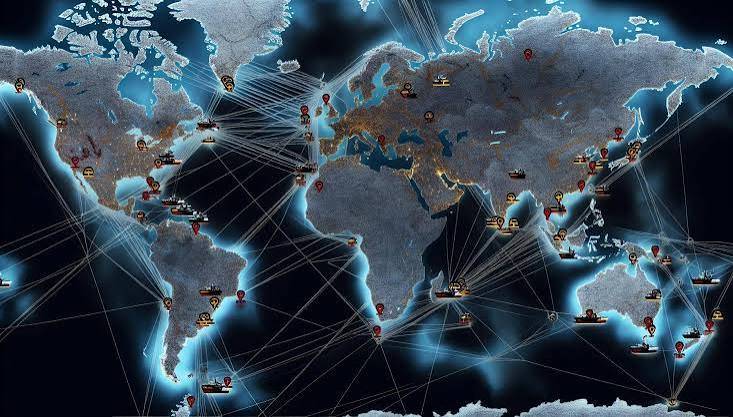
CESMAR Daily Global Maritime Geopolitical Forecast – August 3 2026 –
CESMAR Daily Global Maritime Geopolitical Forecast
– August 3 2026 –
Summary prepared by the Centre for Geopolitics and Maritime Strategy Studies, compiled on the basis of analyses from third-party sources. While the content does not reflect the Centre’s own positions but is instead drawn from the work of other authors and publications, as indicated in the references, the structuring and interpretation of the data are the result of the Centre’s own synthesis process, aimed at creating a coherent and organic analytical framework. The summary therefore represents a structured reorganisation of the collected and selected information, based on the expertise of our scholars, who have subsequently extrapolated its implications in the geopolitical, strategic, technological, and maritime fields, as well as those related to Mediterranean countries. Reproduction, in whole or in part, is authorised provided that the source is acknowledged.
Geopolitical Scenarios of August 3, 2026
Daily Summary of Global Maritime Geopolitics
Introduction
The period between 31 July and 2 August 2026 confirms the trend, highlighted by Mauro Magatti in Avvenire, towards the convergence of multiple regional flashpoints into a single scenario of systemic crisis. Three primary vectors dominate this landscape: the migratory fracture in Ceuta, the fragile detente in the Strait of Hormuz, and persistent Chinese pressure on Taiwan.
Key Events
On the geopolitical plane, the Ceuta crisis has assumed continental proportions. The influx of approximately 49,000 individuals within twenty-four hours, resulting in a death toll of 71 victims, has prompted twenty-two EU Member States to support the Italian-Danish initiative led by Meloni and Frederiksen to suspend the Schengen Agreement, as reported by Sara Gandolfi in Corriere della Sera. Madrid, backed by France and Portugal, rejects the accusations, whilst according to Notizie Geopolitiche, Morocco is instrumentalising these migratory flows as a lever of hybrid coercion against Brussels.
On the strategic-military plane, NATO leaders have attributed responsibility to Moscow for the landing of an errant missile on eastern Polish territory, as reported by the National Interest, even though the munition was ultimately identified as a Ukrainian interceptor missile. The incident has heightened the state of alert along the Alliance’s Eastern Flank, demonstrating how the proximity of the Ukrainian war to NATO borders amplifies the risk of involuntary escalation stemming from miscalculation or technical failure.
On the maritime plane, USNI News reports that an LNG carrier operated by GasLog sustained damage whilst exiting the Strait of Hormuz, with the UKMTO confirming two additional maritime security incidents in the same area. This event, coinciding with a general decline in commercial shipping traffic across the Persian Gulf due to Houthi threats against Saudi tankers, demonstrates that the diplomatic detente between Washington and Tehran remains vulnerable to incidents capable of rapidly undermining it. It is no coincidence that, according to gCaptain, shuttle-based oil trade in the area only resumed momentum following a precautionary lull, illustrating the persistent instability perceived by international maritime operators.
Geopolitical Agorà
The synthesis presented by specialised observers converges on a single assessment: maritime geography remains the true testing ground for the stability of regional balances. The Flashpoint analysis by OHI Magazine on 1 August and La Bussola by CESMAR on 31 July reconstruct—from the respective analytical perspectives of the Study Centre’s two editorial formats—the sequence of events in the Strait of Hormuz and related tensions, providing a comprehensive overview of the preceding week characterised by a fragile normalisation of maritime traffic.
On the Hellenic-Cypriot front, ELISME notes that the absence of shared red lines between Athens and Nicosia regarding the Turkish “Blue Homeland” (Mavi Vatan) doctrine risks weakening the Greco-Cypriot negotiating position in the Aegean and the Eastern Mediterranean. Reviewing the tensions in the Strait of Hormuz, the Real Instituto Elcano stresses that naval skirmishes and threats to commercial shipping continue to reverberate across European energy markets, necessitating route diversification scenarios and continuous monitoring by the international community.
CIMSEC proposes sovereign guarantees and commercial law mechanisms as non-military deterrent levers against a potential Chinese quarantine of Taiwan, capable of neutralising the ambiguity of the “grey zone” without resorting to armed force. Meanwhile, the Center for Maritime Strategy calls for the reactivation of the US Mine Warfare Command (MINEWARCOM), deeming the current mine countermeasures posture insufficient in the face of proliferating sub-surface threats in global chokepoints. A joint reading of these contributions delivers a coherent framework: deterrence over the coming decade will be played out as much in the military sphere as through insurance, regulatory, and infrastructural domains.
Consequences of the Events
Geopolitical Consequences
The Ceuta fracture is accelerating the internal recalibration of power within the European Union. The coalition of twenty-two nations, led by Rome and Copenhagen, stands in opposition to the Franco-Iberian axis. Meanwhile, Daniele Delbene, a SPE representative cited by Notizie Geopolitiche, has relaunched the federal prospect of a “United States of Europe” as the sole structural response to institutional fragmentation. In parallel, the opening of accession negotiations for Moldova and Ukraine marks, according to Geopolitica.info, a paradigm shift in Brussels’ enlargement policy—one now driven by strategic security imperatives rather than rigid technical automatisms.
On the Middle Eastern front, President Trump’s announcement regarding a comprehensive disarmament plan for Hamas and a new technocratic government in Gaza faces resistance from the Islamist faction and regional actors. Periphery crises remain unresolved: the progressive withdrawal of Western diplomacy from the Sahel leaves a vacuum exploited by Russia and China, whilst growing pressure from Iran, Pakistan, and Tajikistan on the Taliban underscores the structural instability of Central Asia.
The IARI research institute has noted that, when managing contested territories, governments frequently opt for immediate political expediency (Realpolitik) rather than adhering to the established rules and treaties of the international community. This dynamic even leads states to rescind formal recognition previously granted to contested entities. In Germany, according to Il Sussidiario, growing discontent within the CDU following the reshuffle orchestrated by Friedrich Merz—compounded by the emergence of alternative leadership scenarios—further weakens Berlin’s capacity to lead the European front cohesively during this phase of compounding crises, precisely when Germany ought to assume a role of regional political and economic stabilisation.
Strategic Consequences
In the military domain, Russia’s decision to deter Washington from granting Kiev licenses for the domestic production of Patriot air defence systems confirms, according to Analisi Difesa, the Kremlin’s acute sensitivity to any expansion of Ukraine’s defence-industrial capacity. To bridge this capability gap, ten European nations have launched the “Freyja” coalition—a continental alternative to US-made anti-missile systems—described by Geopolitica.info as an initiative aimed at operational and industrial integration to reduce strategic dependency on Washington.
On the Russian domestic front, the terrorist attack targeting General Chaiko in Moscow, reported by Notizie Geopolitiche, confirms the extension of Ukrainian irregular warfare capabilities far beyond the forward line of own troops. In the United States, the CSIS warns of persistent, structural ammunition shortages, whilst Responsible Statecraft highlights the operational limitations of the Littoral Combat Ship fleet. Japan, with the first operational launch of a Tomahawk cruise missile from a surface destroyer reported by InsideOver, moves further beyond its post-war constitutional pacifism.
On the Asian continent, USNI News documents China’s display of shipborne hypersonic anti-ship capabilities aboard its latest generation of destroyers. In Sudan, the Rapid Support Forces remain at the centre of debates regarding their potential formal designation as a terrorist organization, along with the complex diplomatic consequences such a measure would entail for peace negotiations. At the doctrinal level, War on the Rocks highlights the limits of cyber deterrence when isolated from conventional coercive instruments, whilst the crash of an F-35B near MCAS Miramar, reported by USNI News, draws renewed attention to the operational wear and tear impacting fifth-generation air fleets.
Economic, Technological, Financial, and Energy Consequences
On the economic front, Notizie Geopolitiche highlights growing market anxiety regarding the trajectory of US sovereign debt, exacerbated by the combined impact of tax cuts, tariffs, and sustained high interest rates. In Europe, Germany is pursuing technological sovereignty with the development of the new Dresden semiconductor hub—described by InsideOver as the world’s largest fabrication facility—whilst the National Interest warns that the expansion of American artificial intelligence infrastructure remains vulnerable to protectionist trade policies targeting Asian hardware imports.
In the energy sector, Venezuela struggles to revitalise its domestic petroleum industry due to a lack of legal guarantees and foreign direct investment, whereas Cuba has introduced 176 market liberalisation measures to counter internal economic collapse. Turkey has extended its crude oil pipeline agreement with Iraq towards Ceyhan for one year, ensuring the continuity of regional hydrocarbon flows as reported by gCaptain. Meanwhile, persistent tensions at Hormuz and Suez continue to drive up maritime war risk insurance premiums and force shipping lines onto costlier alternative sea routes, as documented by Formiche.net, with direct inflationary repercussions on European energy import costs.
The National Interest further underscores the underutilised potential of geothermal energy as a direct heat source for industrial decarbonisation, noting that direct thermal utilization offers superior efficiency compared to electrical conversion alone. In the naval sector, the US investment of $7.6 billion for fourteen new attack submarines, reported by the National Interest, alongside the supply of Australian steel for the Virginia-class program under the AUKUS framework, confirms that naval defence procurement remains a primary engine of Western technological and industrial capital expenditure.
Maritime Consequences
Global maritime chokepoints remain the epicenter of systemic vulnerability. In the Strait of Hormuz, commercial shipping traffic continues to oscillate between contractions induced by Houthi threats and the resumption of shuttle-based oil transport. Concurrently, the structural damage sustained by the GasLog LNG carrier and a satellite-detected oil slick discharged by a shadow fleet tanker off the coast of Oman highlight the severe environmental and maritime security risks posed by unregulated shipping.
In the Central Mediterranean, the Italian Navy patrol vessel Thaon di Revel, operating under the auspices of Operation IRINI, boarded and inspected a Cameroonian-flagged tanker west of Pantelleria (InsideOver). In the Red Sea, an Italian frigate successfully escorted a merchant vessel, contrasting with Houthi statements denying plans to impose transit tariffs. In the Black Sea, the sinking of a civilian vessel following a Ukrainian maritime drone strike illustrates the increasingly thin line between commercial navigation and wartime logistical support.
The China Coast Guard has expanded its maritime patrols east of Taiwan, drawing sharp diplomatic protests from Taipei. At the doctrinal level, proposals to reactivate US MINEWARCOM alongside ongoing debates surrounding the “Golden Fleet” reflect the strategic imperative to balance exquisite, high-end platforms with distributed mine countermeasure capabilities. Furthermore, InsideOver notes the increasing exposure of Mediterranean critical undersea infrastructure—including data cables and gas pipelines—to unacknowledged gray-zone sabotage. Against this backdrop, the commencement of hull lamination for Intermarine’s second minehunter for the Italian Navy, reported by ShipMag, alongside advancements in South Korea’s KDDX destroyer program, confirms that the modernisation of surface fleets dedicated to sea lines of communication (SLOC) protection remains a shared priority among Western and Asian naval powers.
Consequences for the Southern European Mediterranean countries
For Italy, the Ceuta crisis has revived proposals for externalised processing hubs for asylum seekers on African territory, modelled on the bilateral agreement with Albania. Concurrently, the Italian Navy is consolidating its forward operational presence between the Strait of Sicily—evidenced by the boarding action executed by the Thaon di Revel—and the Red Sea, where a national frigate successfully escorted a transiting merchant vessel.
For Spain, the crisis in its North African exclave has assumed an existential dimension: the casualty toll of 71 dead and the execution of 73,000 repatriations to Morocco, coupled with suspicions of external hybrid orchestration cited by InsideOver, have opened a major rift within the European Union. Madrid finds itself isolated against the Italian-Danish coalition, backed only by France and Portugal.
For Greece, the Cyprus issue and the Turkish “Blue Homeland” doctrine represent an enduring operational friction point, exacerbated by the absence of shared red lines highlighted by ELISME. At the regional level, the environmental warning issued by the Marevivo Foundation regarding a Mediterranean basin approaching critical biodiversity tipping points—with sea surface temperatures reaching up to four degrees Celsius above historical averages—adds an ecological threat layer to the region’s existing maritime security challenges, ranging from undersea cable protection to the surveillance of illicit trafficking through the Channel of Sicily. Southern Europe represents the continent’s most exposed domain; it simultaneously faces a triad of compounding vulnerabilities: accelerating migratory pressure, maritime friction in the Aegean Sea, and severe environmental degradation. The convergence of these threats generates a diplomatic, ecological, and maritime security crisis that cannot be understated.
Conclusions
The strategic landscape of the day confirms a trend towards the simultaneous aggravation of multiple theaters of crisis, with none of the primary operational fronts exhibiting signs of genuine stabilization. The Ceuta crisis appears destined for further diplomatic escalation within EU institutions, where an extraordinary summit will be required to resolve the friction between Schengen suspension and the protection of fundamental human rights.
In the Strait of Hormuz, the Riad-mediated detente remains highly fragile and reversible, as demonstrated by the incident involving the GasLog LNG carrier: a single adverse event could rapidly void Saudi diplomatic mediation. In the Indo-Pacific, the intensification of Chinese maritime patrols surrounding Taiwan and within the South China Sea portends a further erosion of the status quo in the coming weeks.
Finally, the operational evolution of the “Freyja” coalition warrants close monitoring; its industrial trajectory has the potential to redefine the architecture of European air and missile defence over the medium term by reducing dependence on US weapon systems, necessitating an accelerated integration timeline among the ten participating nations.
References
This summary has been prepared based on articles from various geopolitical and strategic analysis sources, including: Elisme, Center for Maritime Strategy, CIMSEC, Reuters, ShipMag, Navy Lookout, National Interest, Seapower Magazine, CSIS, RUSI, War on the Rocks, IISS, Responsible Statecraft, Foreign Affairs, Formiche.net, Il Sussidiario, Start Magazine, InsideOver, Notizie Geopolitiche, IARI, Dissipatio, Analisi Difesa, Jamestown Foundation, Atlantic Council, RAND Corporation.
For further insights, please visit the CESMAR websites or social media channels: