

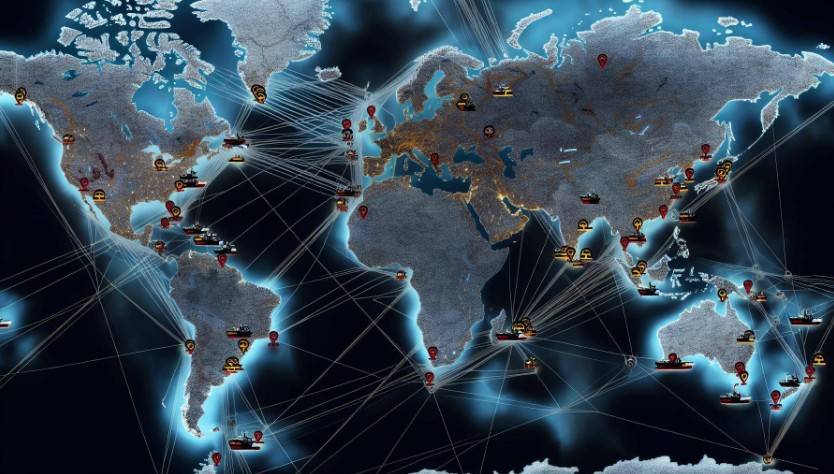
CESMAR Daily Global Maritime Geopolitical Forecast – August 14 2026 –
CESMAR Daily Global Maritime Geopolitical Forecast
– August 14 2026 –
Summary prepared by the Centre for Geopolitics and Maritime Strategy Studies, compiled on the basis of analyses from third-party sources. While the content does not reflect the Centre’s own positions but is instead drawn from the work of other authors and publications, as indicated in the references, the structuring and interpretation of the data are the result of the Centre’s own synthesis process, aimed at creating a coherent and organic analytical framework. The summary therefore represents a structured reorganisation of the collected and selected information, based on the expertise of our scholars, who have subsequently extrapolated its implications in the geopolitical, strategic, technological, and maritime fields, as well as those related to Mediterranean countries. Reproduction, in whole or in part, is authorised provided that the source is acknowledged.
Geopolitical Scenarios of August 14, 2026
Daily Summary of Global Maritime Geopolitics
Introduction
13 August 2026 presents itself as a day of systemic acceleration in global tensions: the Strait of Hormuz remains the primary vector of the international energy crisis, the war in Ukraine reveals new asymmetric balances on the battlefield, and the fragility of Western naval fleets emerges as a medium-term structural vulnerability.
Key Events
Geopolitics / International Relations — Iran claims absolute control over the Strait of Hormuz. As reported by the Fars News agency and carried by Reuters, Tehran has officially declared that maritime navigation within this maritime choke point must comply with regulations imposed by the Islamic Republic. In response, the United States is evaluating the option of an indefinite naval blockade against Iran (Reuters), a measure that, whilst aiming to restrict Tehran’s oil exports, risks triggering a chain reaction with disruptive effects on global energy markets. The rhetorical and military confrontation surrounding the strait elevates the risk profile for the entire global crude supply chain, at a time when maritime traffic in the area is experiencing near-total paralysis, with no signs of recovery (gCaptain).
Strategy and Warfare — Within the framework of Exercise Combined Resolve held in Hohenfels, Germany, Ukrainian operators from the 412th “Nemesis” Regiment inflicted a decisive tactical defeat on a 3,500-strong United States armoured brigade (AGI, Adnkronos). Reconnaissance uncrewed aerial vehicles (UAVs) identified American main battle tanks via the dust clouds kicked up during movements, subsequently neutralizing them with FPV loitering munitions at such a rapid pace that exercise directors were forced to reset eliminated units. The episode exposes structural vulnerabilities within conventional NATO doctrine when confronted with asymmetric warfare using uncrewed systems, prompting the Pentagon to initiate a review of its tactical procedures.
Seapower and Maritime Affairs — The aircraft carrier USS Abraham Lincoln has reached its ninth consecutive month of deployment in the Gulf without port visits, generating an internal crisis documented by numerous suicide attempts among sailors (AGI/Military Times). USS George Washington is en route to the Middle East to conduct a relief-in-place, signalling the extreme degree of operational strain placed upon the US Navy on a global scale. American senators have formally requested explanations from naval leadership, whilst the affair highlights the structural scarcity of naval units available for deployment rotations.
Geopolitical Agorà
On 13 August 2026, the Anglophone strategic press focuses on three converging phenomena that define the relative decline of Western navies. War on the Rocks offers a scathing analysis of the British Royal Navy, documenting how 2026 represents a further year of operational contraction: a reduction in operational surface combatants, deferral of modernisation programmes, and recruitment shortfalls, contrasted against defence rhetoric that far outstrips genuinely available resources. The gap between ambition and capability jeopardises commitments made within NATO and the protection of the nation’s vital sea lines of communication (SLOCs).
The Center for Maritime Strategy argues with analytical precision that naval deterrence is intrinsically linked to and constrained by the rate of industrial production: when a warship depletes its vertical launch system (VLS) cells in a prolonged engagement, the process of replenishing stocks requires months of manufacturing. Structural delays in shipyards and supply chains compromise credible rapid-response capabilities in scenarios involving simultaneous crises or asymmetric attacks by low-cost drones.
These reflections find dramatic confirmation in the case of USS Abraham Lincoln: USNI News documents the redeployment of USS George Washington to the Middle East following nearly nine months of Lincoln‘s deployment, whilst Military Times and AGI reveal cases of attempted suicide on board, food rationing, malfunctioning sanitary facilities, and exhausting watch schedules for the approximately 5,000 ship’s company. The National Interest highlights parliamentary pressure on the Pentagon. The overall picture depicts a US Navy pushed to the absolute limits of operational personnel sustainability.
Consequences of the Events
Geopolitical Consequences
The totality of developments on 13 August sharply redraws the global power architecture. The Hormuz crisis consolidates an ongoing multipolar transition: the Council on Foreign Relations asserts that the US-led Middle Eastern regional order has structurally come to an end, with the Mecca Agreement standing as the most visible manifestation of this regional autonomy, as Saudi Arabia, Turkey, and other actors increasingly manage their own security without relying exclusively on Washington.
In this context, Putin’s visit to the disputed Kuril Islands (Reuters) carries precise symbolic and strategic weight: Moscow reaffirms its claims in the North Pacific, effectively closing the window for any normalization with Tokyo and demonstrating that Russian-Western confrontation now spans from the Atlantic to the Indo-Pacific. Formiche.net emphasizes that this Russian activism coincides with joint Sino-Indonesian naval exercises east of Taiwan (USNI News), signalling informal coordination among revisionist powers on a global scale.
On the European front, EU enlargement to Ukraine, Moldova, and the Western Balkans (IARI) clashes with the need to avoid diluting the accession process’s qualitative standards, whilst Denmark responds to Arctic geopolitical pressures by expanding military conscription (The National Interest). Brazil, meanwhile, initiates commercial reciprocity proceedings against US tariffs (Reuters), indicating that the fragmentation of the liberal economic order continues on all fronts.
Australian Prime Minister Anthony Albanese confirmed the AUKUS security pact proceeds at full speed after talking with US President Donald Trump. Despite American isolationist concerns, Canberra reaffirms the trilateral alliance with the US and UK for nuclear-powered submarines. This cooperation remains crucial for Indo-Pacific stability and deterring Chinese military expansion (Reuters).
Strategic Consequences
On the military and doctrinal plane, 13 August delivers lessons of extraordinary relevance. The Hohenfels exercise empirically demonstrates the tactical superiority of FPV drones and uncrewed reconnaissance systems over conventional NATO armoured formations. As The National Interest notes, Ukrainian service personnel displayed an adaptability in bypassing electronic warfare (EW) and integrating drones with land-based artillery that traditional American training does not replicate. The Pentagon has already begun revising its procedures, advocating for greater force dispersion, advanced camouflage, and intensive EW integration.
Concurrently, the establishment of CENTCOM’s first multinational anti-drone task force (Seapower Magazine) operationally addresses the escalating threat posed by regional militia kamikaze drones in the Gulf, signalling that uncrewed systems warfare has become the decisive tactical domain in Middle Eastern theatres of operation.
Donald Trump’s proposal to open US fleet modernization to allied shipyards (gCaptain) touches a raw nerve in American naval strategy: domestic production capacity is no longer sufficient to sustain the building rates required by the naval peer-competition with the Chinese Navy. As the Center for Maritime Strategy argues, naval deterrence depends on industrial throughput, and structural delays in US shipyards directly compromise Washington’s strategic credibility. The USS Lincoln crisis renders this vulnerability glaringly visible and politically unsustainable.
Economic, Technological, Financial, and Energy Consequences
The paralysis of the Strait of Hormuz (gCaptain) generates shockwaves across the global economy. Shipping lines and maritime insurers continue to avoid the choke point due to the risk of attack and seizure, resulting in storage accumulation in Gulf producing nations and a structural rise in crude oil prices. Maersk and Hapag-Lloyd (gCaptain) find themselves in a paradoxical position: operational costs are climbing due to re-routing via the Cape of Good Hope, yet the reduction in overall global fleet capacity supports container freight rates, boosting profit margins on a global scale.
On the energy front, Russia’s Northern Sea Route (Analisi Difesa) suffers another setback—ice damage to a tanker (gCaptain)—highlighting the operational hazards of attempting to bypass Western sanctions via polar seas. Kazakhstan, which relies on the CPC pipeline through Russia to export its crude to international markets (The National Interest), illustrates the complex entanglement of sanctions, geopolitics, and American energy interests in Central Asia.
Technologically, The National Interest argues that semiconductor export controls alone are insufficient to contain China’s artificial intelligence drive: Beijing compensates through massive state subsidies and software optimization. Finally, Michael Froman in Foreign Affairs warns that structural weaknesses in the Chinese economy—real estate, local government debt, and industrial overcapacity—represent the primary risk of a global economic crisis in the medium term.
Maritime Consequences
13 August 2026 cements the Strait of Hormuz as the planet’s primary geopolitical choke point. Iran asserts operational sovereignty over the narrow waterway (Reuters/gCaptain), while the United States considers an indefinite naval blockade (Reuters). This standoff creates a maritime security limbo that effectively halts hydrocarbon flows from the Persian Gulf, with immediate repercussions for global crude and LNG availability. The merger between SK Shipping and H-Line Shipping in South Korea (gCaptain) to create an LNG transport giant directly responds to this surging demand for secure alternative supply routes.
The Indo-Pacific is the world’s new geopolitical and economic center. Experts, including Scott Morrison, highlight India’s vital role in balancing China’s expansion. As a key QUAD partner with a strategic location, India ensures maritime security and trade route freedom while firmly maintaining its strategic autonomy between Western nations and Russia.
The Ukrainian drone strike on the port of Novorossiysk (Naval News) confirms that no Russian naval base in the Black Sea is safe from long-range strikes, forcing Moscow to reconsider the disposition of its Black Sea Fleet. Concurrently, Ukraine offers a partial truce in Black Sea waters to safeguard grain transit (Reuters), demonstrating Kyiv’s acute awareness of the geopolitical value of agricultural trade routes.
In naval shipbuilding, the launch of ORP Wicher in Poland (Navy Lookout), derived from the British Type 31 design, alongside the start of construction on Vietnam’s indigenous frigate (Naval News), indicates a global trend toward shipbuilding self-reliance and the diversification of regional naval capabilities. Meanwhile, the Baltic Sea records the downing of a drone in Latvia and navigation restrictions in Finland (Reuters), confirming that NATO’s north-eastern flank remains a theatre of constant hybrid pressure.
Consequences for the Southern European Mediterranean countries
For Italy, Greece, and Spain, 13 August 2026 presents a multidimensional risk profile. Italy suffers the indirect effects of the Hormuz crisis through rising energy costs and the disruption of commercial sea routes passing through the Suez Canal, vital for manufacturing exports to Asia. The potential role of the Italian Navy (Marina Militare) in mine countermeasures (MCM) in the Gulf—previously analysed in CESMAR studies on the Strait of Hormuz—takes on renewed urgency given the current paralysis of shipping. The emergence of a Turkey-Pakistan-Saudi Arabia Sunni axis (Il Sussidiario) reshapes Rome’s regional partners in the Eastern Mediterranean and Middle East, complicating Italian diplomatic architecture in the region.
Greece faces the direct threat of wildfires on its home territory, which have struck a resort village—an event Reuters documents as a manifestation of Mediterranean climate vulnerability, with severe impacts on the tourism sector, a cornerstone of the Hellenic economy. Tensions in the Aegean and Eastern Adriatic, fuelled by Turkish activism and Libyan mediation, remain latent in the background.
Spain is engulfed in a domestic political crisis of European significance: polling indicates a collapse in support for Sánchez following tensions in Ceuta and the clash with Meloni (Il Sussidiario), with the People’s Party (Partido Popular) holding a clear lead and Vox rising toward 20%. An eventual change of government in Madrid would alter the decision-making balance within the European Council, with knock-on effects for defence policies and migration management in the Mediterranean.
Conclusions
13 August 2026 confirms three accelerating structural trends: the Hormuz crisis as a long-term factor of global energy instability, the relative decline of Western naval capabilities in the face of rising operational demand, and the emergence of new regional power axes that are reshaping alliances across the Middle East and the Indo-Pacific.
In the coming days, indicators of imminent developments concern: the Iranian response to the proposed US naval blockade—with potential for escalation in the strait; the USS Lincoln crisis serving as a political test for the Trump Administration regarding naval force management; and the outcome of US-Turkish mediation over Libya. For CESMAR, it is recommended to closely monitor the evolution of NATO anti-drone doctrine, the dynamics of Russia’s Northern Sea Route, and the progression of the Saudi nuclear programme as vectors of maximum impact on Mediterranean maritime security.
References
This summary has been prepared based on articles from various geopolitical and strategic analysis sources, including: Elisme, Center for Maritime Strategy, CIMSEC, Reuters, ShipMag, Navy Lookout, National Interest, Seapower Magazine, CSIS, RUSI, War on the Rocks, IISS, Responsible Statecraft, Foreign Affairs, Formiche.net, Il Sussidiario, Start Magazine, InsideOver, Notizie Geopolitiche, IARI, Dissipatio, Analisi Difesa, Jamestown Foundation, Atlantic Council, RAND Corporation.
For further insights, please visit the CESMAR websites or social media channels: