

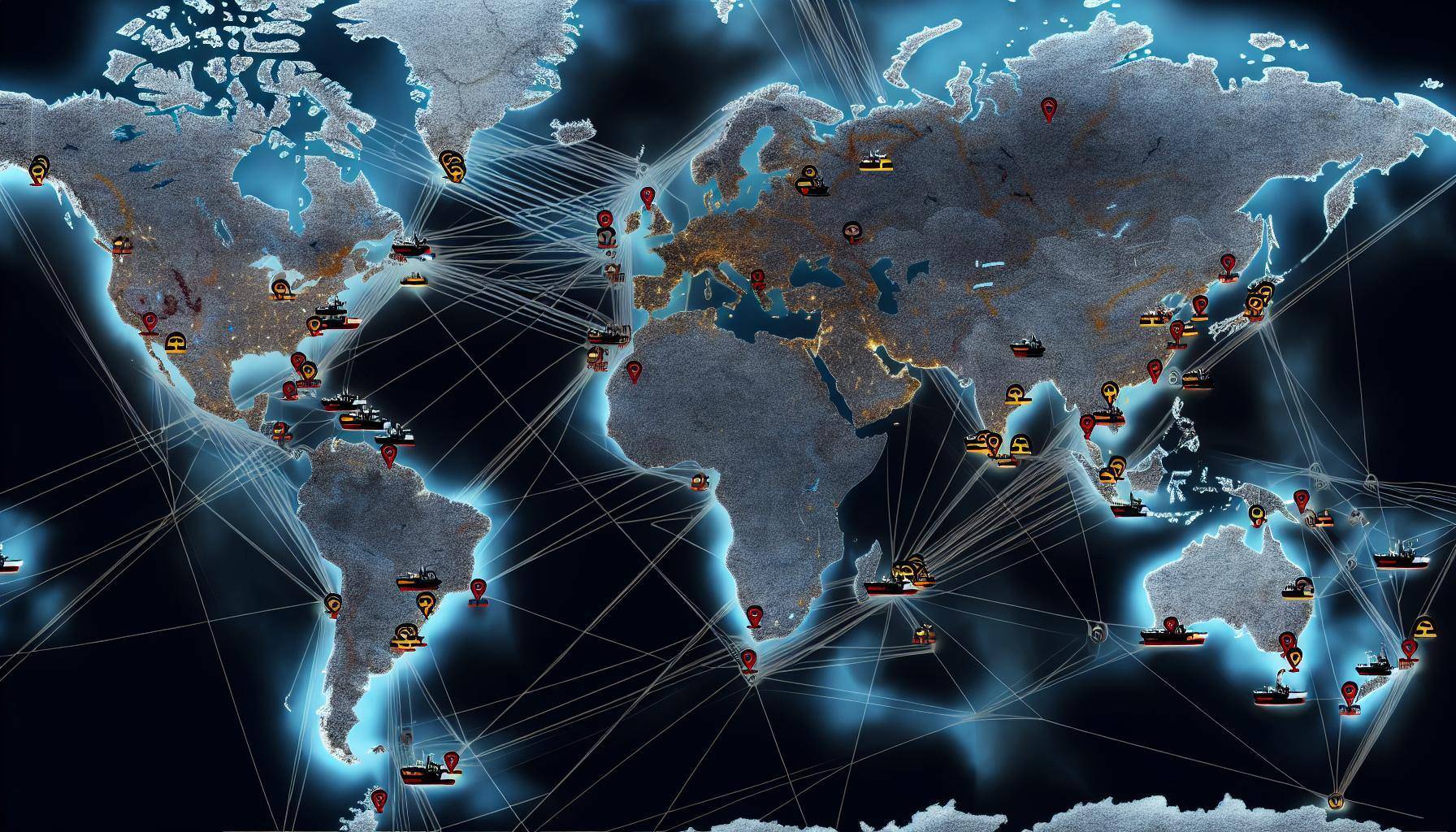
CESMAR Daily Global Maritime Geopolitical Forecast – October 9 2026 –
CESMAR Daily Global Maritime Geopolitical Forecast
– October 9 2026 –
Summary prepared by the Centre for Geopolitics and Maritime Strategy Studies, compiled on the basis of analyses from third-party sources. While the content does not reflect the Centre’s own positions but is instead drawn from the work of other authors and publications, as indicated in the references, the structuring and interpretation of the data are the result of the Centre’s own synthesis process, aimed at creating a coherent and organic analytical framework. The summary therefore represents a structured reorganisation of the collected and selected information, based on the expertise of our scholars, who have subsequently extrapolated its implications in the geopolitical, strategic, technological, and maritime fields, as well as those related to Mediterranean countries. Reproduction, in whole or in part, is authorised provided that the source is acknowledged.
Geopolitical Scenarios of October 9, 2026
Daily Summary of Global Maritime Geopolitics
Reading time: 10 minutes
Introduction
The 8th of October 2026 presents a picture in which the commemoration of the third anniversary of the events that occurred in the Near East on the 7th of October, the saturation of maritime chokepoints, and the technological race among the great powers converge on a single thesis: global competition is increasingly decided at sea, within shipyards, and through the capability to protect flows, alliances, and narratives, whilst regional crises cease to be peripheral.
Key Events
Geopolitics: The Middle East three years after 7 October. Formiche and ISPI concur in describing a region that cannot return to the status quo ante: the crisis originating in Gaza has evolved into a multidimensional conflict, spanning from Lebanon to Yemen and extending to the direct confrontation between Israel and Iran, whilst diplomacy struggles to forge durable solutions. The Council on Foreign Relations adds the internal dimension: Israel is experiencing a reckoning regarding accountability for the security failure and is approaching an electoral deadline destined to weigh heavily upon alliances and regional prospects. Finally, Analisi Difesa highlights the erosion of the Jewish State’s international consensus capital, defining it as a strategic vulnerability of the first magnitude.
Strategy: The industrial reorganization of American submarine power. Naval News reports a joint investment of 6.6 billion dollars between the US Navy and Anduril to expand the undersea industrial base, whilst Formiche.net frames the company’s entry into the Virginia-class submarine supply chain as an attempt to overcome the chokepoints of traditional shipyards through autonomy and artificial intelligence. The CSIS observes that Beijing is studying drone warfare in Ukraine as a laboratory for a potential amphibious operation against Taiwan. The nexus is evident: deterrence is now measured in production scale and speed of adaptation.
Maritime aspects: Hormuz between proclamations and attacks. gCaptain documents the weekly peak in tanker attacks since the commencement of hostilities with Iran, whilst Notizie Geopolitiche reports the contrast between Washington—which declares the strait formally open and the Islamic Revolutionary Guard Corps out of control—and Tehran, which proclaims its closure. The same outlet reports attacks on two tankers near Qatar and Fujairah, proof of a threat extending beyond the Strait of Hormuz. The CIMSEC bulletin confirms maximum red alert following the attack on the On Peace on 6 October, resulting in twelve injured seafarers.
Mediterranean Area: The Trans-Regional Seapower Symposium. Inside Over indicates how the Venice symposium offered a top-tier reflection platform on the radical evolution of maritime security paradigms, shifting the strategic centre of gravity from vast oceanic spaces to so-called enclosed and semi-enclosed seas. The analysis delves into how contemporary geopolitical contexts, characterized by acute regional rivalries, demand a profound revision of traditional naval doctrines. The critical vulnerabilities of maritime lines of communication, energy flows, and submarine infrastructure in confined basins are examined. Speakers and experts gathered at the Venetian event emphasized the necessity of developing targeted deterrence capabilities, enhancing cooperation among allied navies, and integrating advanced surveillance technologies to effectively safeguard constrained and heavily contested spaces. The meeting of representatives from over 70 world navies reaffirms that global stability inevitably depends upon the control and protection of these fundamental strategic maritime nodes.
Geopolitical Agorà
In the Geopolitica broadcast on Naftemporiki TV, hosted by Savvas Kalenteridis, Rear Admiral Vassilios Martzoukos, Vice President of ELISME, analyses international maritime law in the face of Erdogan’s rhetoric, linking them to the credibility of Hellenic deterrence in the eastern Mediterranean.
Martzoukos reconstructs the origins of Turkish claims. Until 1973, Ankara did not systematically contest either Greek airspace or waters. The turning point arrived with drilling operations in the Prinos field and NOTAM 714, which aimed to divide the Aegean. From that dispute, over ten claims have emerged, extended to the “Blue Homeland” and Cyprus. For the Admiral, this reveals a deterrence failure: those who suffer an expansionist policy must halt it immediately, whilst progressive retreat has encouraged the counterpart to escalate its demands.
On a theoretical level, Martzoukos contrasts appeasement and deterrence. The former, recalled by the example of Western powers towards Nazi fascism, can only be a temporary tactic for a weaker state to gain time for rearmament; if it becomes a permanent strategy, it leads to the loss of sovereignty. Deterrence, conversely, is an equation whose factors must operate in concert. Clear and communicated red lines are required, alongside the determination to use force, adequate and ready forces, high morale among the populace—which must not slip into complacent pacifism—and a reputation for credibility built over time.
The comparison with history is stark. In the 1987 crisis concerning the vessel Hora (also known as the Aegean Crisis), political decisions were aligned with his historical firmness towards Turkey (summarized by the slogan “Sink the Hora”, coined during a previous crisis). Papandreou made clear that any intrusion or unilateral Turkish activity within the continental shelf claimed by Greece would be deemed an act of invasion and the vessel would be sunk. Following the Turkish casus belli of 1995 (when the Turkish Parliament resolved that if Greece were to unilaterally extend its territorial waters beyond 6 nautical miles, the Ankara government would be mandated to use military force to defend its vital interests—a declaration Greece still considers a violation of international law and the UN Charter) and the Imia crisis of 1996 (where a minor maritime incident risked triggering a conflict, focusing on two tiny uninhabited islets), the reaction fell short of the balance of forces at the time. As a positive model, the Admiral cites Venizelos in 1910: first internal strengthening, followed by an assertive foreign policy capable of seizing windows of opportunity.
The legal dimension is grounded in UNCLOS, in force since 1994. Greece may extend its territorial waters to 12 nautical miles, a right that Ankara has tried in vain to exclude for the Aegean and has threatened with a casus belli since 1995. According to Martzoukos, the extension should be planned over time, backed by solid diplomatic preparation and guaranteed navigation corridors. He also recalls Article 7, which permits straight baselines in the presence of indented coastlines and archipelagos. Turkey has applied this in the Aegean since 1964, whilst Athens has not fully exploited its potential.
Furthermore, Cyprus represents the linchpin and weak link of Hellenic defence: the Republic has proclaimed its Exclusive Economic Zone in its entirety, and Greece, as a guarantor power, has the obligation to contribute to its security. The southern area, between Rhodes, Karpathos, Crete, and Cyprus, is being reinforced by the “Achilles Shield”, an integrated network that shares real-time situational awareness and includes Barak MX, David’s Sling, and Spider. To these are added the Belharra frigates armed with Aster 30 missiles and the two Bergamini-class (FREMM) frigates. Nevertheless, urgent requirements remain for new submarines, logistics, and spare parts, alongside the Army’s personnel shortages, to be addressed through a revision of conscription.
Finally, Martzoukos criticises the management of the Great Sea Interconnector (a colossal EU-funded energy infrastructure project aimed at constructing a high-voltage direct current [HVDC] submarine power cable in the Mediterranean Sea. The primary objective is to connect the electrical grids of Greece [Crete], Cyprus, and Israel, ending the near-total energy isolation of the island of Cyprus and integrating the region into the European electricity market). Turkey contests the route of the hydrographic and bathymetric survey vessels engaged in submarine surveys. The Turkish government claims jurisdictional rights over its continental shelf in the area and insists that any cable-laying or scientific activity must receive coordination and prior authorization from Ankara. In the past, Turkish naval vessels have been deployed to block survey vessels (such as the Italian-flagged Ievoli Relume), slowing down operations. For Martzoukos, activities should not depend upon any permit from Ankara, and delays caused by Turkish naval intimidation ought to be met with a firm response.
Consequences of the Events
Geopolitical Consequences
Regarding the balance of power, the day reveals an Occidental world engaged in redefining its perimeters. Inside Over perceives in the update to the Monroe Doctrine Washington’s intent to secure the American hemisphere, reducing the margins for systemic competitors, whilst Responsible Statecraft warns of the economic and social cost of empire and invokes a more prudent realism; The National Interest, conversely, argues that realism demands confrontation with authoritarian forces. Marco Rubio’s speech on the Acropolis, commented upon by Formiche and the Hellenic Institute for Strategic Studies, reaffirms transatlantic cohesion on historical-cultural foundations, yet also sparks unease regarding the resilience of alliances. The European front appears vulnerable: Inside Over describes the crisis of Macronism amidst debt and protests and a Spain approaching the polls with Feijóo’s People’s Party on the offensive against Sánchez; the Hellenic Institute attributes Zelensky’s resilience to external support and the suppression of the opposition, whilst simultaneously criticising his inability to control domestic corruption, and RUSI quantifies the burden imposed upon London by Russian hostility. On the margins of Europe, Geopolitica.info notes Turkish neo-ottomanism across Crimea, Syria, and the Black Sea; the International and Strategic Studies Institute describes a semi-anarchic Horn of Africa contested by external powers; and Inside Over highlights Indian missile projection into Central Asia, challenging the spheres of influence of Moscow and Beijing. Finally, The National Interest views artificial intelligence as the driver of a great divergence between the United States and China. The resulting system is one wherein Washington concentrates resources upon its own perimeter, whilst European allies, weakened domestically, must decide how much of their own security to entrust to a more selective American umbrella.
Strategic Consequences
On the military and doctrinal front, the convergence between civilian industry and warfare power emerges. Inside Over describes Project Meridian as the sign of Silicon Valley’s definitive entry into Pentagon planning, with the resulting governance dilemmas and supply chain vulnerabilities; Shipmag adds the contract awarded by the Navy to Saronic for autonomous surface vessels, exemplifying the adoption of dual-use technologies. In the land domain, War on the Rocks examines how to achieve breakthrough manoeuvres in the face of robotic mass, suggesting dispersion, electronic warfare, and distributed air defence, whilst the CSIS notes that Beijing is observing Ukrainian drones as a proving ground. CIMSEC demonstrates how support for Taiwan, calibrated around asymmetric deterrence, reflects America First and places stress on the US industrial base. Equally relevant is the non-conventional dimension: War on the Rocks examines defences against AI-designed viruses, the IISS evaluates the collective impact of intelligence reforms within democracies, and the case of the Royal Navy sailor charged with espionage—reported by Notizie Geopolitiche—underscores the persistence of shadow warfare. Finally, RUSI observes that Moscow is leveraging nuclear deterrence and a war-industrial base capable of bypassing sanctions. The CESMAR Agora reiterates the centrality of the maritime domain in naval doctrines. This yields a precise doctrinal requirement: integrating autonomy, mass production, and command system resilience without exposing flanks in the information and biological domains.
Economic, Technological, Financial, and Energy Consequences
On the economic front, the risk of war translates into costs. gCaptain describes the peak of attacks in Hormuz as a threat to shipowners’ stability and crude oil supplies, whilst Notizie Geopolitiche reports an oil price increase exceeding three percent due to fears of American raids on Iran ahead of November elections, presenting Washington with a dilemma between resolve and an inflationary fuel shock. Nonetheless, the CIMSEC bulletin recalls that Gulf exports remain elevated: volumes hold firm, though at the price of insurance, detours, and persistent kinetic threats. In the Black Sea, Notizie Geopolitiche notes escalating insurance costs and logistical delays for Europe. On the industrial front, Naval News and Formiche.net highlight the mobilization of private capital in submarines, the Center for Maritime Strategy denounces the inefficiencies of Washington’s shipbuilding and the illusion of the self-sufficient fortress, whilst the Hyundai-Iskra agreement and German procurement point to an increasingly globalized naval market. The National Interest links artificial intelligence to a technological divergence founded on semiconductors and data chains, featuring parallel digital ecosystems. RUSI quantifies the cost to London of cyber defences and submarine infrastructure, Inside Over links the French crisis to the growth of public debt, and Shipmag describes Russia’s approximately four-hundred-billion-dollar investment in the Arctic. For markets and enterprises, a common lesson emerges: the resilience of supply, energy, and technological chains becomes a strategic asset equal to production capacity.
Maritime Consequences
The sea acts as the collector of the day’s tensions. At Hormuz, the sequence of tanker attacks documented by gCaptain and Notizie Geopolitiche illustrates a threat extending beyond the strait, reaching Qatari and Fujairah waters, whilst the CIMSEC bulletin maintains maximum red alert. In the Red Sea, Houthi pressure on Aden and the fighting around Mocha and Bab el-Mandeb coexist with the cautious initial return of two Premier Alliance services to Suez—a sign of commercial calculation rather than normalization. The Black Sea remains, according to Notizie Geopolitiche, a theatre of attacks on merchant shipping. Further north, Shipmag illustrates Russia’s Arctic and Northern Sea Route plan, and gCaptain reports British sanctions targeting twelve tankers of the Russian shadow fleet: maritime lines of communication are becoming politicized down to the polar seas. On the naval power front, Naval News reports the agreement between HD Hyundai and the Croatian shipyard Iskra for multi-role corvettes, the German approval of four additional MEKO A-200 frigates, and the launch of Japan’s seventh Taigei-class submarine amidst intensifying domestic debate over potential nuclear propulsion for future submarines. The CSIS denounces the submarine data collection conducted by Beijing using dual-use research vessels, whilst The National Interest reports the deployment of a German submarine by British commando forces. Inside Over, from the Venice symposium, records the importance of the role played by enclosed and semi-enclosed seas compared to the open oceans. Overall, the security of SLOCs depends upon the ability to escort, monitor, and regenerate fleets more rapidly than asymmetric threats can erode them.
Consequences for the Southern European Mediterranean countries
For Italy, Il Sussidiario proposes recalibrating NATO commitments towards the wider Mediterranean and North Africa, alleviating the Baltic front—a thesis consistent with the Bergamini’s deployment in ASPIDES and the prominence of the Venice symposium. Formiche.net invokes General Di Somma’s vision of a structured Arctic commitment, indicating that Italian maritime projection also looks to high latitudes. The potential return of liner services to Suez and the instability of Hormuz impact a country dependent upon energy and maritime commerce, with Il Sussidiario recalling piracy, migratory flows, and North African instability. For Greece, Rubio’s speech in Athens confirms its centrality in the eastern Mediterranean, yet the Hellenic Institute warns of unease regarding questions over alliance resilience; additionally, the Turkish neo-ottomanism described by Geopolitica.info across the Black Sea and the Levant weighs heavily. For Spain, Feijóo’s electoral race against Sánchez, chronicled by Inside Over, could affect Madrid’s Mediterranean and Latin American projection as well as European cohesion, already tested by the French crisis. Finally, all three countries bear the burden of vulnerabilities in the Horn of Africa and Red Sea corridors, alongside the risk of disruptions to energy supply chains. The collective dossiers suggest a convergent interest for the three nations: strengthening naval coordination in the wider Mediterranean, protecting lines of communication towards Suez and the Red Sea, and maintaining an autonomous voice in Alliance decision-making, thereby preventing strategic attention from remaining confined to northern and eastern theatres whilst the southern flank accumulates pressures concerning energy, commerce, and security.
Conclusions
The day points to strategic competition shifting towards the seas, shipyards, and data. Three dossiers show signs of imminent evolution. The first is Hormuz: the attack on the On Peace, fears of American raids ahead of the November vote, and rising oil prices render further hardening probable, with escalation possible following any naval incident. The second is Yemen: the offensive around Aden and Bab el-Mandeb will condition the return to Suez announced for November by the Premier Alliance. The third is Israel, where the electoral campaign and the reckoning over 7 October will weigh upon alliances and regional fronts. Remaining to be monitored are submarine and autonomy procurement contracts, the Spanish electoral contest, and French political attrition.
References
This summary has been prepared based on articles from various geopolitical and strategic analysis sources, including: Elisme, Center for Maritime Strategy, CIMSEC, Reuters, ShipMag, Navy Lookout, National Interest, Seapower Magazine, CSIS, RUSI, War on the Rocks, IISS, Responsible Statecraft, Foreign Affairs, Formiche.net, Il Sussidiario, Start Magazine, InsideOver, Notizie Geopolitiche, IARI, Dissipatio, Analisi Difesa, Jamestown Foundation, Atlantic Council, RAND Corporation.
For further insights, please visit the CESMAR websites or social media channels: