

CESMAR Daily Global Maritime Geopolitical Forecast – October 5 2026 –
CESMAR Daily Global Maritime Geopolitical Forecast
– October 5 2026 –
Summary prepared by the Centre for Geopolitics and Maritime Strategy Studies, compiled on the basis of analyses from third-party sources. While the content does not reflect the Centre’s own positions but is instead drawn from the work of other authors and publications, as indicated in the references, the structuring and interpretation of the data are the result of the Centre’s own synthesis process, aimed at creating a coherent and organic analytical framework. The summary therefore represents a structured reorganisation of the collected and selected information, based on the expertise of our scholars, who have subsequently extrapolated its implications in the geopolitical, strategic, technological, and maritime fields, as well as those related to Mediterranean countries. Reproduction, in whole or in part, is authorised provided that the source is acknowledged.
Geopolitical Scenarios of October 5, 2026
Daily Summary of Global Maritime Geopolitics
Reading time: 10 minutes
Introduction
The current global geopolitical framework outlines a phase of profound systemic instability, characterised by the convergence of interstate military frictions, energy tensions, and vulnerabilities in maritime supply chains. Today’s overview highlights how global strategic competition is redefining the boundaries of economic security and technological power projection.
Key Events
Brussels slams the door: no European support to bridge Kiev’s defence budget gap (Source: analisidifesa.it). The European Union has officially communicated the impossibility of allocating the funds necessary to directly cover the heavy financial deficit of eight billion euro estimated for the Ukrainian defence sector. Despite its continuous political commitment to Kiev, the Community institutions are clashing with insurmountable internal budgetary constraints and political difficulties that prevent the disbursement of an extraordinary sum of such magnitude. This rigid stance will compel the Ukrainian government to recalibrate its internal spending plans, forcing it to seek alternative ways to sustain national war production and the maintenance of armed forces in the field. The situation raises critical questions regarding the long-term sustainability of the Ukrainian military effort in the absence of a continuous flow of fresh resources from individual Western allies, confirming how the funding issue represents one of the most critical nodes in relations between Brussels and Kiev, and highlighting the structural limitations of European financial aid in the face of a conflict of such magnitude and temporal duration.
Evolution of military training between future wars and uncertainty (Source: warontherocks.com). The debate on the training and preparation of armed forces highlights the need to convert military academies from traditional institutions into genuine learning centres for future battle characterised by scenarios of profound uncertainty. The rapid irruption of new technologies, artificial intelligence, and hybrid tactics in contemporary conflicts renders teaching models based solely on lessons of the past inadequate. Analysts emphasise that future military leaders must not limit themselves to executing rigid protocols, but must cultivate cognitive flexibility, critical thinking, and the capacity for immediate reaction in the face of chaotic and shifting contexts. This makes a radical revision of curricula indispensable, enhancing the simulation of complex crises, the understanding of global geopolitical factors, and the governance of technological innovation as a crucial strategic investment to preserve the superiority of democratic nations.
Key questions leaders must ask themselves before deciding on war (Source: cfr.org). The reflection on the decision-making criteria preceding military intervention underscores the fundamental importance of rigorous and preventive analysis by political leadership. Many disastrous conflicts of the past have stemmed from erroneous assessments, unjustified optimism regarding the duration of operations, and a deficient understanding of the long-term repercussions on regional stability. To avert the risk of becoming bogged down in protracted and inconclusive wars capable of eroding resources and international credibility, analysts recommend that governments address indispensable questions with absolute transparency: the precise definition of political objectives, a realistic estimate of human and economic costs, the availability of a credible exit strategy, and a thorough examination of the reactions of adversaries and allies. Decision-making founded on a prudent cost-benefit analysis constitutes the best safeguard against reckless military adventures.
The persistent need for mine countermeasures forces in the artificial intelligence era (Source: cimsec.org). The analysis published on the CIMSEC website (an authoritative US think tank), authored by CESMAR members Massimo Vianello and Giovanni Giorguli, demonstrates that despite rapid progress in artificial intelligence and autonomous systems, modern navies retain an indispensable need for specialised mine countermeasures forces. Naval mines remain lethal, economical, and difficult-to-detect asymmetric weapons capable of paralysing commercial flows and blocking entire combat fleets at strategic chokepoints. Although underwater drones and intelligent devices now offer advanced clearance tools, the safe and definitive removal of such ordnance still requires the intervention of dedicated platforms and highly qualified personnel. Experts warn that relying solely on automated solutions without possessing a robust naval mine countermeasures force represents an unacceptable risk for the security of global maritime communications, the safeguarding of which requires the synergistic integration of artificial intelligence and traditional human expertise.
Geopolitical Agorà
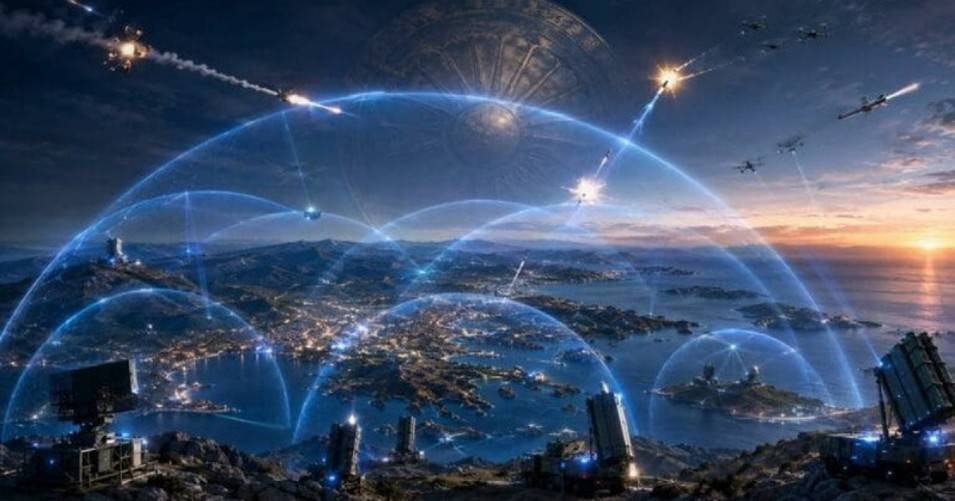
Project Meridian, initiated by the US Department of War and led by Emil Michael alongside figures such as Elon Musk and Palmer Luckey, could outline the future US strategy. Project Meridian represents the most advanced paradigm through which the Pentagon and strategic research centres are rethinking future warfare, placing the convergence between artificial intelligence, commercial satellite networks, and ultra-high-speed autonomous systems at the core of military architecture. The plan is founded on four pillars: the militarisation of cislunar space for the control of Lagrange points and quantum communications; swarm warfare based on millions of autonomous mini-drones equipped with Machine Vision and artificial intelligence to overcome the logistical bankruptcy of traditional missiles; the migration of infrastructure underground with hypogeal robots; and the integration of Brain-Computer Interfaces on combatants. This initiative does not merely modernise the US technological arsenal, but profoundly redefines the very concept of deterrence and command and control in a context of multipolar geostrategic competition. Through the integration of private tech actors, the Department of Defence aims to break the rigidity of traditional command chains, adopting an Autowarcom model that allows the battlefield to be managed at the speed of drones and real-time data flows. From a geopolitical perspective, the Defence-as-a-Service model centralises strategic power within private technology giants and raises critical questions regarding state sovereignty, the cyber vulnerability of orbital nodes, and the resilience of command chains in the face of potential asymmetric or kinetic attacks in outer space. Analysts also underline how Project Meridian inevitably accelerates a digital and cyber arms race, compelling other powers such as China, Russia, and Europe to develop countermeasures likewise based on autonomous artificial intelligence and direct-energy or anti-satellite weapons. In this scenario, the capacity to project power no longer depends exclusively on industrial mass or naval tonnage, but on superiority in data management, network resilience, and algorithmic reaction speed, transforming every civil and space infrastructure into a primary strategic objective of paramount importance for national and global security. Strategically, the transition towards Prediction-Centric Warfare and Digital Twins reduces the human role to a purely formal control, increasing the risks of inadvertent escalation. Finally, the use of autonomous weapon systems opens up insurmountable ethical and legal dilemmas linked to the absence of criminal liability and the inability of algorithms to interpret complex human concepts such as surrender intent.
Consequences of the Events
Geopolitical Consequences
The global geopolitical framework outlines systemic fragmentation characterised by the progressive overcoming of globalisation in favour of the regionalisation of markets and national security. At the geoeconomic and energy levels, the crisis in the Strait of Hormuz and attacks on petroleum infrastructure, such as Saudi and Russian facilities, fuel market instability. This dynamic drives superpowers, including China, to secure their strategic reserves, accelerating de-globalisation and prioritising self-sufficiency over cost efficiency. Simultaneously, a marked reinforcement of military and technological posture is observed, with the United States accelerating the transition towards automated and drone swarm-based conflicts via projects such as Project Meridian and Autowarcom, while the European Union records record military spending driven by tensions on the eastern front. This scenario is reflected in the erosion of stability in crisis theatres, where Russia intensifies attacks in Ukraine targeting bridges across the Dnipro and refineries, while pursuing a hybrid escalation strategy towards Europe, amidst persistent severe hotspots of instability in the Middle East, the Levant, and Yemen. Finally, alliances in the Indo-Pacific are being redefined: China expands its strategic projection by inaugurating an air base in Laos, Taiwan receives new F-16V fighters, and Australia expresses concern regarding the industrial sustainability of AUKUS agreements with the United Kingdom.
Strategic Consequences
Shifting the analysis to a purely strategic and doctrinal plane, the ongoing transformation reflects the definitive superseding of the conventional power paradigm based exclusively on heavy platforms with long development cycles, where recent Pentagon orientations—particularly with the creation of the Autonomous Warfare Command and the launch of Project Meridian—highlight crucial shifts in global operating models. These models transition through a high-low quality mix to saturate adversary defences by exploiting scalable industrial production and accelerating technology adoption cycles to bypass traditional bureaucratic procurement timelines incompatible with commercial innovation speed, ultimately leading towards asymmetric warfare and distributed adaptability where strategic resilience demands flexible command chains and the integration of autonomous capabilities capable of operating even amid the total disruption of traditional communications. On the military and doctrinal plane, global armed forces face a forced transition towards electronic warfare, the massive deployment of uncrewed systems, and the protection of critical infrastructure. The attrition of logistical chains and strain on shipyards, both in the United States and among allied nations, highlight the inadequacy of traditional industrial capabilities to sustain protracted, high-intensity conflicts. Defence doctrine must now contend with contested airspace, hybrid threats, and the need to maintain constant operational readiness across multiple, simultaneous geographical theatres, from the Euro-Asian space to the Indo-Pacific.
Economic, Technological, Financial, and Energy Consequences
On the economic front, geopolitical tensions and ongoing conflicts provoke severe disruptions in supply chains and strategic commercial routes. Such logistical congestion drives operating costs sky-high and fuels inflationary pressures. A progressive de-globalisation thus unfolds, wherein governments favour protectionism, self-sufficiency, and forced market diversification at the expense of the traditional pursuit of efficiency. From a technological standpoint, the world is driven by an accelerated race towards artificial intelligence, autonomous systems, and defence-applied innovations. Technology is redefining state sovereignty, requiring tight integration with private giants and a revision of security doctrines, whilst leaving open criticalities linked to cyber infrastructure vulnerabilities and operational risk management. In the financial sphere, the global system grapples with record defence spending and internal budgetary constraints, with the European Union held back by rigid limits in covering structural deficits. Sanctions and deterrence costs collide with volatile markets, while in the private sector the fintech and digital banking revolution grows at the expense of traditional credit rigidity. Global energy markets react with extreme volatility to geopolitical tensions, as demonstrated by OPEC+’s decision to maintain stable production quotas despite a shortfall of millions of barrels per day and attacks on Saudi oil infrastructure. China’s choice to withdraw part of its oil from the international market and fuel rationing in Russia reflect a strategy of accumulating security reserves in anticipation of prolonged systemic shocks.
Maritime Consequences
Global maritime routes and key strategic chokepoints face unprecedented systemic threats that place the security of maritime lines of communication in severe jeopardy. The lingering crisis in the Strait of Hormuz, linked to Tehran’s stringent conditions and its de facto closure, combined with military operations and asymmetric attacks conducted by Houthi rebels in the Red Sea, demonstrates how freedom of commercial navigation is heavily contested by regional tensions and permanent threats. Navies, already severely strained by long operational rotations, unsustainable workloads, and chronic shipyard and maintenance backlogs, struggle considerably to guarantee comprehensive protection for merchant shipping, highlighting the urgent need to revitalise mine countermeasures capabilities and advanced surveillance in an era of growing naval competition and geopolitical instability. Concurrently, the wider Mediterranean confirms itself as a theatre of extreme strategic vulnerability, where the overlap of energy crises and complex flows demands constant vigilance. The security of maritime routes within the basin is threatened by chronic instability in neighbouring coastal areas and power projection by extra-regional actors, rendering enhanced cooperation among regional navies indispensable to prevent disruptions in commercial and energy flows. Such criticalities directly reflect upon global logistics efficiency, provoking systematic delays and a drastic drop in container ship reliability that reverberates negatively across international markets.
Consequences for the Southern European Mediterranean countries
Mediterranean countries such as Italy, Spain, and Greece face severe and direct consequences on the strategic, energy, and economic fronts due to escalating global instability. The permanent crisis in the Red Sea and the Strait of Hormuz compels shipping companies to avoid key passages, lengthening routes and causing systematic delays that heavily impact Mediterranean ports and logistics efficiency. This congestion situation and systematic delays translate into high additional costs for shipping enterprises, feeding inflationary pressures at a global level. Furthermore, the de facto closure of the Strait of Hormuz and instability in the Middle East fuel the volatility of oil and gas prices, endangering the energy supplies and winter reserves of southern European countries, which are heavily dependent on maritime imports. Regional tensions and asymmetric threats in the Levant and the wider Mediterranean impose a constant presence of the Italian Navy on nations like Italy to protect merchant routes and critical submarine infrastructure. In the eastern Mediterranean, crucial challenges for sovereignty and maritime rights emerge, highlighted by strategic infrastructure projects such as the Great Sea Interconnector, the implementation of which is essential for the energy security of Greece and Cyprus in the face of external pressures. Finally, growing geopolitical pressures prompt Rome, Madrid, and Athens to coordinate closely with European institutions to increase defence spending and industrial cooperation, balancing support for the eastern front with southern neighbourhood stability priorities and ensuring a coordinated response to emerging crises.
Conclusions
In conclusion, the global framework outlined confirms an irreversible transition towards a fragmented international order, wherein technological competition, the weaponisation of information flows, and the contraction of economic globalisation impose a radical paradigm shift for democratic nations. The intersection between conventional and asymmetric conflicts, the rise of autonomous systems propelled by artificial intelligence, and the vulnerability of major maritime and energy hubs redefine the very concepts of state sovereignty and strategic deterrence. For the European Union and particularly for Mediterranean countries, this phase of profound instability demands not only a structural adaptation of the industrial base and defence expenditure, but above all a political and operational coordination capacity capable of balancing geostrategic emergencies along eastern borders with the protection of maritime communication lines and regional energy security. Confronting such complex challenges requires leaders to display foresight, rigorous decision-making processes, and a strengthening of transnational cooperation, since future resilience will no longer depend solely on traditional military force, but on the speed of technological adaptation and the safeguarding of the values and critical infrastructure underpinning global stability.
References
This summary has been prepared based on articles from various geopolitical and strategic analysis sources, including: Elisme, Center for Maritime Strategy, CIMSEC, Reuters, ShipMag, Navy Lookout, National Interest, Seapower Magazine, CSIS, RUSI, War on the Rocks, IISS, Responsible Statecraft, Foreign Affairs, Formiche.net, Il Sussidiario, Start Magazine, InsideOver, Notizie Geopolitiche, IARI, Dissipatio, Analisi Difesa, Jamestown Foundation, Atlantic Council, RAND Corporation.
For further insights, please visit the CESMAR websites or social media channels: