

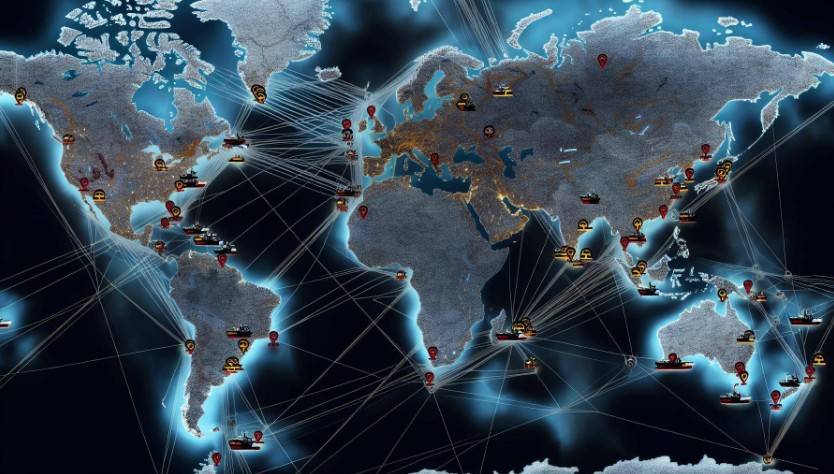
CESMAR Daily Global Maritime Geopolitical Forecast – August 24 2026 –
CESMAR Daily Global Maritime Geopolitical Forecast
– August 24 2026 –
Summary prepared by the Centre for Geopolitics and Maritime Strategy Studies, compiled on the basis of analyses from third-party sources. While the content does not reflect the Centre’s own positions but is instead drawn from the work of other authors and publications, as indicated in the references, the structuring and interpretation of the data are the result of the Centre’s own synthesis process, aimed at creating a coherent and organic analytical framework. The summary therefore represents a structured reorganisation of the collected and selected information, based on the expertise of our scholars, who have subsequently extrapolated its implications in the geopolitical, strategic, technological, and maritime fields, as well as those related to Mediterranean countries. Reproduction, in whole or in part, is authorised provided that the source is acknowledged.
Geopolitical Scenarios of August 24, 2026
Daily Summary of Global Maritime Geopolitics
Introduction
The period between 21 and 23 August 2026 witnessed the convergence of three major vectors of systemic tension: the progressive crisis of political legitimacy in Ukraine, the paralysis of global energy routes at Hormuz, and the re-articulation of naval alliances across the Indo-Pacific and the Wider Mediterranean. The ramifications project across the entire international order.
Key Events
Geopolitics/International Relations — Turkey requests an Interpol Red Notice for Netanyahu. The unprecedented escalation of the diplomatic confrontation between Ankara and Tel Aviv reached an institutional breaking point between 21 and 23 August 2026. As reported by notiziegeopolitiche.net and reuters.com, the Turkish government has formally initiated procedures requesting Interpol to issue a Red Notice for Israeli Prime Minister Benjamin Netanyahu, relating both to military operations in Gaza and the naval assault on the pro-Palestinian flotilla. The initiative—unprecedented in Middle Eastern diplomacy for a NATO member—reflects Erdoğan’s ambition to assume political leadership of the Islamic front against Israel, intertwining the Syrian and Palestinian crises. The repercussions for the security architecture of the Eastern Mediterranean are of primary significance, particularly in light of operational ties between Turkey, NATO, and the Alliance’s naval command structures.
Strategy/Warfare — Russia: Missile Strike on a Ukrainian Shopping Centre. Between 22 and 23 August, Russian armed forces conducted a heavy missile strike on a crowded shopping centre within Ukrainian territory, resulting in—according to notiziegeopolitiche.net—at least sixteen fatalities and over one hundred and thirty injured. The attack forms part of an escalation in wartime tension between the two belligerents, demonstrating a progressive strategic shift towards targeting high-density civilian infrastructure aimed at breaking public morale and overburdening Ukrainian healthcare systems. The international response was immediate: a trilateral summit between France, the United Kingdom, and Germany, reported by reuters.com, discussed new air defence packages. Concurrently, France confirmed the dispatch of long-range missiles, whilst Putin—according to reuters.com—stated that Kyiv had “opened Pandora’s box” by striking Russian economic targets, foreshadowing systematic retaliatory strikes against critical Ukrainian infrastructure during the autumn-winter season.
Seapower/Maritime Domain — Strait of Hormuz: Two Mariners Killed, Oil Traffic Paralysed. The most concerning scenario within the maritime domain pertains to the Strait of Hormuz. On 21 August, news.usni.org confirmed the deaths of two merchant navy mariners during transit through the narrow choke point, whilst gcaptain.com reported that AIS tracking data indicates a drastic drop in supertanker transits, contradicting optimistic statements from the Trump Administration. The strategic impasse between Washington, Tehran, and Muscat—analysed in depth by shipmag.it—has paralysed freedom of navigation as enshrined in international law, with the IRGC demanding transit fees of up to 7% of cargo value. The departure of the aircraft carrier USS Abraham Lincoln following a seven-month deployment in the area, reported by news.usni.org, accentuates the deterrence vacuum, whilst discussions among NATO members regarding operational options outside the Alliance’s formal umbrella—according to reuters.com—attest to the systemic gravity of the crisis.
Geopolitical Agorà
During the period under review, the Ukrainian dossier presents a multidimensional complexity encompassing political legitimacy, military sustainability, and Western cohesion. According to reuters.com and notiziegeopolitiche.net, President Zelenskyy has reiterated his categorical refusal to hold presidential elections under martial law, asserting that such an option would “destroy Ukraine”. The Kremlin systematically exploits this constitutional deadlock to deny the legal legitimacy of its Ukrainian counterpart in negotiations, whilst ilsussidiario.net highlights systemic corruption that the European Union tends to overlook in the name of wartime imperatives.
On the military-industrial front, formiche.net reports Kyiv’s indigenous progress with satellite-guided glide bombs, as well as the strike delivered against two Russian frigates in the Black Sea, as reported by nationalinterest.org. Concurrently, insideover.com highlights the emerging Germany-Japan axis on the joint development of military AI and drones, partially stimulated by lessons drawn from the Ukrainian conflict.
Tensions with Poland, analysed by responsiblestatecraft.org, remain a deep fissure: the historical controversy surrounding Stepan Bandera and the UPA led Warsaw to revoke an honour awarded to Zelenskyy, whilst Polish nationalist parties use the issue to redirect military resources towards national defence. The visit of British Mayor Burnham to Kyiv—according to reuters.com—to support long-range missile production, alongside the detention in Croatia of a Ukrainian suspect linked to the Nord Stream attack—confirmed by reuters.com and denied by Zelenskyy, who stated that “Ukraine has never officially taken part in any sabotage operation against the Nord Stream 2 pipeline (Reuters)”—adds further complexity to the alliance-accountability framework. It remains striking that Zelenskyy himself had to confirm that Ukrainian authorities are fully cooperating with investigators working to clarify the dynamics of the attack and identify its actual perpetrators. The official stance appears aimed at rebuffing any allegations that could erode political and military support from European nations, yet leaves open the complexities and controversies of an event that still retains many dark corners. The industrial and financial toll of the Ukrainian conflict, analysed by insideover.com, reveals increasingly depleted NATO arsenals and growing fatigue among Western publics.
Consequences of the Events
Geopolitical Consequences
The period under review significantly accelerates the realignment of multipolar balances on a global scale. The Turkish request for an Interpol Red Notice (an international request to locate and provisionally arrest a suspect) for Netanyahu signals Ankara’s intent to position itself as an autonomous Islamic power, openly challenging NATO’s internal cohesion on regional dossiers. As highlighted by notiziegeopolitiche.net and reuters.com, Turkey weaves the Palestinian question together with its own strategic ambitions in Syria, where Israeli strikes continue to draw condemnation from Damascus.
On the Euro-Atlantic front, the summit between France, Great Britain, and Germany—reported by reuters.com—demonstrates a push for European leadership attempting to compensate for American uncertainty. However, the trade rift between the US and Canada, involving punitive tariffs of 50% according to notiziegeopolitiche.net, demonstrates that the unilateral vision of the Trump Administration is eroding even historic alliances on the North American continent.
In Eurasia, the Azerbaijan-Uzbekistan summit described by notiziegeopolitiche.net consolidates the bloc of Turkic-speaking states along the Middle Corridor, whilst Iran—according to the same source—strengthens alternative trade networks to de-dollarisation via Russia and Central Asia. The growing Chinese penetration into the Central Asian arms market, analysed by nationalinterest.org, indicates that Beijing is projecting itself as a security guarantor in the region, eroding decades of Russian hegemony. The realignment is structural, not conjectural.
Strategic Consequences
In the military and doctrinal domains, the weeks under review reveal three converging trends. Firstly, the war in Ukraine continues to rewrite operational doctrine: formiche.net documents Kyiv’s technological autonomy with indigenous glide bombs, whilst nationalinterest.org reports the sinking of a further two Russian frigates in the Black Sea using uncrewed surface vessels (USVs) and guided missiles, confirming the effectiveness of asymmetric tactics. Secondly, the US Navy faces structural attrition documented by navytimes.com: prolonged deployment periods in the Persian Gulf during the Iranian crisis have degraded operational readiness and crew morale, narrowing rapid-response margins in other theatres. Meanwhile, as reported by nationalinterest.org, the US Army is reintroducing traditional, drone-free tactical training to operate within heavily degraded electromagnetic environments.
Thirdly, the proliferation of uncrewed naval capabilities—such as the Turkish Marlin USV capable of mine-laying, described by navalnews.com—attests to the rapid diffusion of uncrewed technologies among middle powers, reshaping the entire architecture of littoral warfare. Finally, the intensification of NATO surveillance over Kaliningrad using EA-37B aircraft and ARTEMIS II systems, reported by notiziegeopolitiche.net, signals that electronic warfare has become the primary competitive domain along the Alliance’s eastern flank.
Economic, Technological, Financial, and Energy Consequences
The economic disruptions generated during the period under review concentrate along three axes. The first is energy: the crisis at Hormuz—analysed by shipmag.it and gcaptain.com—has produced a contraction in tanker transits verified by AIS data, refuting official statements from Washington. The ramifications ripple across insurance premiums, crude prices, and the operational margins of global shipping lines. The second axis is defence-industrial: the so-called “new China shock” analysed by rusi.org portends a massive penetration of Chinese defence manufacturing—naval, electronic, missile systems—into armaments markets at competitive prices, creating risks of technological dependence for NATO. The third axis is financial-commercial: the US-Canada tariff war—featuring 50% duties according to notiziegeopolitiche.net—destabilises the integrated North American supply chain, generating inflationary pressure and equity market volatility.Technologically, the Germany-Japan axis on AI, robotics, and cybersecurity—reported by insideover.com—indicates the formation of a new industrial cluster for next-generation defence. Furthermore, nationalinterest.org highlights the urgency of “Q-Day”, the threshold at which quantum computers could breach current cryptographic standards, necessitating an accelerated transition towards post-quantum cryptography for Western military and financial infrastructure.
Maritime Consequences
The global maritime domain for the period 21-23 August 2026 is dominated by three critical choke points: Hormuz, the Black Sea, and the Baltic Sea. At Hormuz, the situation is most severe: shipmag.it documents the paralysis of freedom of navigation between Iranian toll demands, Omani mediation, and American ambiguity, whilst gcaptain.com verifies the drop in oil transits and news.usni.org confirms the loss of two mariners. The departure of USS Abraham Lincoln further diminishes US naval deterrence in the area.
In the Black Sea, nationalinterest.org reports damage to two additional Russian frigates caused by Ukrainian USVs, forcing the Russian Black Sea Fleet to withdraw further from Sevastopol to Novorossiysk. According to reuters.com, Putin rejected the commercial truce proposal put forward by Zelenskyy, retaining the naval blockade as leverage for food blackmail. In the Baltic Sea, the resumption of Nord Stream investigations—marked by the arrest in Croatia of a Ukrainian suspect according to reuters.com—reopens friction over European subsea energy infrastructure. Somali piracy is regaining momentum in the Horn of Africa, as noted by nationalinterest.org, taking advantage of the redeployment of Western naval assets towards the Persian Gulf. The proliferation of the dark fleet, analysed by iari.site, elevates environmental and seizure risks across unmonitored waters.
Consequences for the Southern European Mediterranean countries
For Italy, Greece, and Spain, the period between 21 and 23 August 2026 generates direct implications across four levels. On the energy level, the Hormuz crisis and the Russian blockade in the Black Sea exacerbate upward pressure on oil and gas prices, with direct consequences for domestic energy tariffs. Italy, historically dependent on gas imports via southern routes and North African corridors, remains the most exposed among the three nations.
On the maritime security level, the resurgence of Somali piracy and the migration crisis in the Channel of Sicily—with the bodies of eight migrants recovered off Tunisia according to reuters.com—confirm continuous pressure on Central Mediterranean routes. The Italian Coast Guard and EU Mediterranean missions face additional operational strain. On the industrial level, insideover.com’s article on Italian defence technological sovereignty highlights that national rearmament is proceeding without adequate control over strategic know-how, with patents and source codes for weapons systems remaining under foreign control, thereby constraining the genuine operational autonomy of the Italian Armed Forces.
On the diplomatic level, the Turkey-Israel dispute and Israeli strikes in Syria—reported by reuters.com—further destabilise the Eastern Mediterranean, an area of vital national interest for the foreign policies of Rome, Athens, and Madrid, as all three seek to maintain open channels of dialogue with all parties.
Conclusions
The geopolitical landscape of 21-23 August 2026 reveals an international system undergoing accelerated fragmentation, with three dossiers facing imminent development. The first is Hormuz: declining oil transits and the deaths of merchant mariners indicate that the crisis could deteriorate into a prolonged disruption within weeks, exerting destabilising effects on global energy markets. The second is Ukraine: the autumn season will almost certainly bring renewed strikes against Ukrainian energy infrastructure, whilst the debate over Zelenskyy’s legitimacy and friction with Poland could erode allied cohesion. The third is the China-Indo-Pacific technological-military axis: the “new China shock” in defence and the Germany-Japan partnership outline the perimeter of strategic competition for years to come. European institutions and defense analysts are strongly advised to prioritise monitoring the resilience of naval coalitions at Hormuz and the Ukrainian peace process over the next 72 hours.
References
This summary has been prepared based on articles from various geopolitical and strategic analysis sources, including: Elisme, Center for Maritime Strategy, CIMSEC, Reuters, ShipMag, Navy Lookout, National Interest, Seapower Magazine, CSIS, RUSI, War on the Rocks, IISS, Responsible Statecraft, Foreign Affairs, Formiche.net, Il Sussidiario, Start Magazine, InsideOver, Notizie Geopolitiche, IARI, Dissipatio, Analisi Difesa, Jamestown Foundation, Atlantic Council, RAND Corporation.
For further insights, please visit the CESMAR websites or social media channels: