

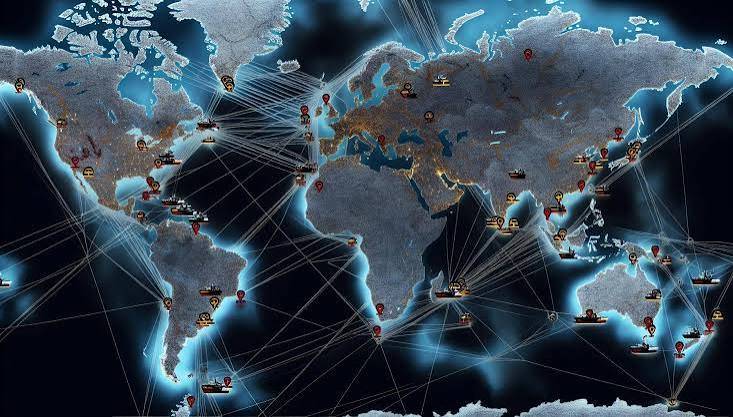
CESMAR Daily Global Maritime Geopolitical Forecast – July 31 2026 –
CESMAR Daily Global Maritime Geopolitical Forecast
– July 31 2026 –
Summary prepared by the Centre for Geopolitics and Maritime Strategy Studies, compiled on the basis of analyses from third-party sources. While the content does not reflect the Centre’s own positions but is instead drawn from the work of other authors and publications, as indicated in the references, the structuring and interpretation of the data are the result of the Centre’s own synthesis process, aimed at creating a coherent and organic analytical framework. The summary therefore represents a structured reorganisation of the collected and selected information, based on the expertise of our scholars, who have subsequently extrapolated its implications in the geopolitical, strategic, technological, and maritime fields, as well as those related to Mediterranean countries. Reproduction, in whole or in part, is authorised provided that the source is acknowledged.
Geopolitical Scenarios of July 31, 2026
Daily Summary of Global Maritime Geopolitics
Introduction
The events of 30 July 2026 present a landscape dominated by three converging vectors: the broadening of the US–Iran confrontation in the Persian Gulf, the doctrinal hardening of information warfare within the US Navy, and migratory pressure on Europe’s southern flank. Sources from CESMAR, ISPI, and gCaptain confirm the growing interconnectedness among energy, maritime, and political security across the wider Mediterranean.
Key Events
Geopolitics. The Spanish enclave of Ceuta has been struck by unprecedented migratory pressure, with approximately 1,500 arrivals in a single week prompting local authorities to request a state of emergency from the Madrid government (ilsussidiario.net). The Italian government is closely monitoring the evolution of the crisis, mindful of the systemic dimension of a phenomenon impacting the entirety of Europe’s southern border (notiziegeopolitiche.net). The episode reignites the debate over agreements with Morocco and the inadequacy of EU-wide redistribution mechanisms, forcing Brussels into an urgent reflection on burden-sharing among frontline states.
Strategy/Warfare. The United States has intensified its offensive against Iran with a new wave of overnight air strikes targeting dozens of strategic objectives, striking command centres, missile depots, and Islamic Revolutionary Guard Corps infrastructure (notiziegeopolitiche.net; formiche.net). The operation, framed as retaliation for attacks on American bases and commercial shipping, marks an escalation in scale and raises the prospect of Iranian reprisals against Western assets in the Gulf. This bears direct consequences for regional energy security and the viability of remaining diplomatic channels between Washington and Tehran (ilsussidiario.net; insideover.com). On 30 July 2026, the Ukrainian front was likewise engulfed by a massive Russian drone and missile assault. Russian armed forces launched a very large-scale offensive that resulted in at least 8 civilian fatalities and dozens of injured across the country, alongside triggering a severe diplomatic incident with Poland due to a missile entering NATO airspace.
Maritime Domain. The London insurance market has expanded the High Risk Area in the Red Sea following persistent Houthi attacks, levying additional premiums and driving an increasing number of shipowners to reroute around the Cape of Good Hope (gcaptain.com). Concurrently, Qatar has resumed LNG shipments through the Strait of Hormuz following a three-week precautionary hiatus—an ambiguous signal of partial normalization within a landscape nonetheless marked by a drone attack near the Suez Canal, demonstrating that asymmetric threats now extend beyond traditional Red Sea boundaries (gcaptain.com).
Geopolitical Agorà
The CESMAR Commentary of 30 July analyses the redesignation of the US Navy’s Information Professional community as Communications Systems Warfare Officers (CSWO), a doctrinal shift that elevates digital connectivity to the status of a primary weapon system, equivalent to kinetic platforms (cesmar.it). The Research Centre links this transformation to the concept of Assured Command and Control (AC2) and highlights its relevance for Italy, home to critical strategic nodes, recommending a similar recruitment and training pathway for the Italian Navy (Marina Militare). The National Interest confirms this same process from an American perspective, describing the transition of IT specialists into operational warfare officers as a reflection of the centrality of the digital domain in modern conflict (nationalinterest.org). On a strictly political-institutional level, OHI Magazine’s Global Flashpoint devotes considerable space to General Stanley McChrystal’s reflections on the politicisation of the US Armed Forces, warning that the erosion of an apolitical military ethos and the widening rift between the military and civil society constitute a structural vulnerability that manifests fully only during acute crises (ohimag.com). Read in sequence, these three contributions form a coherent strategic forum: on one side, the technical-doctrinal strengthening of the American posture in the cyber domain; on the other, a warning regarding institutional resilience that must accompany such transformation—matters of direct interest for the Italian Navy’s alignment with Allied standards. The convergence among these three analysis suggests that, within Western think-tank debate, technological innovation cannot be divorced from reflections on the institutional culture tasked with governing it.
Consequences of the Events
Geopolitical Consequences
In terms of power dynamics, the day confirms the expansion of the US–Iran front across multiple simultaneous theatres, stretching from the Persian Gulf to the Red Sea, in line with ISPI analysis describing systemic instability capable of embroiling the broader Middle East (ispionline.it). China is reinforcing its power projection by supplying surface-to-air missile systems to Iran, confirming the consolidation of the Tehran–Beijing axis (notiziegeopolitiche.net), while suspected Russian involvement in attacks against CIA bases in the Gulf would mark a qualitative shift in Great Power competition, extending intelligence warfare into Middle Eastern theatres (notiziegeopolitiche.net). In Europe, the Ceuta migration crisis places the management of the southern frontier back at the top of the EU agenda, whilst the violation of Polish airspace during Russian raids on Ukraine renews pressure on the air defence of NATO’s eastern flank (formiche.net; notiziegeopolitiche.net). On the intra-Alliance front, Germany’s political fragility surrounding Chancellor Merz and the rise of the AfD in the eastern Länder introduce elements of instability into European leadership precisely as continental rearmament is being debated (gzeromedia.com; csis.org). Collectively, these developments reinforce the trend towards a fragmented multipolar order, wherein competition between Washington, Beijing, and Moscow blends with regional crises that are not fully controllable, compelling European capitals to make increasingly stark alignment choices. Furthermore, the Brazilian elections—described by ISPI as a bellwether for a deeply polarized country—and Venezuela’s search for stability confirm that Latin American dynamics remain intertwined with global geopolitical balances (ispionline.it).
Strategic Consequences
Following a brief truce lasting only a few days, during the night between Wednesday 29 and Thursday 30 July 2026, US Central Command ordered the resumption of strikes on Iran. From a military standpoint, the American offensive against Iran marks another transition from low-intensity confrontation to a systematic air campaign, bearing direct effects on the deterrence posture in the Gulf and carrying the risk of miscalculations capable of triggering an uncontrolled escalation (formiche.net; ispionline.it). The CSWO redesignation within the US Navy institutionalises information warfare as a primary operational domain, obliging Allied navies—including Italy’s—to review their interoperability and cyber training standards (cesmar.it). On the industrial front, the mega-contract worth $76.6 billion for Virginia- and Columbia-class submarines confirms the centrality of undersea deterrence in US strategy, whilst the retirement of legacy SSGNs opens a transitional phase of reduced long-range conventional strike capability (navalnews.com; nationalinterest.org). In Europe, Project Freyja aims to reduce dependency on American Patriot systems, and the United Kingdom has confirmed funding for the Dreadnought-class submarines to guarantee its Trident deterrence, even as a declining willingness among British citizens to defend their country introduces friction between industrial capability and societal cohesion (geopolitica.info; navylookout.com; analisidifesa.it). Finally, the launch of the second new-generation minehunter by Intermarine enhances Italian capabilities in seabed warfare and the protection of critical subsea infrastructure—an increasingly central element in contemporary maritime doctrine (analisidifesa.it). The modernization of German F123 frigates entrusted to Rheinmetall also fits into this collective effort to adapt European fleets to the hybrid and conventional threats of the new strategic environment (navalnews.com).
Economic, Technological, Financial, and Energy Consequences
On the economic and financial level, Leonardo closed the first half of 2026 with strong growth in profits and order intake, driven by demand for advanced defence systems and cybersecurity, whilst Fincantieri posted record results thanks to US Navy orders (analisidifesa.it; gcaptain.com). The allocation of SAFE funds remains the subject of intense debate between Brussels and Rome, with the latter forced to reconcile effective resource absorption with its own budgetary priorities ahead of the 2027 elections (analisidifesa.it; insideover.com). On the energy front, the resumption of Qatari LNG shipments through Hormuz offers a signal of partial normalization, but remains contingent upon sustained security in the strait, through which approximately one-fifth of global LNG transits (gcaptain.com). Meanwhile, Iraq is relaunching new energy corridors towards the Mediterranean to reduce reliance on the Persian Gulf, while Libya remains paralyzed by chronic blackouts that impede US plans for regional stabilization (notiziegeopolitiche.net; ilsussidiario.net). Container spot freight rates fell for the third consecutive week, signaling a softening in global demand, although overall costs remain above pre-crisis levels due to the longer sea routes around Africa (gcaptain.com). Finally, the Middle Corridor (formally known as the Trans-Caspian International Transport Route (TITR)—a multimodal trade and transport route connecting East Asia, primarily China, to Europe while completely bypassing Russia) is consolidating its role as an Eurasian infrastructural alternative, benefiting from the instability affecting traditional routes (ispionline.it). Meanwhile, the Asia-Pacific region remains the gravity centre of global trade, requiring Western diplomacy to employ flexible economic strategies capable of balancing commercial interdependence with Beijing against security partnerships with Washington (ispionline.it).
Maritime Consequences
The maritime picture of 30 July confirms the centrality of Middle Eastern choke points. Extreme risk persists in the Strait of Hormuz, fueled by intense electronic warfare involving GNSS/GPS spoofing and jamming, as well as a proportion of commercial traffic operating in “Dark AIS” mode exceeding seventy per cent, as confirmed by OSINT updates from the Italy Chapter of CIMSEC (cimsecitalia.jimdosite.com). In the Red Sea, the expansion of the High Risk Area by London underwriters and the persistent asymmetric threat from the Houthis—described by gCaptain experts as underestimated in its ideological resolve—continue to force the rerouting of shipping around the Cape of Good Hope (gcaptain.com). Saudi Arabia has proposed a multinational maritime coalition for Red Sea and Bab el-Mandeb security, whilst a drone attack near the Suez Canal extends the asymmetric threat into the Eastern Mediterranean (gcaptain.com – news item already noted in yesterday’s summary). In the Mediterranean, NATO and national forces maintain intensive multi-domain surveillance to protect fiber-optic cables and energy trunklines (cimsecitalia.jimdosite.com). Finally, the historic firing of a Tomahawk from a Japanese destroyer and the delivery of OQQ-25 sonars to Australian Mogami-class frigates confirm the global expansion of naval competition into the Indo-Pacific, where Tokyo scrambled fighter jets following an alarm in the East China Sea (news.usni.org; navalnews.com; notiziegeopolitiche.net).
CIMSEC Italy Bulletin summary
The CIMSEC bulletin of 30 July 2026 confirms extreme risk to maritime security, with particular attention focused on tensions in the Upper Persian Gulf and the Strait of Hormuz. In the Red Sea, Operation ASPIDES—comprising two Italian Navy units, one Greek, and one French—guards a high-threat corridor, while the situation in the Mediterranean and Gulf of Guinea remains stable under active surveillance. It should also be noted that two Italian Navy minehunters, designated for mine clearance operations in the Strait of Hormuz and the Persian Gulf, are currently pre-positioned in the port of Djibouti. European merchant shipping is advised to restrict transit through Iranian waters and maintain active countermeasures against widespread GNSS spoofing. For further details, consult the official CIMSEC report.
Consequences for the Southern European Mediterranean countries
For Italy, Greece, and Spain, 30 July outlines a cluster of direct implications. The Ceuta crisis places Spain on the front line of managing migratory flows from Morocco, while the government in Rome closely tracks the situation, fearing a potential spillover effect onto Central Mediterranean routes (ilsussidiario.net; notiziegeopolitiche.net). On the energy and diplomatic fronts, Greece remains tied to the Cypriot dossier, where the relaunch of UN negotiations for the island’s reunification clashes with interests in Exclusive Economic Zone gas fields and Turkish opposition to any unilateral initiative (notiziegeopolitiche.net). Italy, for its part, has turned the risk of isolation at the NATO summit into a diplomatic opportunity, steering the debate towards southern flank security and the stability of the wider Mediterranean—areas where Rome can leverage its operational commitments (geopolitica.info). The Meloni government is activating the SAFE mechanism pragmatically, aiming to enhance its bargaining power in European forums rather than embarking on massive rearmament ahead of the 2027 elections (insideover.com). The presence of US bases in Naples and Sigonella, highlighted in the CESMAR Commentary on CSWOs, underscores Italy’s status as an indispensable node in the Allied communication architecture in the Mediterranean, with direct implications for industrial cooperation (cesmar.it). Italian naval transfers to partner nations round out the picture of an increasingly structured, multilateral maritime security policy (geopolitica.info). For Greece and Spain, both exposed on distinct migratory and energy fronts, the day confirms that Southern Mediterranean security remains a shared interest requiring tighter coordination among Rome, Athens, and Madrid across EU and NATO frameworks.
Conclusions
The landscape of 30 July highlights three trajectories to monitor in the coming days. The US–Iran confrontation presents the most immediate signs of potential escalation, carrying a tangible risk of direct Iranian reprisals against Western assets in the Gulf and consequential impacts on global energy prices. The Ceuta migration crisis, if not managed swiftly at the European level, threatens to become another test of Union cohesion regarding external border controls. Finally, the doctrinal evolution of information warfare within the US Navy through the creation of CSWOs requires timely reflection by Italy on recruitment, training, and cyber interoperability, under pain of a gradual decoupling from Allied standards. In the short term, CESMAR’s focus will remain on the evolution of Operation ASPIDES in the Red Sea and the resilience of energy corridors through the Strait of Hormuz—both critical indicators of global maritime stability. The political situation surrounding the AfD in Germany also warrants close monitoring, as regional gains for the party could undermine European cohesion at the most delicate phase of continental rearmament.
References
This summary has been prepared based on articles from various geopolitical and strategic analysis sources, including: Elisme, Center for Maritime Strategy, CIMSEC, Reuters, ShipMag, Navy Lookout, National Interest, Seapower Magazine, CSIS, RUSI, War on the Rocks, IISS, Responsible Statecraft, Foreign Affairs, Formiche.net, Il Sussidiario, Start Magazine, InsideOver, Notizie Geopolitiche, IARI, Dissipatio, Analisi Difesa, Jamestown Foundation, Atlantic Council, RAND Corporation.
For further insights, please visit the CESMAR websites or social media channels: