

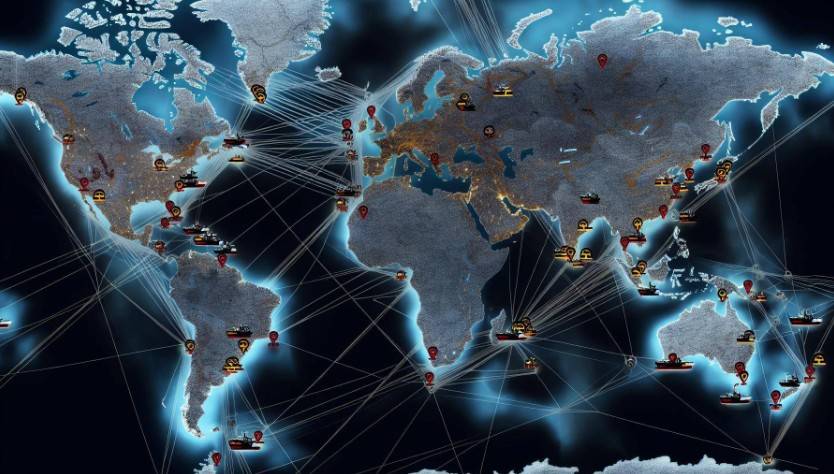
OHiMAG Daily Global Maritime Geopolitical Forecast
OHiMAG Daily Global Maritime Geopolitical Forecast
– July 3 2026 –
Summary prepared by the Centre for Geopolitics and Maritime Strategy Studies based on third-party analyses – the contents do not reflect the Centre’s own positions but are inspired by the work of other authors and publications, as indicated in the references.
Daily Summary of Global Maritime Geopolitics
Introduction
The events of July 2, 2026, confirm the persistent instability of the multipolar international system, which is currently experiencing converging tensions across multiple theaters. From the Ukrainian front to the delicate balance of the Strait of Hormuz, and from the Eastern Mediterranean to the NATO Summit in Ankara, the analyzed events bear witness to the growing intertwining of the military, economic, and maritime dimensions. This synthesis, prepared by CESMAR on the basis of qualified open sources, offers a comprehensive overview useful for strategic analysis and national decision-making planning.
Key Events
Ukraine — Missile Escalation and Political Outlook
A new, massive Russian missile strike hit Kyiv overnight, deploying over seventy vectors including cruise and ballistic missiles, as well as drones, against civilian and energy infrastructure, leaving at least seventeen dead and eighty-six injured. President Putin reiterated that Moscow demands the recognition of the four annexed Ukrainian regions as a condition for a peace agreement, ruling out any territorial compromises. The situation confirms Russia’s strategy of attrition, while in Kyiv the first reflections on a future electoral transition are emerging, with Valeriy Zaluzhny among the most credited names.
Strait of Hormuz — Continuity of Flows and Iranian Leverage
U.S. intelligence estimates confirm a stable flow of approximately ten million barrels per day transiting the Strait of Hormuz, thanks to international escort missions, thereby downsizing Tehran’s geopolitical leverage over energy markets. In parallel, political scientist Daniel Pipes defined Western diplomatic agreements with Iran as “catastrophic,” deeming them incapable of curbing the Islamic Republic’s nuclear and regional ambitions. The stability of the world’s primary oil transit passage remains at risk due to the tension between the necessity of ensuring crude oil transit and Iran’s ongoing aggressive policy.
Eastern Mediterranean — Syria, the Golan, and “Greater Israel”
The expansion of Israeli settlements beyond the Golan Heights, combined with repeated air and ground operations against pro-Iranian militias and Hezbollah on Syrian territory, is transforming southern Syria into a new front of open confrontation. The vision of a “Greater Israel” intertwines with strategic security requirements, fueling the risk of a regional escalation. On the institutional level, the proclamation of a transitional Parliament in Damascus, which excludes the Kurdish component of the SDF, further weakens the prospects for national reconciliation and the stability of the Levant.
NATO — The Ankara Summit and the Solbiate Olona Conference
The NATO Summit in Ankara placed the concepts of burden sharing and burden shifting at the center of the debate, with Washington pressing for an increase in European defense spending beyond the two percent of GDP threshold and for greater operational autonomy on the continental flank, within a framework marked by distinct budgetary divisions. Concurrently, the commander component conference of the new Allied Reaction Force, hosted in Solbiate Olona at the NRDC-ITA headquarters, defined the operational readiness procedures of the allied rapid reaction force, confirming Italy’s role in multi-domain deterrence.
Venezuela — Natural Crisis and Political Stalemate
Venezuela faces a dual crisis, both natural and political. Climate calamities that aggravate already dramatic socioeconomic conditions are compounded by persistent institutional instability linked to the regime’s management of power, featuring widespread protests and allegations of dissent repression. Formiche.net observes that the emergency response cannot be separated from a structural political turning point, while ISPI highlights international polarization: Western powers demand transparency, whereas Russia and China confirm their support for Caracas, perpetuating a stalemate that worsens the regional humanitarian crisis.
Maritime Dossier — The Ukrainian Blockade of Crimea
The systematic employment of medium-range maritime drones and Western long-range missiles is progressively strangling the “land bridge” and the supply lines of occupied Crimea, forcing the Russian Black Sea Flotta to partially retreat from its historical bases. According to the Atlantic Council, the impact is not merely military but deeply political and psychological, as the peninsula represents the core symbol of the Kremlin’s imperial rhetoric, whose prolonged vulnerability exposes the structural limits of Russian naval projection in the basin.
Maritime Dossier — “Nodal Control” in Hormuz
CIMSEC’s analysis confirms that in the contemporary scenario, the “nodal control” of chokepoints is supplanting traditional control of open ocean spaces: actors equipped with low-cost anti-ship missiles and drones can exercise geoeconomic veto power by blocking single strategic passages like Hormuz. In response, the conversion of merchant shipping into unmanned surface platforms is proposed, capable of ensuring the continuity of energy flows while reducing human exposure and Iranian blackmail leverage, thereby freeing Western Navies to directly counter the sources of the threat.
Rapprochement between Rome and Paris
The Antibes Summit marks a change of course: Italy and France have forged a pragmatic bilateral agreement to fill the strategic vacuums of the European Union, responding to changing U.S. priorities and the crisis of the French-German axis. This new bond, born in a phase of profound geopolitical reconfiguration, does not break existing treaties but acts as a complementary engine for security and integration, redefining the hierarchies of influence within the new UE.
Consequences of the Events
Geopolitical Consequences
On the general geopolitical level, the day highlights a recomposition of power alignments both within the European Union and in the global multilateral system. Geopolitica.info’s analysis of the Italian-French rapprochement following the Antibes Summit signals the emergence of a possible alternative proactive core to the traditional French-German axis, a symptom of an EU searching for new internal balances in a context of growing transatlantic uncertainty. This news proves decisive since the Anglo-German axis, characterized by an aggressive and threatening posture toward Russia, generates deep regional instability. This scenario, while serving traditional British strategies, penalizes the interests of European nations, for whom coexistence with Russia remains a geographical and political necessity.
This uncertainty is confirmed by the U.S. decision not to automatically extend the USMCA agreement and by Chatham House’s reading of the structural transformation of American domestic politics toward a transactional and potentially isolationist orientation, which forces Europe to accelerate toward strategic autonomy. Concurrently, Responsible Statecraft warns of the geopolitical costs of the “America First” doctrine: disengagement from key theaters creates power vacuums promptly filled by China, Russia, and Iran, as demonstrated by the case of the Solomon Islands, where Honiara’s deepening ties with Beijing alarm Canberra and Washington. On the democratic front, the Algerian elections mark a mass abstention as a form of passive delegitimization of power, while in Peru the consolidation of reactionary coalitions witnesses a paradigm shift. Finally, the Sudanese humanitarian crisis, with documented ethnic cleansing in Darfur, remains exemplary of the inertia of multilateral diplomacy and the inability of the UN Security Council to enforce truly effective arms embargoes.
Strategic Consequences
On the strategic-military level, the Solbiate Olona conference confirms the urgency for NATO to translate the new concept of multi-domain rapid reaction into concrete operational procedures. However, this occurs within a context marked—as The National Interest notes in its analysis of “NATO 3.0″—by a severe structural shortage of military personnel that current European demographics struggle to meet, forcing a reflection on forms of selective conscription and the strengthening of reserves. The United Kingdom responds to these challenges with an investment plan that focuses on drones, GCAP/F-35 fighters, and a transition toward a “Hybrid Navy,” where traditional surface units will be flanked by swarms of autonomous systems.
On the U.S. front, the establishment at the Pentagon of a Direct Reporting Portfolio Manager for Unmanned Systems accelerates the integration of unmanned systems across all domains in an attempt to maintain a technological edge over China and Russia. The latter, according to ASPI, has developed an effective military logistics system based on artificial intelligence that generates efficiency in peacetime but conceals structural vulnerabilities in the event of high-intensity conflict due to an excessive reliance on centralized digital networks. Finally, The National Interest warns that the network of Iranian proxies—Hezbollah, Houthi, Shia militias—will survive any eventual conclusion of direct hostilities with Tehran, imposing on the West a prospect of prolonged asymmetric confrontation, while the conflict has accelerated the development of the Central Asian Middle Corridor as a geoeconomic alternative to Russian and Iranian routes.
Economic, Technological, Financial, and Energy Consequences
The economic-financial and technological framework of the day confirms the centrality of the industrial dimension of defense and energy in geopolitical balances. The UAMA Report certifies that Italian armaments exports exceeded nine billion euros in 2025, marking a growth driven by global demand for defensive systems and the consolidation of domestic industry. On the technological front, Spain’s decision to block new contracts with Palantir broadens the European front of distrust toward U.S. tech giants, rooted in concerns over digital sovereignty and algorithmic dependence in sensitive sectors. Italy, instead, consolidates its space leadership with the launch of the operational phase of the IRIDE constellation, funded by the PNRR.
On the energy plane, the incident at the Qatari Barzan plant exposes the vulnerability of the LNG infrastructure upon which European energy security depends, while Russia is forced to import gasoline from India to compensate for damages suffered by its refineries, in a paradox of oil triangulation that evades Western sanctions. In parallel, the EU is intensifying controls on the Russian “shadow fleet” operating under a false Cameroonian flag. Moreover, Brussels has opened negotiations with Beijing to rebalance the bilateral trade imbalance, while RUSI proposes to align the sanctions regime with industrial banking codes to more effectively intercept dual-use triangulations. Last but not least, Trump’s asset disclosure showing over 500 million dollars in cryptocurrencies fuels the U.S. debate on digital regulation.
Maritime Consequences
The maritime dimension remains the privileged terrain of contemporary multipolar competition. The Institut FMES reports how the security crisis in the Red Sea has transformed the Mozambique Channel into an indispensable strategic crossroads for European traffic circumnavigating Africa, while the North Atlantic returns to the center of Western reflections due to the vulnerability of undersea infrastructure and transatlantic communication lines. In the South China Sea, AMTI/CSIS documents an unprecedented escalation of the Chinese presence at Scarborough Shoal, with maneuvers assimilable to those evaluable as gray-zone tactics that severely test the mutual defense treaty between Manila and Washington; Taipei responds by ordering its ships to ignore Chinese Coast Guard inspections in the Taiwan Strait, in a high-risk dynamic for an incident.
On the industrial-naval level, the start of local construction of the Scorpène Evolved submarine in Indonesia and the presentation of MBDA’s new LCM Mk2 deep-strike cruise missile confirm the acceleration of global underwater and missile modernization, while Bollinger begins construction of the first U.S. Arctic Security Cutter, narrowing the icebreaker gap with Russia and China in the Arctic. Finally, the Center for Maritime Strategy highlights how the Russian doctrine of “reflexive control” applied to maritime drones aims not only to strike physical targets but to manipulate the cognitive perceptions of NATO commands, imposing a psychological warfare parallel to the kinetic one within the European naval domain.
Consequences for the Southern European Mediterranean countries
For southern Mediterranean Europe, and particularly for Italy, Greece, and Spain, the events of July 2, 2026, confirm the urgency of a unified maritime strategic vision. Il Sussidiario highlights the ambiguity of the European posture toward Turkey, which only partially brakes Ankara’s expansionism: for Rome, however, the relationship with Turkey remains indispensable on the energy, economic, and migratory levels, particularly in managing the Libyan crisis and the maritime routes of the Wider Mediterranean. The consolidation of the Italian-French axis emerging from the Antibes Summit fits into this framework, potentially offering Rome additional negotiating leverage within the Union, balancing the historical French-German centrality.
Formiche.net reiterates the centrality of the sea as a strategic resource for Italy, underlining the need to integrate the Blue Economy, the protection of commercial routes, and the safeguarding of undersea infrastructure—data cables and energy pipelines—into a single national security framework, an urgency reinforced by the NATO conference in Solbiate Olona, which confirms Italy’s role as a hub for allied operational readiness. The launch of the operational phase of IRIDE further strengthens Italian technological sovereignty in coastal monitoring and civil protection. For Spain, the decision to block contracts with Palantir signals growing attention from Madrid toward digital sovereignty, a relevant theme also for managing sensitive data in the port and defense sectors. Greece, though not directly mentioned in today’s review, remains exposed—like Italy—to the energy vulnerability connected to incidents in LNG terminals like the Barzan one in Qatar, upon which replacement supplies of Russian gas toward the Eastern Mediterranean depend. Overall, the three countries share a structural exposure to instability risks in the Wider Mediterranean, which dictates a coordinated strengthening of Southern Europe’s naval, cyber, and infrastructural capabilities.
Conclusions
The review of July 2, 2026, confirms an international system traversed by structural rather than conjunctural tensions, in which the maritime dimension proves to be a decisive strategic variable. The persistence of the Ukrainian conflict, the absence of stable solutions in the Strait of Hormuz and Syria, and uncertainty regarding the future posture of the United States impose upon Europe—and particularly upon Italy—a reinforced commitment in terms of strategic autonomy, naval capabilities, and infrastructural resilience.
The following deserve priority monitoring over the coming days:
- The evolution of the Russian-Ukrainian peace negotiations and the territorial conditions set by Moscow;
- The developments of the Syrian political transition and the risk of an Israeli-Syrian escalation along the Golan;
- The outcome of the NATO Summit in Ankara regarding burden sharing;
- Ukrainian electoral dynamics linked to a possible candidacy of Zaluzhny;
- The evolution of the Qatari energy crisis at Barzan, with potential repercussions on LNG prices destined for Southern Europe.
The Italian-French post-Antibes front and its repercussions on intra-EU balances also merit constant attention in the weeks ahead. CESMAR will continue to monitor these dossiers, providing timely analytical updates to support the national strategic community.
References
This summary has been prepared based on articles from various geopolitical and strategic analysis sources, including: Center for Maritime Strategy, CIMSEC, Reuters, ShipMag, Navy Lookout, National Interest, Seapower Magazine, CSIS, RUSI, War on the Rocks, IISS, Responsible Statecraft, Foreign Affairs, Formiche.net, Il Sussidiario, Start Magazine, InsideOver, Notizie Geopolitiche, IARI, Dissipatio, Analisi Difesa, Jamestown Foundation, Atlantic Council, RAND Corporation.
For further insights, please visit the CESMAR websites or social media channels:
- cesmar.it
- ohimag.com
- https://www.linkedin.com/company/cesmar-geopolitica/
- https://www.instagram.com/cesmar.it/?hl
- https://www.facebook.com/share/19y15mJ5Z3/?mibextid=wwXIfr
The contributions are the direct responsibility of the editorial staff and reflect their views. Total or partial reproduction is authorized provided that the source is cited.
The structuring and interpretation of the data are the result of a synthesis process aimed at creating a coherent and organic analytical framework. The summary does not represent an original analysis, but rather a structured reorganization of the information collected and selected based on the expertise of our scholars, who then extrapolated the consequences in the geopolitical, strategic, maritime, and Italy-related fields