

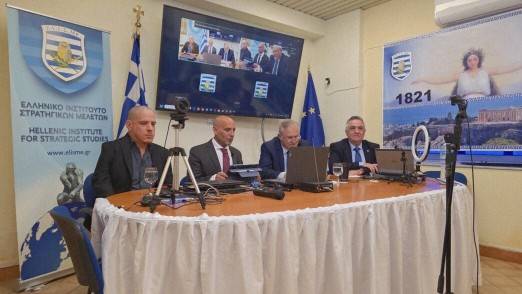
Sovereignty, Control, and Europe’s Mediterranean Test | ELISME, 4/5/26
SHAY GAL . SPEECH IN ELISME 4-5-26
Sovereignty, Control, and Europe’s Mediterranean Test | ELISME, 4/5/26
I. The Turkish Perimeter
Lieutenant General Baltzoi,
Members of ELISME,
Distinguished officers, diplomats, scholars,
Friends,
It is a privilege to speak with you here in Athens, at the Hellenic Institute for Strategic Studies.
Institutes like ELISME matter because serious nations need rooms where strategy is not performed for cameras, but examined before power moves.
Nor do I take this address lightly.
28 October Street.
Some addresses are administrative.
This one is not.
For Greece, 28 October is not only a date.
It is a national reflex.
The memory of a moment when a nation was asked to surrender strategic ground, and answered before history had decided whether that answer was safe.
Ohi was not rhetoric.
It was decision.
That is why Athens matters.
Here, symbols still carry strategic weight.
Greece understands something many in Europe are only beginning to rediscover:
History is not behind us.
It is beneath us.
Under the sea.
Inside borders.
Embedded in islands, bases, corridors, ports, pipelines, airfields and memory.
And when history moves, it does not always announce itself.
Poseidon does not ask permission before he shifts the sea.
He does not warn the arrogant.
He does not respect maps drawn by people who forgot the force beneath them.
He moves.
And when he moves, the sea remembers.
Today, the Eastern Mediterranean is not calm.
It is moving.
Not only through war, occupation or annexation.
Often, it moves through ambiguity.
A legal claim.
A naval deployment.
A temporary system that becomes permanent.
A port agreement.
A maritime memorandum.
A civilian nuclear facility.
A drone runway.
A fighter jet temporarily deployed.
A gas route.
A cable route.
A mediator who becomes a gatekeeper.
One by one, each looks manageable.
Together, they form a perimeter.
That perimeter is not a metaphor.
It is a system.
The error is to read it through separate files:
the Aegean, Cyprus, Libya, Syria, Hamas, Somalia, the Black Sea, the Bosphorus, Akkuyu, F-16, F-35, energy, migration and mediation.
Bureaucracy separates.
Strategy integrates.
And Turkey integrates.
What appears from Brussels as a set of tensions appears from Athens, Nicosia and Jerusalem as one operating system:
the Turkish perimeter.
A perimeter is not a border.
A border separates.
A perimeter surrounds.
A border says: this is mine.
A perimeter says: your movement depends on me.
That is the difference.
The Aegean is not a dispute.
It is a pressure arena.
Cyprus is not frozen.
It is forward depth.
Libya is not a diplomatic file.
It is a corridor drawn across the sea.
The Bosphorus is not merely a strait.
It is a gatekeeping instrument.
Akkuyu is not merely a power plant.
It is strategic dependency on the Mediterranean coast.
The F-16 is not procurement.
It is escalation control.
The F-35 is not technology.
It is whether the alliance still understands the consequences of its own capabilities.
And Hamas is not only Palestinian.
It is part of a regional ecosystem in which permanent instability creates leverage.
Every move has a technical explanation.
Every deployment has a defensive narrative.
Every threat is wrapped in sovereignty.
Every ambiguity is called dialogue.
Together, they become doctrine.
Turkey is building layered leverage over the movement of others.
At sea.
In the air.
Through law.
Through energy.
Through migration.
Through mediation.
Through alliance procedure.
Through unresolved conflicts.
This is not normal diplomacy.
A normal ally reduces uncertainty.
Turkey produces it.
A normal ally clarifies commitments.
Turkey monetizes ambiguity.
Turkey did not remain outside UNCLOS by accident.
It remained outside because freedom of action is power.
The 1995 parliamentary threat against a Greek extension of territorial waters was not an old gesture.
It remains a strategic instrument.
Dialogue continues.
The war threat remains.
No contradiction.
Method.
Approach the line.
Question the line.
Normalize the question.
Create fatigue.
Let Europe choose calm over clarity.
Then move the line.
Europe separates what Turkey unifies.
That is Europe’s weakness.
Ankara understands that shelves, straits, islands, bases, ports, drones, migrants, energy routes, armed factions and legal disputes are one portfolio.
A portfolio of pressure.
And pressure, patiently applied, becomes routine.
The endpoint is not necessarily open war.
It is something more useful:
a region where every actor must calculate Turkey before it moves.
Greece before it extends.
Cyprus before it drills.
Israel before it connects.
Europe before it sanctions.
NATO before it deploys.
That is not partnership.
That is conditional sovereignty.
And conditional sovereignty is not sovereignty.
It is permission.
For Jerusalem, this is operational.
Israel maps trajectories.
The Aegean is read as intent in motion.
Northern Cyprus as forward operating depth.
Libya as maritime disruption.
The Bosphorus as controlled access.
Akkuyu as strategic exposure.
The Horn of Africa as reach.
Hamas as overlap between ideology, financing, protection and regional leverage.
Nothing is compartmentalized.
The perimeter is mapped.
Monitored.
Modelled.
The absence of a shared land border creates no distance.
It eliminates illusion.
This does not make Turkey an enemy in every context.
It makes the old category of normal ally obsolete.
A state that uses alliance membership as cover for strategic ambiguity is structurally dangerous.
A state that turns unresolved conflicts into operating space is converting disorder into doctrine.
A state that makes others dependent on its permission seeks veto power over sovereignty.
By the time the perimeter is complete, reaction becomes negotiation.
And negotiation takes place inside the map someone else has already drawn.
That is why the Aegean matters far beyond the Aegean.
From Jerusalem, it is not a quarrel over islands.
It is Europe’s early warning system.
Not because it predicts war.
Because it exposes method.
This is how maps change without official surrender.
Europe has doctrines against invasion.
Sanctions after catastrophe.
Language for violations.
But it does not yet have a reflex against erosion.
And erosion is the method.
II. Cyprus Is Occupied Infrastructure
Cyprus must be discussed plainly.
Cyprus is not a frozen conflict.
That phrase is one of the most dangerous fictions in European diplomacy.
Frozen conflicts do not build runways, host armed drones, extend strike envelopes, develop SIGINT nodes, or turn ports, universities, casinos and airports into channels of finance, corruption, influence and cover.
A frozen conflict does not become an aircraft carrier.
The occupied north of Cyprus is Turkey’s unsinkable aircraft carrier inside the European Union’s security space.
And Europe has learned to live with it.
That is the scandal.
Not only the occupation.
The adaptation.
Ankara does not treat northern Cyprus as a dispute.
It treats it as depth.
Forward depth.
Military depth.
Intelligence depth.
Political depth.
Psychological depth.
From Lefkoniko, unmanned systems extend reach.
From the Kyrenia ridge, signals intelligence turns Cyprus, Israel and parts of the Eastern Mediterranean into a glasshouse.
From the coast, Turkish strike logic threatens shipping lanes, gas platforms, cables, interconnectors and the future corridor between Asia and Europe.
The pseudo-state is not only a political fiction.
It is a shell.
A shell under which military posture matures, Turkish presence becomes routine, illegal reality becomes administration, and Europe forgets that what it calls unresolved is already being used.
That is how occupations survive.
Not only through force.
Through normalization.
Through fatigue.
Through conferences.
Through euphemism.
Through the polite fiction that if we keep calling something frozen, we are not required to confront the fact that it is moving.
But it is moving.
Every runway improvement, drone deployment, intelligence node, missile envelope, financial network and propaganda campaign protected by the occupation moves it.
Turkey accuses others of controlling Cyprus while it maintains a military occupation on Cypriot soil.
It accuses Israel and Greece of turning Cyprus into a platform while it spent decades turning the occupied north into exactly that.
The occupier calls defensive cooperation occupation.
The state that militarized the north calls lawful partnership a threat.
And when exposed, it does not refute.
It erupts.
That is not confidence.
It is exposure.
When a pseudo-state must calm its public, when Turkish media repeats the same script, when Blue Homeland’s architects answer, and when intelligence institutions study scenarios they publicly mock, deterrence has already entered the room where decisions are made.
This is deterrence by clarity.
We see what you are building.
We understand what it means.
And we will not allow ambiguity to become surprise.
This is why Israel must look at northern Cyprus.
Not because Israel seeks a new front.
It does not.
Greece does not.
Cyprus does not.
But because there is already a name for the moment in which the occupied north stops being treated as an unresolved wound and becomes a threat platform.
Poseidon’s Wrath.
A military contingency framework built around one purpose:
the liberation of northern Cyprus,
the end of Turkish occupation,
and the reunification of the island under the internationally recognized sovereignty of the Republic of Cyprus.
Not as a call for war.
As a doctrine of consequence.
If occupied land becomes a threat platform, the response will not come from one domain alone.
It will come from the sea.
It will come from the air.
And, if required, it will come on land.
Occupation cannot be converted into immunity.
Assets built to project pressure from occupied territory can become liabilities once red lines are crossed.
Additional long range missile systems.
Sustained armed UAV activity over international shipping lanes.
Cyberattacks on civilian infrastructure.
The conversion of the occupied north into a direct platform against Israel, Cyprus, Greece or European connectivity.
These are not symbolic moves.
They would change the island from unresolved occupation into active threat architecture.
No serious state can ignore threat architecture because diplomacy still calls it frozen.
This is Cyprus’s lesson.
When law is not enforced, illegal reality becomes infrastructure.
When infrastructure is militarized, it becomes posture.
When posture is normalized, it becomes doctrine.
And when doctrine sits on occupied European soil, Europe is no longer observing a conflict.
It is hosting a vulnerability.
An occupation born in 1974 will not endure forever because Europe became used to it.
Its permanence is not destiny.
It is policy.
And policy can change.
Peacefully, if Ankara is wise.
Through pressure, isolation and a new balance of power, if Ankara is not.
Cyprus has been seen again.
Poseidon’s Wrath did not threaten Turkey with emotion.
It threatened it with clarity.
It told Ankara:
the occupied north is no longer hidden behind diplomatic sleep.
It has entered strategic planning.
And once seen, it cannot be unseen.
III. Akkuyu: Before It Becomes a Target, It Becomes Evidence
Now to Akkuyu.
Turkey built a Russian nuclear enclave inside NATO and called it sovereignty.
Europe saw energy.
NATO saw infrastructure.
Ankara saw prestige.
Moscow saw a lever.
Akkuyu is not a normal power plant.
It is Russian-controlled from construction to fuel, service, training and operation.
On Turkey’s Mediterranean coast.
Inside NATO.
Inside Europe’s most exposed southern security space.
Civilian does not mean neutral.
A reactor is civilian only while its function remains civilian.
That is the line.
Akkuyu is protected while it produces electricity.
If it becomes military continuity, Russian depth, command support, shielding, or part of a Turkish threat chain, the file changes.
Then the test is no longer what Akkuyu is called.
The test is what Akkuyu does.
Function, not label, decides the next phase.
Akkuyu does not have to be destroyed to fail.
It can stand and still lose value.
Operate and still lose trust.
Connect cables and still lose immunity.
Become concrete without confidence.
Prestige without protection.
A monument without sovereignty.
Modern neutralization does not begin with aircraft.
It begins with classification.
Classification brings sanctions exposure, insurance doubt, export controls, financing risk, cyber scrutiny, fuel constraints and supply-chain denial.
A nuclear asset weakens the moment others stop treating it as normal.
Iran taught this lesson.
Nuclear infrastructure is not always defeated first by bombs.
It can be slowed by code, paralyzed by uncertainty, strangled by supply chains, frozen by finance, delayed by regulation and exposed by intelligence.
And when a civilian shield becomes operational cover, the shield begins to crack.
No serious state treats a nuclear facility casually.
But no serious state grants permanent immunity to a facility whose civilian label becomes cover for strategic use.
Ankara wants the world to see Akkuyu as electricity.
But Erdoğan himself opened the other door.
He rejected a world where some states hold nuclear armed missiles while Turkey is told it cannot.
He allowed uranium enrichment into Turkey’s sovereign vocabulary.
He placed grievance, nuclear ambition and strategic reach in the same bloodstream.
Akkuyu does not sit alone.
It sits beside missile development, long range threats, statements about Athens, threats of entering Israel as Turkey entered Libya and Nagorno Karabakh, northern Cyprus and the Turkish perimeter.
Akkuyu is not concrete, turbines and electricity.
Akkuyu is a nuclear file.
Russian control.
Turkish ambition.
Alliance ambiguity.
Mediterranean proximity.
Missile culture.
One file.
If Ankara believes the word civilian will protect every layer of that file forever, it miscalculates.
Article 5 will not solve this for Turkey.
Article 5 is not a spell.
It is a political judgment.
It requires confidence.
It requires consensus.
And consensus does not form easily around a Russian-controlled nuclear vulnerability that Turkey built by choice.
The first NATO question will not be:
Who acted against Turkey?
The first question will be:
What did Akkuyu become?
Why did a NATO member invite Moscow into its baseload system?
Why did it create a Russian veto node inside Alliance space?
Why did it turn civilian infrastructure into strategic ambiguity?
And why should the Alliance protect the consequences?
That is Article 3 before Article 5.
Resilience before solidarity.
Accountability before automaticity.
Allies defend Turkey from aggression.
They do not defend Russian control inside Turkey.
They do not underwrite nuclear ambiguity under civilian cover.
They do not convert Moscow’s leverage into NATO’s burden.
This is the sentence Ankara does not want said aloud:
Akkuyu is safe only while it is harmless.
If it becomes useful to a threat chain, it becomes vulnerable to one.
Akkuyu was meant to prove independence.
It proves dependence.
It was meant to project prestige.
It projects exposure.
It was meant to complicate others.
It now complicates Turkey.
Before Akkuyu becomes a target, it becomes evidence.
Before it is struck, it is isolated.
Before it is isolated, it is named.
And now it has been named.
IV. The Libya Line: Fiction Must Not Become Fact
The Turkey Libya maritime memorandum is not a border.
It is a weapon pretending to be a map.
It is not only about Libya.
Not only about Greece.
Not only about Crete.
It is about whether a divided country can be used to coerce third states.
A weak signature became a sea claim.
A civil war became a corridor.
A faction’s dependence became Turkish leverage.
That is Ankara’s method.
Rescue a faction.
Create dependency.
Extract a memorandum.
Draw a line.
Send vessels.
Run surveys.
Sign contracts.
Invite companies.
Then call the fiction normal.
The line is illegal in substance.
But Ankara does not need it to be legal.
It needs it to be useful.
Useful enough to pressure Greece.
Squeeze Egypt.
Complicate Israel.
Threaten cables, energy routes, shipping lanes and Asia Europe corridors.
Useful enough to make every actor ask a Turkish question before moving in the Mediterranean.
That is the objective.
Not ownership.
Veto.
Turkey is not trying to win a legal argument.
It is building facts before Europe builds consequences.
Europe writes objections.
Turkey writes coordinates.
Europe cites law.
Turkey sends ships.
Europe delays.
Turkey normalizes.
That is how illegality becomes infrastructure.
Libya gave Ankara the material:
fragmented authority,
migration leverage,
foreign patrons,
and a contested sea.
Ankara did not merely back a side.
It converted Libya’s fragmentation into Turkish strategic depth.
Now it is monetizing the fiction.
Energy deals.
Seismic surveys.
Foreign companies.
Elastic words like Mediterranean.
This is not business.
It is map laundering.
An illegal line laundered through contracts.
Coercion laundered through energy.
Pressure laundered through commerce.
If the Turkey Libya line survives politically, every island becomes negotiable.
Crete becomes negotiable.
Rhodes becomes negotiable.
Cyprus becomes negotiable.
And once islands can be reduced by pressure, the law of the sea becomes a permission slip issued by the stronger navy.
That cannot stand.
For Israel, this is not academic.
Israel lives through the sea: trade, gas, electricity, cables, ports, air routes, naval access and connection to Europe.
Israel is not an island politically.
But strategically, it has island vulnerabilities.
If Turkey narrows the Mediterranean, Israel feels it.
If Turkey pressures Greek maritime space, Israel feels it.
If Turkey uses Libya to contest the routes between Israel, Cyprus, Greece and Europe, Israel feels it.
The target is not only Athens.
It is the architecture connecting Jerusalem, Nicosia, Athens, Cairo and Europe.
The same logic reaches the Red Sea.
When Bab al Mandeb becomes unstable, Suez weakens.
When Suez weakens, Egypt bleeds.
When sea routes become uncertain, Turkey markets itself again as the bridge.
Israel knows this language.
In 1956, the closure of maritime access through the Straits of Tiran helped produce Operation Kadesh.
In 1967, when Egypt again closed the Straits of Tiran, Israel did not accept the slow death of its southern sea lane.
The blockade turned pressure into threshold.
It taught the region a rule Israel has never forgotten:
when a maritime artery is closed, geography becomes aggression.
Do not build a Turkish version of Tiran in the central Mediterranean.
Do not turn Libya into a map that conditions Israel’s access to Europe.
Do not use the Red Sea, the Houthis, Suez pressure or Mediterranean fiction to test whether Israel still treats freedom of navigation as a strategic red line.
It does.
From the central Mediterranean to the Red Sea, Ankara wants to sit on the switch.
To make shipping ask.
Energy ask.
Cables ask.
Europe ask.
That is not partnership.
It is geographic extortion.
And it must be answered with denial.
No recognition.
No insurance cover.
No financing.
No commercial normalization.
No survey impunity.
No port legitimacy.
No invented border shaping the Mediterranean’s future.
The Mediterranean is not empty water.
It is the operating system of European sovereignty.
If Turkey weaponizes a fictional line across it, that line will not become a border.
It will become evidence.
Evidence of coercion.
Evidence of intent.
Evidence that the Turkish perimeter is being drawn across the sea.
Turkey drew fiction.
Now the region must draw consequence.
V. No Western Airpower for Coercion
Western airpower was never technology alone.
It was discipline.
An F-16 was not only an aircraft.
It was a relationship.
Rules.
Training.
Maintenance.
Interoperability.
End use.
Restraint.
Turkey is testing that premise.
In the Aegean.
Over Cyprus.
In Syria.
In Iraq.
In Libya.
In Somalia.
And now, most dangerously, in the occupied north of Cyprus.
When Turkish F-16s appear in Mogadishu, this is not only a Somalia deployment.
It proves that American origin combat aircraft can be moved into remote contested arenas under counterterrorism cover.
When Turkish F-16s are placed in northern Cyprus, the issue hardens.
Turkey is projecting Western airpower from occupied European territory.
Airpower laundered through occupation.
That cannot be treated as normal alliance activity.
The F-16 question is no longer delivery.
It is sustainment.
A fighter jet does not live by metal alone.
It depends on software, engines, radars, weapons, mission data, upgrades, training, certification, spares and political permission.
Every layer is leverage.
If Turkish F-16s defend NATO airspace, sustainment can continue.
If they pressure allies, violate airspace, intimidate Cyprus, alter the Eastern Mediterranean balance, or extend Turkish coercion into Somalia and the Red Sea, every layer must become conditional.
Upgrades.
Weapons.
Software.
Spares.
Support.
Access.
This is not punishment.
It is enforcement.
An alliance that cannot control the use of its own weapons is not an alliance.
It is a quartermaster.
And NATO cannot become the quartermaster of Turkish coercion.
The F-35 question is simpler.
Turkey must not receive the F-35.
Not delayed.
Denied.
Unless Turkey’s strategic conduct changes beyond recognition.
The S-400 was the legal trigger.
It was never the whole problem.
The problem is doctrine.
A stealth aircraft in the hands of a state that pressures Greece, occupies northern Cyprus, threatens Israel, hosts Hamas, works with Russia, operates in Libya and Somalia, and treats ambiguity as power is not a sale.
It is a crisis in waiting.
No serious planner believes Turkish F-35s would be aimed at Moscow.
No serious planner believes they would be aimed at Tehran.
They would alter the balance where Turkey already applies pressure:
the Aegean,
Cyprus,
Syria,
the Eastern Mediterranean,
and, in a future crisis, Israel.
This cannot be left to personal chemistry.
Personal assurances are not strategy.
“They will not use it against you” is not policy.
It is a gamble.
And in the Eastern Mediterranean, gambling with stealth airpower is strategic malpractice.
The answer is clear:
No F-35 for Turkey.
Conditional F-16 viability.
No Western logistics for Turkish coercion.
If Ankara wants alliance aircraft, it must accept alliance discipline.
If it rejects discipline, it should not expect the aircraft.
Western airpower must defend sovereignty.
It must not become the engine of Turkish coercion.
VI. The Other Map
The world understands closure.
A blockade.
Mines.
Warships.
Missiles.
Denied passage.
That is why the world understands Hormuz.
But the real lesson of Hormuz is not closure.
It is control.
A chokepoint does not need to close to become a weapon.
It only needs to become uncertain.
Screening, sequencing, pilotage, insurance, delays, risk premiums and selective priority.
None of this looks like war.
All of it changes power.
Hormuz coerces by force.
The Bosphorus can coerce by administration.
That is more dangerous still.
Administration looks normal until the damage has already entered the system.
Montreux guarantees passage.
That is the legal layer.
Power lives in flow: timing, traffic control, notice, daylight windows, insurance conditions and priority.
Turkey does not need to close the Bosphorus.
It can condition it.
And conditioned passage is not freedom.
It is dependency with paperwork.
That is the Turkish method:
Do not shut the gate.
Sit on the valve.
Do not break the rule.
Bend the environment around it.
Do not announce coercion.
Administer it.
This is how Ankara thinks about the Black Sea, the Eastern Mediterranean, the Red Sea and Eurasian connectivity.
The Bosphorus is not only a strait.
It is part of a contest between maps.
One map runs through Turkey:
TurkStream.
The Bosphorus.
The Middle Corridor.
The Turkey Libya line.
Eastern Mediterranean pressure.
Red Sea instability.
This is a map of leverage.
Europe receives flow through Turkish valves.
Energy.
Transit.
Cargo.
Access.
China’s Belt and Road follows the same instinct.
Different flag.
Same hierarchy.
Infrastructure that looks like connectivity but produces dependency.
The Middle Corridor is sold as diversification.
But if it ends in Turkish controlled interfaces, it does not remove dependency.
It moves the gatekeeper.
That is not sovereignty.
It is outsourced vulnerability.
Europe’s answer cannot be complaint.
It must be another map.
That map already has a name.
IMEC.
And in energy, its northern spine has a name:
The Vertical Corridor.
This is not summit language.
It is sovereign geography.
A sovereign axis:
India and the Gulf to Israel.
Israel and Cyprus to Greece.
Greece northward through the Vertical Corridor into Europe.
A Mediterranean route anchored in European and partner space.
Not Turkish space.
Not Russian space.
Not Chinese space.
IMEC matters because it bypasses gatekeepers.
The Vertical Corridor matters because it turns Mediterranean sovereignty into continental distribution.
EastMed logic and the Vertical Corridor are one strategic line:
southern supply,
northern distribution,
one answer to three dependencies:
Russian supply,
Turkish mediation,
Chinese corridor logic.
Without that axis, Europe remains trapped.
The molecules may arrive.
The cargo may move.
The contracts may be signed.
But control sits elsewhere.
And whoever controls the gateway controls the politics.
Greece is not a periphery in this story.
It is a gateway state.
Cyprus is not an obstacle.
It is an anchor.
Israel is not an external participant.
It is a producing and strategic node.
Together, Greece, Cyprus and Israel are the European backbone of the other map.
Ankara sees the threat.
That is why it pressures the Eastern Mediterranean.
That is why it insists Israeli gas should pass through Turkey.
That is why it promotes the Middle Corridor.
That is why Red Sea instability and Suez pressure serve its leverage.
When the sea becomes uncertain, overland dependency through Turkey becomes more attractive.
That is not coincidence.
It is geometry.
And in geopolitics, geometry becomes doctrine.
Corridors are not infrastructure.
They are sovereignty in motion.
They decide who governs access, prices delay, interrupts, reroutes and vetoes without saying veto.
These are competing systems.
One conditions Europe.
The other connects it.
One turns geography into blackmail.
The other turns geography into sovereignty.
One says: ask Ankara.
The other says: build around Ankara.
That is the choice.
The Constantinople Protocol is not a treaty.
It is a strategic fact.
The Bosphorus may remain open in law and still fail in practice.
Europe already plans by this logic.
It reroutes.
Stores.
Insures.
Builds buffers.
Strengthens the Danube.
Elevates Greek routes.
Now Europe must complete the doctrine.
The answer to a conditioned Bosphorus is not adaptation.
It is replacement of dependency.
The answer to the Middle Corridor is not applause.
It is IMEC.
The answer to transit blackmail is not diplomacy.
It is the Vertical Corridor.
The answer to Belt and Road is not complaint.
It is sovereign infrastructure.
And Ankara should hear this clearly:
If Turkey turns geography into leverage, Europe will route around Turkey.
If Turkey conditions passage, Europe will condition investment.
If Turkey insists on being a gatekeeper, Europe will build a map that leaves the gate behind.
That is the real threat to Ankara.
Not rhetoric.
Irrelevance.
Once Europe completes the other map, Turkey no longer sits on the switch.
It sits beside the route.
And that is the future Ankara fears most.
VII. The Southern Front
The same logic runs south.
Gaza, Judea and Samaria, Lebanon, the Houthis, Iran and Somalia are not isolated crises.
They are the southern pressure system.
On October 7, that system stopped being theoretical.
October 7 was the deadliest day for Jews since the Holocaust.
It was not resistance.
It was not an operation that lost control.
It was a massacre designed to break a society.
Greece and Cyprus understand this language.
Operation Attila was presented by Turkey as peace.
Cyprus experienced invasion, displacement, occupation and the conversion of force into political fact.
October 7 was not Attila.
But the method echoes:
shock first,
narrative second,
facts on the ground third,
then the world is asked to manage the wound instead of reversing the crime.
Israel will not do that.
It will not manage October 7.
It will not normalize October 7.
It will not allow October 7 to become the opening chapter of a new regional order.
The accusation now thrown at Israel is genocide.
When used to erase the difference between a state defending civilians and an armed organization hiding behind them, that word is not analysis.
It is ammunition.
Gaza’s suffering is real. But the moral logic of the war must not be inverted.
The IDF does not place command rooms inside hospitals.
Hamas does.
The IDF does not store weapons in schools.
Hamas does.
The IDF does not fire rockets from refugee camps and then call the response proof of victimhood.
Hamas does.
Israel fights behind its soldiers to protect its civilians.
Hamas fights behind its civilians to protect its commanders.
Then it waits for the images.
Because the images are part of the plan.
Iran understands this.
Turkey understands this.
Qatar understands this.
Hamas survives not only through tunnels in Gaza.
It survives through external lifelines.
Tehran.
Doha.
Ankara.
Israel will not accept a reconstruction of Gaza that rebuilds those lifelines.
Turkey and Qatar cannot be central actors in rebuilding Gaza if their systems sustained the machinery that destroyed Gaza.
You do not rebuild a burned house by inviting the arsonist to manage the insurance.
Gaza must be rebuilt.
But not through the channels that fed Hamas.
A rebuilt Hamas is not Palestinian recovery.
It is the next October 7.
And Israel will not finance its own next trauma.
A new rule has already been demonstrated.
Tehran was not immune.
Doha was not immune.
The strike in Qatar proved that distance, wealth and mediation language do not automatically protect a Hamas command node.
That lesson will travel.
Ankara should listen carefully.
Article 5 was not written to protect terrorist headquarters.
NATO was not created so that one member could host, finance, shelter or enable the command architecture of a group that massacres civilians, then demand alliance protection when that architecture is exposed.
If Hamas command structures in Istanbul remain part of the threat chain, the question will not be whether Turkey is a NATO member.
The question will be what Turkey allowed its territory to become.
Function before label.
Conduct before status.
Responsibility before immunity.
The West Bank is not Gaza waiting to happen.
Israel did not cancel Oslo.
It did not annex Judea and Samaria.
It did not declare every Palestinian horizon dead.
The state knows the deeper truth:
Israel cannot remain both democratic and Jewish if it absorbs millions of Palestinians without separation.
It does not need to marry the Palestinians.
It needs to divorce them safely.
A Palestinian state alongside Israel is not dead.
But it cannot be born as an Iranian, Turkish, Qatari or Hamas platform on Israel’s border.
It must be demilitarized.
Institutions, not militias.
Budgets, not tunnels.
Police, not terror brigades.
And Israel will not trade security for a flag.
Ankara says it supports Palestinians.
In practice, it supports the forces that prevent Palestinians from ever having a state.
If there is peace, Ankara loses utility.
That is not pro Palestinian.
It is anti Palestinian in outcome.
Lebanon is not Hezbollah.
Lebanon is a country taken hostage by Hezbollah.
Israel and Lebanon are not natural enemies.
They signed an agreement in 1983.
It was frozen under Syrian pressure.
Peace between Israel and Lebanon is not fantasy.
It is an interrupted file.
The obstacle was never geography.
It was external control.
Then Syria.
Then Iran.
Now Turkey wants a seat at the same table.
Hezbollah is no longer only an Iranian arm.
It is becoming useful to the Turkish perimeter:
against Israel,
against Cyprus,
against any Mediterranean order that bypasses Turkish permission.
Israel sees this.
It maps it.
And it will not treat Hezbollah’s recovery as an internal Lebanese matter.
On Iran, Israel and the United States share major interests.
But they are not identical.
Washington can declare a phase over.
Israel cannot.
If Iran keeps enriched uranium, ballistic capability, and proxy funding, the file is not closed.
If the regime survives and calls survival victory, Israel will not confuse American language with Israeli security.
A weaker Iran is still dangerous.
A negotiating Iran is still dangerous if the architecture remains.
Israel has plans for the day after America moves on.
Serious states prepare for the day allies leave the room.
Turkey needs Iran wounded, but not gone.
A weakened Iran keeps Israel busy, Europe divided and the proxy map alive.
Ankara does not need Iran to win.
It needs Iran to remain.
The Houthi problem has two addresses.
Tehran.
And Ankara.
The point is not command.
It is convergence.
Houthi disruption serves Turkish strategy.
When the Red Sea becomes unsafe, Suez weakens.
When Suez weakens, Egypt bleeds.
When maritime routes become expensive, overland alternatives become attractive.
The Middle Corridor becomes more valuable.
This is how proxy violence becomes corridor policy.
The Houthis fire from Yemen.
But the profit is booked elsewhere too.
Somalia is not distant.
It is outside Western sight.
Turkey has built one of its largest overseas military footprints there: training, ports, drones, naval access and future missile and space testing on the Indian Ocean.
Strategy does not judge by labels.
It judges by function.
A military footprint near the Red Sea and Indian Ocean is not local.
For Israel, Somalia belongs to the same operational horizon as Yemen.
And Israel has already shown that Yemen is within its horizon.
This is not a threat.
It is geography.
Ankara should not mistake Western inattention for strategic darkness.
What is built in Somalia will be watched.
What is tested there will be mapped.
Israel will not allow that map to mature quietly.
Ambiguity will not become immunity.
The age in which terror headquarters, proxy corridors, civilian shields, maritime disruption and distant bases could hide behind diplomatic language is ending.
The map has been seen.
And once seen, it will be acted upon.
VIII. No More Patrons: Control, Not Title
Now to the United States.
America remains indispensable.
But indispensable is not a foundation.
Power remains.
Continuity does not.
Donald Trump did not create this reality.
He made it impossible to ignore.
He stripped away the illusion many allies preferred to keep:
that American power would always arrive in the same form, at the same speed, for the same reasons.
It will not.
The lesson for Europe, Israel, Greece and Cyprus is brutal:
the United States can understand your threat and still sustain it.
It can know what Turkey is doing and still call Ankara useful.
It can see pressure on Greece and Cyprus and still treat Erdoğan as a channel.
It can hear Israel’s warnings and still search for a deal.
Washington often values access over alignment.
India learned this with Pakistan.
Washington knew the proxies and the double game.
It returned anyway.
Usefulness became immunity.
Ankara understands the precedent.
Make yourself useful enough, and contradiction becomes policy.
Turkey applies this inside NATO.
It buys Russian systems and asks for Western aircraft.
It pressures Greece and speaks of alliance.
It occupies European territory and speaks of security.
It hosts Hamas and offers mediation.
It works with Russia and asks for American trust.
It threatens Israel and sells itself as indispensable.
That is not diplomacy.
It is leverage.
Under Trump, leverage becomes doctrine.
Strategy becomes personal chemistry.
Security becomes a promise.
A red line becomes a conversation.
A threat becomes something managed by instinct.
That is not how serious states survive.
Trump’s Turkey file is not a footnote.
It is a warning about what happens when private leverage, theater and state power begin to blur.
Ankara understands that world.
It knows how to flatter it.
It knows how to sell usefulness.
It knows how to turn itself from problem into channel.
And when Washington treats a dangerous actor as useful, allies pay the price.
That is why the Eastern Mediterranean cannot live under a patronage model.
Israel, Greece and Cyprus must work with Washington.
They must not wait for Washington.
They must value the alliance.
They must not confuse it with insurance.
In crisis, Washington may help.
It may also hesitate, bargain, split internally, wait for Congress or follow a president’s instinct.
That is not betrayal.
It is reality.
And strategy begins where sentiment ends.
This is where Lisbon matters.
Article 42.7 is not academic.
It is Europe’s answer to the problem NATO cannot solve cleanly:
pressure from inside NATO.
Turkey knows Article 5 creates ambiguity when the pressure actor is an ally.
Article 4 creates consultation.
Consultation creates time.
And Turkey knows how to use time.
Lisbon is different.
Turkey cannot veto Lisbon.
Cyprus is inside the Union.
Greece is inside the Union.
Their sovereignty is not an external file.
It is European territory.
If Europe cannot defend Cyprus, secure Greek air and maritime space, protect infrastructure linking Israel, Cyprus and Greece, or answer coercion by a NATO member, then Europe has no strategic autonomy.
It has vocabulary.
The Eastern Mediterranean does not need a patron.
It needs a center.
Israel, Greece and Cyprus can be that center:
able to work with Washington without waiting for Washington,
able to pull Europe into reality,
able to tell Ankara that the old game is ending.
The foundation must be built here.
In Athens.
In Nicosia.
In Jerusalem.
With Europe, not instead of Europe.
With America, not under America.
That is the doctrine.
No more patrons.
No more strategic outsourcing.
No more survival by permission.
The deeper question is control, not title.
A flag is not control.
A treaty is not control.
A declaration is not control.
Control is who operates the base, secures the cable, guards the runway, owns the data and creates dependency.
Greenland is the northern test.
Cyprus is the warning.
French Guiana is the next file.
Europe must protect itself not only from enemies that violate sovereignty, but from friends that learn how to price it.
If Europe cannot tell cooperation from conversion, it will lose control while still holding title.
Sovereignty survives only when it is exercised.
If Europe grades sovereignty by geography, others will grade it by opportunity.
IX. Operational Europe: The Map Will Not Change
Now to Europe.
Europe matters to Israel not as sentiment, but as structure.
Europe is market, regulation, diplomacy, industry, culture and, increasingly, security.
Europe is not weak.
It is unassembled.
Power without reflex.
Institutions without tempo.
Law without enforcement.
Geography without command.
Moscow understands this.
Ankara understands this.
Tehran understands this.
Beijing understands this.
At times, Washington understands it too well.
The answer is not another speech about strategic autonomy.
That phrase has too often become elegant delay.
The answer is operational sovereignty.
Sovereignty that moves.
Sovereignty that enforces.
Sovereignty that protects what it claims.
In the Eastern Mediterranean, this becomes three obligations.
First: assessment and warning.
A permanent Greece Cyprus Israel assessment cell focused on the Turkish perimeter.
Not a conference.
A mechanism.
One table.
One picture.
One assessment.
It must track maritime indicators, air posture, drone deployments, energy routes, legal moves, port activity and information operations.
It must build warning before impact.
Not only radar.
Political warning.
What moved in northern Cyprus?
What changed in Libya?
What was signed in Somalia?
What shifted in the Bosphorus?
What aircraft moved?
What narrative was seeded?
Modern warning is not only about missiles.
It is about intent before impact.
Second: defense and enforcement.
Cyprus must become a European security file.
If Cyprus is EU territory, its defense, ports, airspace, bases, infrastructure and resilience must enter European planning.
Not after crisis.
Before crisis.
Europe needs a Mediterranean air and missile defense architecture.
The missile problem is not only eastern.
It is southern.
Iranian systems, Turkish missile ambitions, drones, cruise missiles and proxy arsenals do not respect European categories.
A battery is not a shield.
Procurement is not architecture.
Architecture means integration, command, logistics, rules of engagement and political permission before the first launch.
Europe also needs enforcement: mapping, sanctions, compliance, financial channels, logistics networks, energy laundering, proxy facilitation, dual use flows, aviation, port services and insurance.
If Europe can track Russian evasion through the Arctic and Central Asia, it can track the southern routes as well.
Third: energy, connectivity and Israel.
Pipelines, electricity interconnectors, data cables, ports and LNG terminals are not development projects.
They are anti coercion systems.
They decide whether Europe can move without asking permission.
And here Israel enters the European question.
Not as an exception.
Not as a moral file.
Not as an external problem.
Israel is already inside Europe’s operating system: trade, regulation, aviation, research, cyber, energy, intelligence, standards, infrastructure, technology, civil defense and missile defense.
These are not symbols.
They are nerve endings.
The taboo is not membership.
The taboo is admitting dependence.
Europe often wants Israeli capability without Israeli integration.
Israel often wants European access while treating Europe as an irritation.
Both positions are obsolete.
Europe cannot ask Israel for intelligence, technology, resilience, energy options, cyber capacity, defense innovation and operational experience while pretending Israel is only a normative problem to be managed from Brussels.
And Israel cannot dismiss Europe as lectures while depending on its markets, standards, research platforms, regulation, aviation access and diplomatic weight.
That is not strategy.
It is immaturity.
Israel is not outside Europe’s system.
Culturally, economically, technologically and strategically, it is already connected.
The question is whether Europe is strategic enough to include what it already depends on.
Full European Union membership may be distant.
Fine.
But the horizon must exist.
Because horizons shape planning.
A strategic Europe must stop asking only where Europe ends.
It must ask where European security begins.
In the Baltic?
Yes.
In the Arctic?
Yes.
In the Black Sea?
Yes.
In the Eastern Mediterranean?
It must.
And if European security begins there, Israel is part of the front.
Energy from the Levant, cables through the Mediterranean, missile threats from the south and east, Iranian networks, Turkish pressure, Russian leverage, Hamas, Hezbollah, Red Sea disruption, cyber warfare, migration routes, organized crime and hostile finance are not Israeli files alone.
They are European exposure points.
Operational Europe will not be built in Brussels language.
It will be built through corridors, bases, cables, air defense, intelligence, enforcement and partners who already live on the front line.
Europe becomes serious not when it declares sovereignty.
When it can operate it.
That is why the Israel file should no longer be taboo.
It should be opened.
Not because it is easy.
Because the map has already changed.
I will end with Israel’s democracy.
Israel is loud.
Wounded.
Restless.
It protests, investigates, votes, argues, and still sends its sons and daughters to defend the state.
This year, Israel is scheduled to go to elections.
By October, it may have a new government, a new prime minister, a new coalition, a new tone.
But not a new map.
Iran will remain.
Hezbollah will remain.
Hamas will try to survive.
The Houthis will threaten the sea.
Turkey will keep building its perimeter.
Akkuyu will still sit on the Mediterranean coast.
Northern Cyprus will still be occupied.
The Bosphorus will still condition access.
The Libya line will still try to turn fiction into fact.
And Greece, Cyprus and Israel will still share the same strategic sea.
Do not mistake Israeli argument for weakness.
Do not mistake elections for confusion.
Do not mistake democracy for drift.
Governments change.
Geography does not.
Coalitions change.
Threats do not.
The duty remains:
to prevent another October 7,
to stop Iran’s nuclear and proxy architecture,
to prevent Hamas and Hezbollah from rebuilding veto power,
and to stand with Greece and Cyprus against coercion.
Greece gave Europe one of its greatest strategic words:
No.
Ohi.
But no is not only refusal.
It is architecture.
A serious no requires air defense, maritime control, legal enforcement, energy independence, allied clarity, industrial capacity and national morale.
Without those, no becomes memory.
With them, no becomes policy.
That is what Europe needs now.
Not another speech about unity.
The ability to say:
this line holds,
this sovereignty is real,
this occupation cannot be normalized,
this chokepoint cannot become a political weapon,
this weapons sale cannot undermine alliance discipline,
and this region will not be managed by ambiguity.
Democracies are not weak because they argue.
They are strong when argument still produces decision.
Authoritarian states look faster because they hide dissent.
They call occupation peace.
Propaganda journalism.
Terrorism resistance.
Coercion sovereignty.
Ambiguity diplomacy.
But false language eventually meets hard geography.
And in the Eastern Mediterranean, that moment has arrived.
Democracy must be armed with structure.
Without power, democracy becomes commentary.
Without democracy, power becomes coercion.
The future belongs to states that can hold both:
freedom and force,
law and readiness,
sovereignty and consequence.
That is the Eastern Mediterranean we must build.
Not a sea managed by blackmail.
Not a region governed by ambiguity.
Not an alliance paralyzed by those who exploit it.
But an architecture built by states that know what they defend.
Poseidon does not calm because speeches are made.
He calms when the balance changes.
And balance changes when serious states decide:
enough ambiguity,
enough occupation,
enough fictional maps,
enough weaponized corridors,
enough terror headquarters behind diplomatic curtains,
enough waiting for someone else to draw the line.
The line will be drawn by those who live here.
Whose aircraft fly here.
Whose ships sail here.
Whose cables run here.
Whose citizens pay the price when strategy fails.
Greece is not the edge of Europe.
Cyprus is not Europe’s exception.
Israel is not outside Europe’s security reality.
Together, they are the southeastern test of the European idea.
If Europe holds here, it can hold elsewhere.
If Europe hesitates here, the lesson will travel.
The storm is not coming.
It is already here.
The question is whether we enter it as observers,
or as architects.
Thank you.