

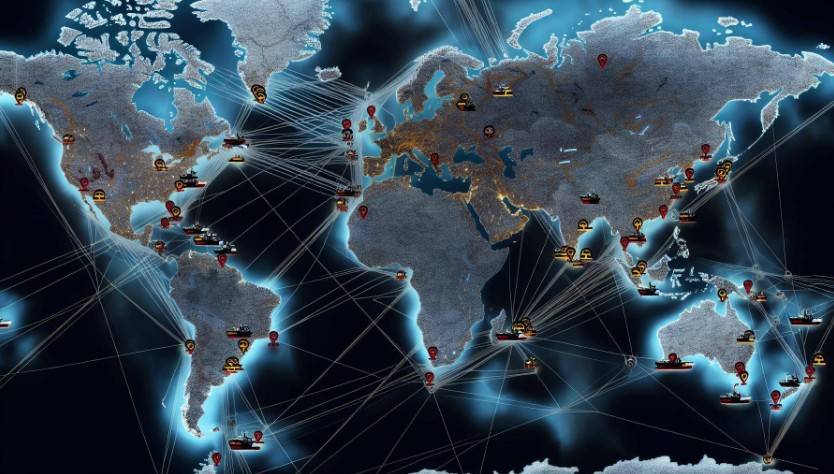
CESMAR Daily Global Maritime Geopolitical Forecast – August 7 2026 –
CESMAR Daily Global Maritime Geopolitical Forecast
– August 7 2026 –
Summary prepared by the Centre for Geopolitics and Maritime Strategy Studies, compiled on the basis of analyses from third-party sources. While the content does not reflect the Centre’s own positions but is instead drawn from the work of other authors and publications, as indicated in the references, the structuring and interpretation of the data are the result of the Centre’s own synthesis process, aimed at creating a coherent and organic analytical framework. The summary therefore represents a structured reorganisation of the collected and selected information, based on the expertise of our scholars, who have subsequently extrapolated its implications in the geopolitical, strategic, technological, and maritime fields, as well as those related to Mediterranean countries. Reproduction, in whole or in part, is authorised provided that the source is acknowledged.
Geopolitical Scenarios of August 7, 2026
Daily Summary of Global Maritime Geopolitics
Introduction
The events of 6 August 2026 confirm a global geopolitical landscape marked by overlapping tensions across multiple theatres: from European financial support for Kyiv to the technological transformation of warfare, extending to the persistent precariousness of Middle Eastern maritime corridors. The common thread remains the growing interdependence between energy security, naval power, and global technological competition.
Key Events
On the geopolitical plane, the European Union has formalised the disbursement of €1.4 billion to Kyiv. These funds are drawn not from national budgets, but from the interest accrued on frozen Russian Central Bank assets held in Europe (analisidifesa.it). The mechanism—the product of a complex legal architecture designed to avert international litigation—ensures a predictable flow of resources for Ukrainian reconstruction and security. Moscow has denounced the measure as unlawful expropriation, yet Brussels intends to continue the periodic utilisation of these yields, cementing a mechanism of sustained financial leverage against the Kremlin.
On the politico-military and strategic plane, an analysis by geopolitica.info details how the pervasive employment of uncrewed aerial systems has fundamentally altered the nature of the Russo-Ukrainian war, virtually eliminating the element of tactical surprise through unprecedented battlefield transparency. Drones—utilised for reconnaissance, artillery spotting, and precision loitering-munition strikes—have diminished the role of conventional armoured fighting vehicles, compelling both belligerents to continually adapt their doctrines and electronic warfare capabilities: the war of attrition has thus morphed into an industrial race centred on the production velocity of such platforms.
On the maritime plane, the portal iari.site analyses the reorganization of the international naval presence in the Red Sea, where the international community has reinforced joint protection structures against asymmetric drone and missile attacks targeted at merchant shipping. This updated architecture aims to ensure the continuity of maritime flows along the Sea Line of Communication (SLOC) connecting the Indian Ocean to the Suez Canal. However, it underscores the friction involved in coordinating navies operating under disparate rules of engagement: military power projection alone remains a palliative measure, lacking enduring efficacy without a parallel diplomatic stabilization of the Yemeni littoral.
Geopolitical Agorà
The debate surrounding the United States Navy’s proposed Trump-class battleships dominates the strategic narrative of the day across four convergent contributions. The Center for Maritime Strategy (centerformaritimestrategy.org) evaluates the proposition of outsourcing portions of production to commercial shipyards or foreign partners—a solution conceived to circumvent current bottlenecks within the US defence industrial base, yet one that raises profound questions regarding industrial sovereignty and the security of critical technologies. The Congressional Budget Office, in a report highlighted by both news.usni.org and gcaptain.com, projects the total lifecycle and acquisition cost of the program at $275 billion. This figure risks overstretching the overall industrial capacity of the US Navy, potentially cannibalising resources allocated to attack submarine and auxiliary logistics vessel programs. Nationalinterest.org corroborates that final costs will substantially exceed initial estimates, driven by the engineering complexity of advanced nuclear propulsion, compounding material inflation, and shortages of skilled shipyard labour. Taken together, these analyses delineate an ambitious yet financially fragile naval procurement program. Its ultimate viability hinges on Congress’s willingness to authorise escalating appropriations amidst an already constrained federal budget, carrying a tangible risk of force-structure cuts or deferred modernisation across other fleet segments.
A technical agreement signed in Rome in early August between the Italian Navy (represented by CINCNAV) and the European naval mission EUNAVFOR MED IRINI establishes systematic cooperation for the protection of critical undersea infrastructure in the Central Mediterranean. The initiative is tailored to counter escalating hybrid threats in the realm of Seabed Warfare, which imperil fiber-optic submarine cables and strategic gas pipelines (a vulnerability laid bare following the Nord Stream sabotage). The framework provides for the exchange of sensitive data via encrypted communications channels, the deployment of shared geospatial mapping platforms, and standardized protocols for reporting maritime anomalies. By fusing national naval and air assets with IRINI’s wide-area surveillance and early-warning architectures, the agreement significantly enhances Underwater Domain Awareness (UDA), compressing response times and facilitating threat attribution. The accord consolidates Italy’s role as the primary gatekeeper of infrastructure security across the Wider Mediterranean, establishing the foundation for a future interoperable European maritime surveillance framework.
Consequences of the Events
Geopolitical Consequences
The occurrences of yesterday actively reshape geopolitical balances across multiple dimensions. The European financing of Kyiv via the proceeds of frozen Russian assets (analisidifesa.it) consolidates a structural, predictable posture of support for Ukraine. This insulates Brussels from the volatility of ad-hoc emergency appropriations while further antagonising Moscow, which sees its sovereign offshore reserves systematically eroded. Concurrently, the Middle Eastern theatre remains characterized by a diffuse escalation involving a constellation of state actors and non-state proxies. Meanwhile, Iran—via statements from the diplomat Gharibabadi—has reiterated its categorical refusal to enter into any bilateral negotiations with Washington regarding the Strait of Hormuz (notiziegeopolitiche.net), an impasse compounded by the Houthi movement’s simultaneous declaration of a general mobilization targeting Saudi Arabia. On the Asian vector, China persists with its purge of senior military leaders to solidify Communist Party control over the People’s Liberation Army (notiziegeopolitiche.net). In London, a diplomatic and legal dispute continues over a proposed US diplomatic facility on the site of Royal Mint Court—the historic former Royal Mint situated in a strategic location near the Tower of London—which was previously acquired by Beijing for £255 million to construct a massive embassy complex (it.insideover.com). The project has triggered a fierce geopolitical, legal, and security contest involving the United States, illustrating how Sino-American competition has thoroughly permeated the urban planning and national security calculus of Western capitals.
In Armenia, the national leadership appears to be deprioritising historical identity claims in favour of regional normalisation (ispionline.it), signaling a broader post-imperial strategic retreat across the Caucasus. Collectively, these developments confirm a deepening polarization between the Western, Russo-Chinese, and Middle Eastern blocs. Europe, consequently, is forced to balance its support for Kiev, its persistent energy vulnerabilities, and the management of weaponised migration flows (formiche.net). Montenegro’s explicit refusal to host offshore processing centres on behalf of the Union (notiziegeopolitiche.net) further underscores the operational and political limits of Europe’s border externalisation strategy within the Western Balkans.
Strategic Consequences
From a military and doctrinal perspective, the day’s intelligence reflects an accelerated transformation of operational paradigms. Ukrainian battlefield experience in the mass employment of uncrewed systems for ISR, targeting, and strike (geopolitica.info) now serves as a doctrinal laboratory for global armed forces. Concurrently, a parallel analysis advocates fusing Ukrainian battlefield innovation with Israel’s defense-technology base to develop uncrewed systems highly resilient to dense Electronic Warfare (EW) environments (nationalinterest.org). In the United States, the Navy continues to pursue the modernisation of its attack submarine fleet through the integration of advanced modular payload launchers designed to deploy uncrewed underwater vehicles (UUVs), hypersonic weapons, and off-board sensors (news.usni.org), while evaluating tactical concepts that would allow submerged submarines to engage enemy aircraft (nationalinterest.org). The US Marine Corps has officially established a dedicated robotics integration group to rapidly field autonomous systems into tactical doctrine (news.usni.org).
Nevertheless, institutional and supply-chain friction remains evident: the administrative relief of the Navy’s uncrewed systems program lead after a mere eight months (militarytimes.com) and warning flags regarding the depletion of critical US munitions stockpiles (nationalinterest.org) highlight the persistent gap between technological innovation and combat readiness. Regionally, Europe faces structural deficiencies in Counter-Uncrewed Aerial Systems (C-UAS) air defence. This was highlighted by an unauthorized drone intrusion over Leipzig Airport (startmag.it)—an incident that has reopened the debate surrounding the point-defence of continental critical infrastructure (ispionline.it). The broader picture points toward an asymmetric arms race, wherein high-tech superiority is continuously offset by logistical bottlenecks and industrial vulnerabilities that Western military establishments have yet to resolve.
Economic, Technological, Financial, and Energy Consequences
Financial, and Energy Consequences From an economic and energy perspective, Europe remains acutely exposed to structural vulnerabilities. Natural gas storage levels across the Union have plummeted to ten-year lows for this time of year (startmag.it). Paradoxically, imports of Russian energy continue to rise despite regime sanctions, facilitated by complex trade re-exports and regulatory loopholes (notiziegeopolitiche.net). Analisidifesa.it warns of a potential “perfect energy storm,” originating from the absence of a unified procurement strategy and fully integrated cross-border infrastructure among member states. On the industrial front, the Italian government has exercised its Golden Power executive authority to clear the acquisition of Tekne by the US firm Nuburu, a transaction that couples American high-power laser expertise with Italian defence manufacturing capacity. Meanwhile, Italy and Australia have deepened their strategic partnership on critical raw materials via SACE financial guarantees, seeking to de-risk supply chains and reduce dependence on Chinese processing of lithium and rare earth elements (startmag.it).
In the technological domain, the European Union is evaluating the establishment of seven AI Gigafactories. However, without an autonomous domestic research ecosystem, this initiative risks generating a fresh technological dependency on foreign semiconductor foundries (geopolitica.info). Simultaneously, Palantir has posted record financial results, propelled by surging demand for enterprise and defence AI platforms (it.insideover.com)—a testament to the central role of big data analytics in global geoeconomic competition. These dynamics illustrate a European continent caught between the imperative to invest in strategic autonomy and its enduring reliance on external supply chains, both Western and non-Western.
Maritime Consequences
The maritime domain remains the primary epicenter of global strategic friction. In the Strait of Hormuz, global shipping associations have firmly rejected Iranian proposals to levy maritime transit tolls, deeming the concept a violation of the international law of the sea and the freedom of navigation (shipmag.it). Meanwhile, Iran claims to have reached an agreement in principle with Oman regarding security management in the strait, though international observers maintain a cautious stance regarding its operational enforceability (gcaptain.com). In the Red Sea, the Houthis have threatened further escalation following a claimed attack on a Saudi-flagged crude carrier (5 August, the latest of eight vessels targeted by the Houthis), a reality forcing maritime operators to reroute fleets around the Cape of Good Hope (shipmag.it). Simultaneously, China has engaged in direct bilateral negotiations with the Yemeni movement to secure passage for its own commercial fleet, explicitly bypassing Western-led maritime coalitions and altering conventional paradigms of global maritime security (it.insideover.com).
Within the Red Sea theatre, the EU’s EUNAVFOR ASPIDES task force—featuring the Italian frigate Federico Martinengo, the Hellenic Navy frigate Psara, and the French frigate Alsace—operates in tactical coordination with US destroyers USS Laboon and USS Gravely to escort merchant shipping. Lloyd’s List Intelligence has characterised the Middle Eastern maritime environment as “predictably unpredictable,” forcing shipowners to institute permanent risk-mitigation protocols (gcaptain.com). Elsewhere, operational disruptions persist: the Panama Canal Authority has further restricted vessel draft limits due to prolonged drought conditions (gcaptain.com); low water levels on the Rhine continue to impede German industrial barge logistics (gcaptain.com); and in the Arctic, Russia’s energy shadow fleet of crude tankers has been tracked operating within 500 nautical miles of the North Pole to circumvent Western sanctions (gcaptain.com). The United Kingdom has responded by expanding its sanctions regime against this shadow fleet, designating an Arctic LNG carrier and five Russian crude tankers (gcaptain.com). Together, these developments reconfirm the strategic criticality of maritime chokepoints and the intensifying competition for control over Arctic and global energy SLOCs. In this environment, multinational naval deterrence remains the indispensable, if costly, instrument for guaranteeing the flow of global commerce.
Consequences for the Southern European Mediterranean countries
For Southern European nations, the day’s developments carry direct operational and strategic implications. Italy is intimately involved in the Nuburu-Tekne acquisition, an operation that strengthens the sovereign defence electronics sector while necessitating the careful preservation of domestic industrial capacity and employment—a balance enforced via Golden Power stipulations (analisidifesa.it). The SACE-backed partnership with Australia for critical raw materials offers a tangible de-risking pathway for Italian industrial actors driving the energy transition (startmag.it). At sea, the deployment of the frigate Federico Martinengo under Operation ASPIDES demonstrates the Marina Militare’s active role in safeguarding sea lines of communication in the Red Sea, while CINCNAV maintains vigilant surveillance over seabed infrastructure in the Central Mediterranean—a domain critical to the energy and digital interconnectivity linking Italy, Greece, and North African partners.
The European gas storage shortfall (startmag.it) leaves Italy acutely exposed, given its historical reliance on diversified pipeline imports and its vulnerability to global LNG spot-price volatility ahead of the winter heating season. Greece and Spain—the former contributing the frigate Psara to Operation ASPIDES, and the latter managing the acute border crisis in Ceuta (realinstitutoelcano.org)—share with Rome a direct exposure to weaponised migration along the EU’s southern flank (formiche.net). Furthermore, Spain’s pragmatic attempt to balance openness to Chinese technological investment with infrastructure security protocols (realinstitutoelcano.org) reflects a broader regional challenge. The Wider Mediterranean thus remains a primary operational theatre where energy security, critical undersea infrastructure protection, and border management converge, uniting Southern European states around a shared strategic interest in maintaining stable, monitored maritime spaces.
Conclusions
The events of 6 August 2026 confirm a period of structural, multipolar tension in which energy security, technological competition, and the defense of maritime trade routes are inextricably linked. Key indicators requiring close monitoring in the coming days include: the operational evolution and enforceability of the Iran-Oman principle agreement on Hormuz; the tactical impact of the Houthi general mobilization on regional negotiations with Riyadh; the US Congressional debate over the funding and force-structure viability of the Trump-class battleships; and the trajectory of European natural gas storage injection rates ahead of winter. For CESMAR, primary monitoring remains focused on the operational posture of Operation ASPIDES in the Red Sea and its broader implications for Italian naval force employment, as sea power continues to prove itself the decisive variable in the global geopolitical balance.
References
This summary has been prepared based on articles from various geopolitical and strategic analysis sources, including: Elisme, Center for Maritime Strategy, CIMSEC, Reuters, ShipMag, Navy Lookout, National Interest, Seapower Magazine, CSIS, RUSI, War on the Rocks, IISS, Responsible Statecraft, Foreign Affairs, Formiche.net, Il Sussidiario, Start Magazine, InsideOver, Notizie Geopolitiche, IARI, Dissipatio, Analisi Difesa, Jamestown Foundation, Atlantic Council, RAND Corporation.
For further insights, please visit the CESMAR websites or social media channels: